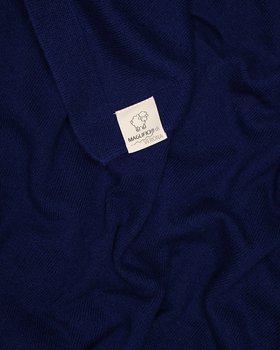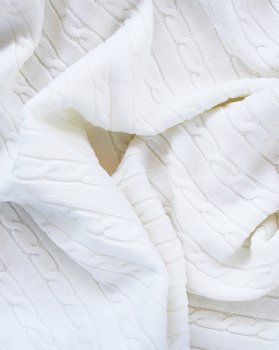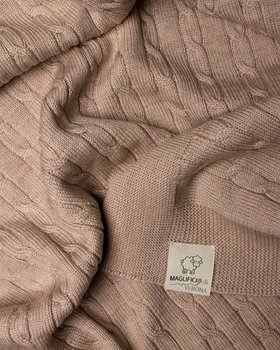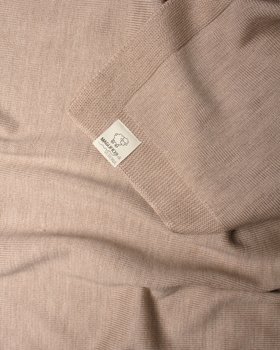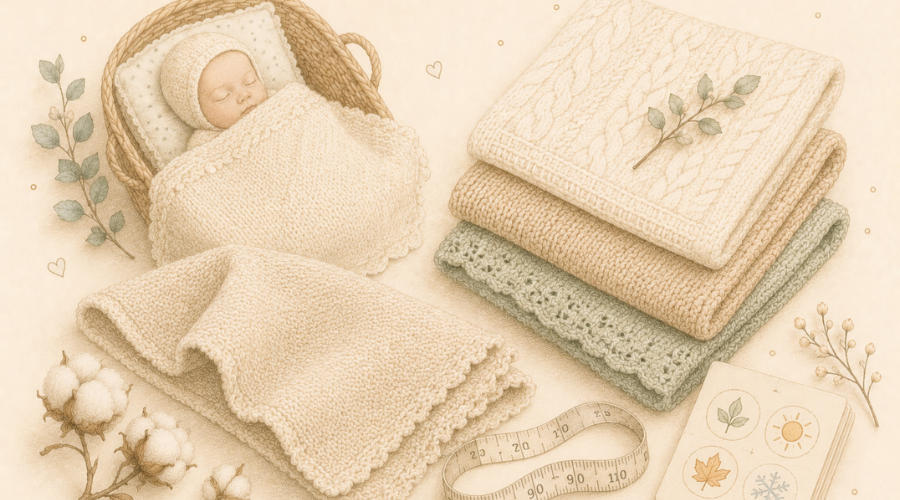
A newborn blanket is one of the most commonly used accessories during the first months of a baby’s life.
It can accompany the baby:
However, not all blankets are interchangeable.
A lightweight, compact model may be practical for the pram, while a larger and more structured blanket may be intended for the child’s bed or used as the baby grows.
Before choosing, it is therefore useful to consider five elements:
Fibre composition is important, but on its own it is not enough to determine whether a blanket is lightweight, warm or suitable for a particular temperature.
Stitch, density, weight and dimensions also contribute to the final result.
To see all the types currently available, explore our selection of newborn blankets in natural fibres.
Where and how will it be used?
A blanket intended for the pram should be practical to fold and carry.
A cot blanket should have dimensions suited to the available space and to the way it will be positioned.
A blanket for a child’s bed can be larger and accompany the child through a later stage of growth.
For a pram or pushchair, it is generally practical to choose a model that is:
A smaller blanket can be convenient while travelling because it takes up less space and can be managed easily when temperatures change.
A cot blanket is generally smaller than a blanket intended for a child’s bed.
It can be used:
The current Maglificio di Verona collection includes cot blankets in different sizes, including 70×80, 75×80 and 80×100 cm. The dimensions should therefore always be checked on the individual product page rather than assumed from the description “cot blanket” alone.
You can compare sizes, materials and knitted constructions in our dedicated category of blankets for cots and prams.
As the child grows and moves into a bed, a larger blanket may be needed.
In the current Maglificio di Verona collection, the bed blanket category includes a 100×150 cm size, which is considerably larger than our cot blankets.
The larger dimensions allow the product to be used for longer, but make it less practical for a pram, carrycot or short journeys.
You can see the available models in the section dedicated to blankets for children’s beds.
There is no universal size suitable for every use.
The dimensions depend on:
This table provides guidance on the sizes available in our current collection.
| Size | Uses to Consider | Characteristics |
|---|---|---|
| 70×80 cm | Cot, pram, pushchair | Compact and easy to carry |
| 75×80 cm | Cot and pram | Compact size for the first months |
| 80×100 cm | Cot, larger pram, longer-term use | Larger and more versatile |
| 100×150 cm | Child’s bed and older children | Greater and longer-lasting coverage |
These indications are intended as general guidance: before purchasing, always compare the dimensions of the product with the size actually required.
The choice mainly depends on how it will be used.
A larger size does not automatically make a blanket better.
If the product is too large for the space in which it is being used, it can create folds, bulk and excess fabric.
The material should be considered together with:
A lightweight wool blanket and a heavily structured blanket made from the same material do not necessarily provide the same level of insulation.
Similarly, a stockinette cotton blanket can behave differently from a compact construction or one made using multiple yarn strands.
Merino Wool can be worked in different weights and structures.
It is often chosen for:
The natural crimp of the fibres helps create air spaces within the knitted structure, while wool can interact with water vapour in the microclimate close to the body.
This does not mean that every Merino Wool blanket is suitable for every season or that it prevents the baby from feeling too warm.
Its behaviour always depends on weight, stitch, dimensions and number of layers.
For a more detailed explanation, read our guide to Merino Wool newborn blankets and how to choose one.
Cotton is often chosen for:
Weight and construction remain important factors.
For more information, read our guide to cotton newborn blankets and how to use them.
Cashmere is obtained from the undercoat of the Cashmere goat and is particularly valued for:
A Pure Cashmere blanket may be chosen as:
It is generally more delicate than many Merino or cotton models and may require greater care during use, washing and storage.
A bamboo and cotton composition may be considered for:
The final feel depends on the percentage of each fibre, the yarn count and the stitch.
The word “bamboo” alone does not indicate weight, coolness or washing requirements: the complete product information should always be checked.
Eucalyptus-fibre blankets can be chosen for lightweight collections and mild or warm seasons.
In this case too, it is important to consider:
The combination of linen and cotton can create a drier feel and a structure suited to spring and summer collections.
The percentage of the two fibres and the type of construction affect the characteristics of the blanket.
Not all linen-cotton blends therefore have the same weight or texture.
The current Maglificio di Verona collection includes blankets in Extrafine and Ultrafine Merino Wool, Cashmere, organic cotton, eucalyptus, linen and cotton, and bamboo and cotton.
This is one of the most frequently asked questions, but there is no answer that applies to every situation.
| Feature | Merino Wool | Cotton |
|---|---|---|
| Most common seasons | Autumn, winter, spring | Spring, summer, indoor environments |
| Weight | From lightweight to structured | From lightweight to compact |
| Feel | Elastic and enveloping | Cooler and drier |
| Knitted constructions | Stockinette, cables, jacquard, woollen-spun | Stockinette, openwork, ribbing, knitted motifs |
| Care | Requires suitable detergent and washing programme | Depends on the label, often more practical |
| Use | Walks, cot, cooler seasons | Mild days, summer, indoors |
| Appearance | Soft and enveloping | Clean, lightweight or textured depending on the stitch |
The choice should take into account the actual time when the blanket will be used.
A baby born in August may use a wool blanket a few months later, during autumn.
A baby born in January may use a cotton blanket indoors when the environment is heated.
The month of birth should therefore be considered a starting point rather than an absolute rule.
During winter, you can consider:
However, a heavy blanket, very warm clothing and a high indoor temperature should not automatically be combined.
The Italian Ministry of Health recommends avoiding overheating and excessive clothing and blankets during infant sleep; it also indicates a room temperature of approximately 18 to 20 °C.
Suitable options in spring may include:
Spring temperatures can change throughout the same day.
A blanket that is easy to fold and add only when needed may be more practical than a very heavy option.
During summer, it is useful to prioritise:
Materials to consider include:
Even a summer blanket may be excessive in very warm environments.
Before using one, consider the temperature, the baby’s clothing and the baby’s condition.
Autumn is a transitional season and does not automatically require a winter blanket.
At the beginning of the season, suitable options may include:
As temperatures fall, you may consider:
The choice should be based on the actual temperature rather than simply on the month shown on the calendar.
To understand more about how weight affects the behaviour of wool, read our guide to using wool in spring and transitional seasons.
Two blankets with the same fibre composition can differ in weight, volume and appearance.
Stockinette stitch generally creates a surface that is:
It can be suitable for both lightweight models and more compact blankets depending on the yarn, number of strands and density.
Cables add:
A cable-knit blanket may feel more substantial than a stockinette blanket made from the same material.
Jacquard makes it possible to create:
The presence of multiple colours or yarn strands can affect weight and density.
An openwork construction creates decorative openings within the stitch.
It can give the blanket:
However, “openwork” does not automatically mean suitable for every warm temperature: yarn, weight and density should always be considered together.
The border also affects the structure of the blanket.
It may be:
A well-designed border helps the blanket maintain its shape and proportions during use.
The fibre composition answers the question:
Which fibre is it made from?
Weight and knitted construction instead answer the question:
How structured is it?
To compare two blankets, consider together:
A 400-gram blanket and a 230-gram blanket do not offer the same level of structure, even when both are made from Merino Wool.
At the same time, a larger blanket will generally require more material: weight must therefore be interpreted together with size.
Where possible, the product page should indicate:
A blanket should always be used in accordance with safe-sleep guidance.
The Italian Ministry of Health recommends that the baby sleeps:
When a blanket is used, the Ministry recommends positioning the baby with their feet towards the bottom of the cot and tucking the blanket securely under the mattress so that the baby cannot slide underneath it; a sleeping bag is also indicated as a possible alternative.
International recommendations are not all identical: the American Academy of Pediatrics recommends keeping loose blankets and other soft objects completely out of the sleep space during the first year.
For this reason, it is important to:
A possible alternative is a sleeping bag, chosen in the correct size and used according to the product instructions.
You can explore the available models in our category of knitted sleeping bags for babies.
Comfort should not be assessed only by touching the baby’s hands or feet, which may feel cooler than the rest of the body.
It is more useful to check:
If you have any doubts, medical conditions or particular needs, ask your paediatrician for advice.
A blanket should not automatically be used to compensate for every perceived change in the temperature of the baby’s hands or feet.
A blanket is a popular birth gift because it can be:
Before purchasing, consider:
For a dedicated guide, read which blanket to choose as a birth gift.
When available, you can complete the gift with one of our gift packaging options.
The washing method depends on the fibre composition and on the instructions stated on the individual product label.
There is no universal washing temperature suitable for every blanket.
In general, it is important to:
For complete instructions, read our guide on how to wash, dry and store Merino Wool.
In this case too, always follow the care label.
The presence of cotton does not automatically mean that the product can be:
Stitch, colour, finishing and the presence of multiple fibres may alter the required care.
Before storing it, make sure it is:
Wool and Cashmere blankets should also be protected from moths.
I would avoid completely airtight packaging when the item is not perfectly dry, as residual moisture can cause odours and deterioration.
Fibre composition alone does not indicate weight, warmth or structure.
70×80, 75×80, 80×100 and 100×150 cm are designed for different uses.
Excess fabric can be impractical in a small cot or pram.
Merino Wool can also be worked in lightweight constructions, but each individual product should be assessed.
A woollen-spun blanket can appear voluminous while still remaining relatively lightweight.
Temperature, clothing and the blanket should always be considered together.
Fabric should remain away from the baby’s face and should not obstruct ventilation.
Safe-sleep recommendations should be followed together with your paediatrician’s advice.
Each fibre and knitted construction may require different care.
A precious blanket should be compatible with the family’s everyday habits.
Consider intended use, size, season, material, weight and knitted construction. There is no single model that is universally better.
The Maglificio di Verona collection includes sizes such as 70×80, 75×80 and 80×100 cm. The choice depends on the dimensions of the cot or pram and on the intended use.
The 70×80 cm size is more compact and practical for the pram and travelling. The 80×100 cm size is larger and can be used for longer.
In the current collection, the bed blanket measures 100×150 cm.
Merino Wool is often chosen for cooler seasons and enveloping constructions. Cotton is widely used in spring, summer and indoor environments. Weight and stitch remain important factors.
Extrafine Merino, Ultrafine Merino, Cashmere and more structured constructions can be considered, while still avoiding overcovering the baby.
Lightweight models in cotton, bamboo and cotton, eucalyptus or linen and cotton can be considered, using them only when temperature and clothing make them necessary.
At the beginning of autumn, lightweight fibres or fine Merino may be suitable. As temperatures fall, Merino Wool and more structured knitted constructions can be considered.
It may be more voluminous and structured than a stockinette model, but warmth also depends on yarn, weight and density.
It can be worked in different weights, but not every Merino blanket is suitable for every temperature.
Safe-sleep guidance should always be followed. The Italian Ministry of Health recommends avoiding excessive blankets, keeping the baby’s face uncovered and securing the blanket correctly; a sleeping bag may be an alternative.
It can be used as an alternative during sleep when chosen in the correct size and used according to the product instructions and your paediatrician’s guidance.
It is useful to check the back of the neck and chest and look for signs such as sweating, damp hair or pronounced flushing. If in doubt, consult your paediatrician.
Follow the label of the individual product. Fibre composition, knitted construction, dyeing and finishing may require different procedures.
Consider the month of birth, season of first use, material, size and ease of care. A cot-sized blanket is generally a versatile option.
Choosing a newborn blanket means finding a balance between practicality, comfort, season and intended use.
The dimensions should suit the cot, pram, pushchair or child’s bed.
The material should be considered together with weight and knitted construction.
A Merino Wool blanket can be lightweight or structured. A cotton model can be openwork or compact. A cable-knit blanket can feel fuller than a stockinette one even when the fibre composition is identical.
Before purchasing, therefore, consider:
The best blanket is not necessarily the largest, heaviest or most precious one.
It is the one that genuinely suits the baby, the space in which it will be used and the family’s habits.
At Maglificio di Verona, we make knitted blankets in different sizes, yarns and constructions to accompany babies through their first months and different seasons without relying on a single characteristic when making the choice.
You can compare all the available options in our collection of Made-in-Italy newborn blankets.
Spedizione veloce e gratuita (>75€)
Filati naturali e pregiati
Design essenziale e senza tempo

Assistenza clienti online
Artigianalità made in Italy dal 1975
Resi facili e veloci