

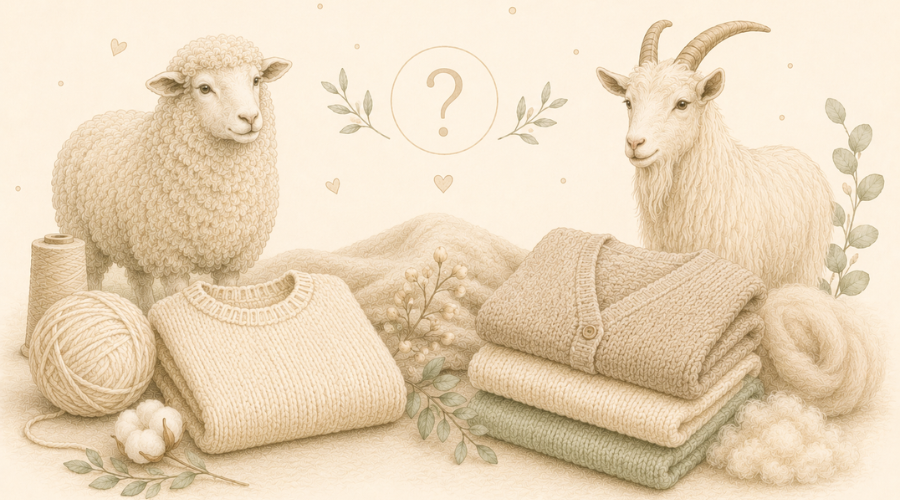
Merino Wool and Cashmere are often associated with the softest and most precious knitwear.
Both can be used to create jumpers, cardigans, rompers, blankets and accessories, but they are not two different names for the same fibre.
Merino Wool comes from the fleece of Merino sheep, while Cashmere is obtained from the fine undercoat of Cashmere goats.
They therefore differ in:
The choice should not start with the question:
Which yarn is better?
It is more useful to ask:
Which fibre is best suited to the garment, the person and the way it will be used?
To learn about wool fibre as a whole first, read our guide to Merino Wool, its characteristics and properties.
Merino Wool is obtained from the fleece of sheep belonging to the Merino breed.
These sheep are known for producing particularly fine fibres compared with many traditional wools. This fineness can allow the fibre to bend more easily when it comes into contact with the skin, contributing to a softer and less rigid feel.
However, the word “Merino” only identifies the breed of origin.
It does not automatically describe:
Before becoming yarn, the wool must be shorn, sorted, washed, carded or combed and finally spun.
To explore the complete process, discover how wool is made, from fleece to yarn.
Cashmere does not come from sheep.
It is obtained from the fine undercoat grown by Cashmere goats to protect themselves from low temperatures. This soft layer grows beneath the longer and coarser outer hair.
After collection, the fibre must be separated from the coarser hairs through a process called dehairing. Only the fine part suitable for spinning is then used to create Cashmere yarn.
The Cashmere and Camel Hair Manufacturers Institute defines Cashmere as the fine, dehaired fibre obtained from the undercoat of the Cashmere goat. In its technical definition, the average diameter must not exceed 19 microns and the presence of fibres exceeding 30 microns is limited.
The quantity of fine fibre obtained from each animal is limited and requires careful selection and processing. This contributes to the value and generally high cost of Cashmere.
| Characteristic | Merino Wool | Cashmere |
|---|---|---|
| Origin | Fleece of Merino sheep | Undercoat of Cashmere goats |
| Type of fibre | Fine sheep wool | Fine, dehaired animal fibre |
| Feel | Soft, elastic and versatile | Very soft, lightweight and enveloping |
| Elasticity | Generally high | Generally lower |
| Volume | Depends greatly on spinning and stitch | Can create volume with little weight |
| Warmth | Excellent insulation, variable depending on the garment | High warmth-to-weight ratio |
| Durability | Suitable for frequent use | More delicate and sensitive to friction |
| Pilling | Possible, depending on yarn and use | Possible, especially in areas exposed to friction |
| Care | Delicate | Particularly delicate |
| Price | Generally more accessible | Generally higher |
| Ideal use | Everyday wear, school, babies and children | Precious, lightweight garments requiring careful handling |
The table describes general behaviour. The actual result always depends on fineness, fibre length, spinning, twist, stitch, weight and finishing of the individual garment.
Cashmere is generally known for its particularly soft, lightweight and velvety feel.
Its fine fibre can create a soft and enveloping surface even when the garment is relatively lightweight.
This does not mean that Merino Wool is necessarily coarse.
Fine, uniform and correctly processed Merino Wool can be very soft and suitable even for knitwear worn close to the skin.
Perception depends on several factors:
Softness therefore cannot be assessed simply by reading “Merino” or “Cashmere” on the label.
Cashmere made with short fibres or a poorly constructed yarn can quickly lose its appearance. Good-quality Extrafine Merino Wool can instead feel extremely soft while retaining greater elasticity during use.
Cashmere and Merino Wool can both provide good thermal insulation.
However, the warmth of a garment does not depend only on its composition.
Other factors include:
Cashmere is particularly valued for its high warmth-to-weight ratio: it can provide an enveloping feeling without necessarily requiring a great deal of thickness.
Merino Wool can instead be transformed into very different garments, from a lightweight jumper for transitional seasons to a voluminous woollen-spun crew-neck jumper for winter.
It is therefore not correct to say that every Cashmere garment is always warmer than every Merino garment.
A heavy Merino Wool jumper may provide greater insulation than a lightweight Cashmere crew-neck. To compare two products, you need to assess garments that are similar in weight, stitch, density and fit.
To learn more about how garment construction affects comfort, read our guide to wool during transitional seasons and thermoregulation.
The natural crimp of wool contributes to trapping air within the textile structure, while the fibre can absorb and release water vapour, influencing the microclimate close to the skin.
Merino Wool is a hygroscopic fibre: it can interact with water vapour, absorb it within its structure and release it gradually when conditions change.
This behaviour can help to:
Cashmere is also a natural protein fibre and can provide comfort and insulation, but perceived breathability depends significantly on garment construction.
A garment that is too dense, heavy or worn in a warm environment can feel hot regardless of how precious the fibre is.
Neither material prevents sweating.
A breathable garment can contribute to managing water vapour, but it does not eliminate the body’s natural response to temperature, activity and number of layers.
Merino Wool generally has natural elasticity and a good ability to recover its shape.
Its crimp can help the yarn respond to creasing, movement and tension, making it suitable for everyday knitwear.
Cashmere tends to be more delicate and less elastic.
A Pure Cashmere garment may require greater care to avoid:
Behaviour still depends on the yarn.
Twist, number of plies, stitch and density can make knitwear more or less stable regardless of fibre composition alone.
In general terms, good-quality Merino Wool is better suited to frequent use.
It can be chosen for:
Cashmere can last a long time, but it requires more careful maintenance and mindful use.
Its fine fibres may be more affected by:
Durability does not depend only on the fibre. Cashmere made from long fibres and a well-constructed yarn can perform better over time than a product made from lower-quality raw materials and processing.
The more useful question is therefore not simply:
Merino or Cashmere: which lasts longer?
You should also consider:
Both can develop small pills on the surface.
This phenomenon is called pilling and occurs when some fibres work their way out of the yarn, are moved by friction and become tangled together.
The areas most exposed are generally:
Cashmere can be particularly prone to pilling when the yarn contains very fine, short fibres or has a soft twist.
Merino Wool can also pill, especially when the yarn is particularly soft and voluminous.
The initial appearance of a few pills does not automatically indicate poor quality. You should observe:
Pilling should be removed gently, avoiding pulling the fibres or using tools that are too aggressive.
The price of Cashmere is influenced mainly by the limited availability of the fine fibre and the processing needed to separate it from the coarser hairs.
Factors affecting the price include:
Merino Wool can also reach high prices when it features particularly fine fibres, traceable supply chains, certifications and high-level processing.
The difference in price therefore does not mean that all Merino Wool is inexpensive or that every Cashmere product is automatically excellent.
Composition should be assessed together with the actual quality of the yarn and garment.
The label should state the fibre composition of the product using the recognised fibre names and percentages.
For example, it may state:
A small percentage of Cashmere in a blend does not automatically make the garment equivalent to Pure Cashmere.
However, a blend can be designed to combine:
To understand terms such as “pure”, “100%” and “virgin” correctly, read our guide to Pure Virgin Wool and how to read the label.
The European Regulation on textile fibre names establishes the rules for stating fibres and percentages on labels, with the aim of providing clear information to consumers.
Yes.
Cashmere is the English spelling now most commonly used in the fashion industry, while cachemire is the form traditionally adapted into Italian and French.
Both refer to the same fibre.
On the Maglificio di Verona website, we mainly use Cashmere, maintaining this spelling in categories, product pages and communications.
The old blog URL contains the spelling “cachemire”, but there is no need to change it. The slug can remain unchanged to preserve the page’s history.
Extrafine Merino Wool is selected for the small diameter of its fibres and is used to create soft, elastic and versatile garments.
Compared with Cashmere, it generally tends to offer:
Cashmere can instead offer:
To learn more about the sheep fibre in detail, explore the characteristics of Extrafine Merino Wool.
Ultrafine Merino Wool can reach particularly small fibre diameters and provide an extremely soft feel.
The difference from Cashmere therefore does not concern fineness alone.
They also differ in:
In our case, the definition woollen-spun Ultrafine also combines two distinct concepts:
For more information, read our guide to woollen-spun Ultrafine Merino Wool and its characteristics.
Both fibres can be used for newborn knitwear, provided that the yarn and garment are suitable.
Composition alone is not enough.
You should check:
Merino Wool can be particularly practical for:
Its elasticity and the possibility of producing different weights make it versatile.
To see the available styles, explore our newborn knitwear in Extrafine Merino Wool.
Cashmere can be chosen for:
Its lightness makes it suitable for enveloping garments without excessive thickness, but it requires care during use and washing.
Discover our selection of newborn knitwear in Pure Cashmere.
Neither fibre should automatically be described as hypoallergenic or suitable without exception for every type of skin. Tolerability and comfort depend on the yarn, finished garment and individual sensitivity.
The choice depends on how the blanket will be used.
It can be suitable for:
Merino Wool can also be used to create blankets in different weights, sizes and constructions.
To see the available styles, explore our blankets in Extrafine Merino Wool.
It can be chosen when you want:
It should be protected from friction, aggressive washing and uses that are not suitable for the delicacy of the yarn.
Explore our newborn blankets in Pure Cashmere.
For school and everyday use, I would generally choose Merino Wool.
It is suitable for garments that need to accommodate:
Cashmere can be reserved for:
This does not mean that a child cannot wear Cashmere every day. However, more delicate care and greater sensitivity to friction should be taken into account.
Both can make excellent gifts, but they meet different needs.
Before purchasing, also consider:
A precious gift should also be genuinely practical for the person receiving it.
The care label of the individual garment should always be the first reference.
Not all products can be washed in the same way.
In general, for both fibres it is important to:
Cashmere generally requires greater care, especially when handling the garment while wet.
For complete instructions, read our guide on how to wash, dry and store wool knitwear.
Merino and Cashmere should be stored clean and completely dry.
It is preferable to:
Cashmere should not remain compressed for long periods beneath heavy garments, as it may lose volume and shaping.
Composition is important, but fineness, fibre length, spinning, stitch and finishing also matter.
Fine, correctly processed Merino can be extremely soft and suitable even for contact with the skin.
Weight, density and construction can completely change how a garment behaves.
A high price does not remove the fibre’s delicacy.
The care label of the individual garment should be followed.
The weight of the water can distort the shoulders, body and sleeves.
A few pills can also form on high-quality yarns, particularly during the first stages of use and in areas exposed to friction.
A garment should suit its actual intended use. The most expensive product is not automatically the most practical.
Tolerability varies according to the person and the finished garment.
The percentage and quality of both fibres should be stated clearly.
☐ Is the composition stated clearly?
☐ Is it pure yarn or a blend?
☐ Will the garment be used every day?
☐ Will it be exposed to backpacks, car seats or belts?
☐ Are the weight and construction suitable for the season?
☐ Will the garment be worn directly against the skin?
☐ Can the family follow the washing instructions?
☐ Is the fit correct?
☐ Is the price consistent with the yarn and construction?
☐ Does the product page describe origin and certifications accurately?
☐ Am I choosing the most suitable yarn or simply the most expensive one?
Merino Wool comes from Merino sheep. Cashmere is obtained from the fine undercoat of Cashmere goats.
In everyday language, it is often grouped among fine wools, but it does not come from sheep. It is an animal fibre obtained from the undercoat of the Cashmere goat.
Cashmere is generally known for its particularly soft feel. However, fine and uniform Merino Wool can also be extremely soft.
Not necessarily. It often provides considerable warmth with little weight, but the final result depends on thickness, stitch and garment density.
Merino Wool is generally more elastic and suitable for frequent use. Cashmere can last a long time, but requires greater care.
Both can develop pills. The phenomenon depends on fibre length, twist, softness, stitch and friction. Cashmere can be more sensitive in areas exposed to rubbing.
Merino Wool is practical for everyday use. Cashmere can be chosen for particularly lightweight and precious garments. In both cases, the finished garment should be assessed, not only the fibre.
Merino is versatile and suitable for frequent use. Cashmere offers lightness and preciousness, but requires more care.
Generally Merino Wool, because it is more elastic and better suited to movement, friction and regular use.
The amount of fine fibre available is limited and it must be separated from the coarser hairs through careful processing.
Yes. They are two spellings for the same fibre. On our website we mainly use “Cashmere”.
Only when permitted by the garment care label. The appropriate programme and detergent should be used.
It depends on the intended use. Pure Cashmere offers particular lightness and softness; a wool blend can provide greater structure and stability.
It is not correct to describe them automatically as hypoallergenic. Tolerability depends on the yarn, construction and individual sensitivity.
Merino Wool and Cashmere are two different natural fibres, both capable of creating soft, warm and refined knitwear.
Merino Wool generally offers greater elasticity, versatility and resistance to everyday use. It can be worked in different weights and is suitable for rompers, cardigans, jumpers, trousers, accessories and blankets.
Cashmere stands out above all for its lightness, softness and ability to provide an enveloping feel without necessarily requiring great thickness. However, it is a more delicate, expensive fibre and is more sensitive to friction.
There is no absolute winner.
Merino Wool may be the more suitable choice when practicality, movement and frequent use are important. Cashmere may be preferred for a precious, lightweight garment intended to be treated with particular care.
Final quality always depends on the combination of:
Choosing consciously therefore means looking beyond the name of the fibre and understanding which garment genuinely meets your needs. 🧶🤍
Spedizione veloce e gratuita (>75€)
Filati naturali e pregiati
Design essenziale e senza tempo

Assistenza clienti online
Artigianalità made in Italy dal 1975
Resi facili e veloci