

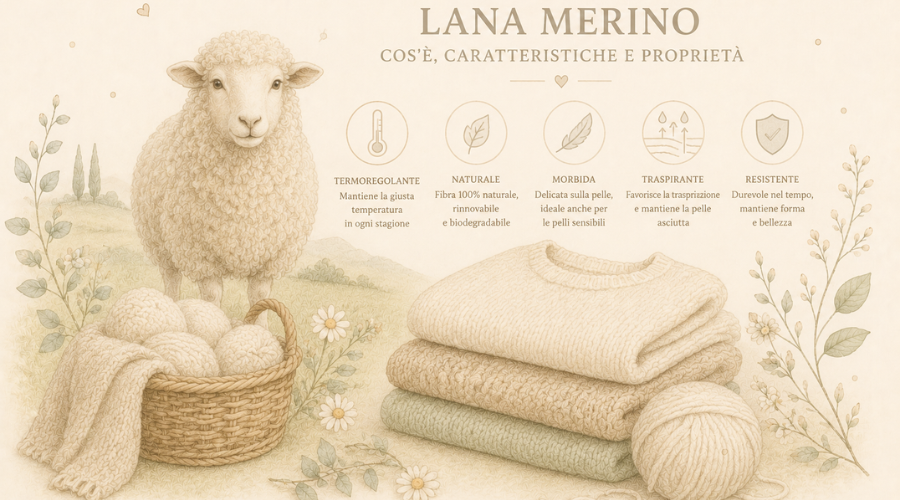
Merino Wool is a natural animal fibre obtained from the fleece of sheep belonging to the Merino breed.
It is particularly valued in clothing because it can reach very fine diameters and be transformed into soft, elastic yarns suitable even for garments worn close to the skin.
Before reaching a knitwear factory, however, the fibre goes through a long process: shearing, fleece selection, washing, carding, possible combing and spinning.
To understand all these stages, read our guide on how wool is made, from fleece to yarn.
Merino Wool therefore does not arrive at the knitting machines ready to become a jumper. The raw fibre is selected and transformed into yarn, which is then chosen and worked according to the type of garment to be made.
Final quality depends on the entire process:
For this reason, two garments both labelled “100% Merino Wool” can feel very different in terms of weight, softness, volume and appearance.
Merino Wool comes from Merino sheep, a breed known for producing a particularly fine, dense and regular fleece.
Today, Merino sheep are raised in different parts of the world, including Australia, New Zealand, South Africa, South America and Europe.
Climate, diet, genetics, age of the animal and farming practices can influence the characteristics of the fleece. Even within the same breed, therefore, not all wool has exactly the same fineness or quality.
The word “Merino” identifies the origin of the fibre, but does not describe all the characteristics of the yarn on its own.
To assess it correctly, you should also consider:
Wool quality is in fact assessed through several parameters, including diameter, clean yield, length, strength, colour and presence of vegetable matter.
Both forms are used.
Merino is the form generally used in English, while merinos comes from the Spanish plural and has entered common usage through other European languages.
You may therefore come across expressions such as:
On the Maglificio di Verona website, we mainly use the form Merino Wool, because it is clearer and allows us to keep terminology consistent across categories, blog articles and product pages.
The form “merinos wool” is not necessarily incomprehensible, but it is preferable to choose one main spelling and use it consistently.
Merino Wool is a type of wool. It is therefore not a completely different fibre, but wool obtained from a specific sheep breed.
The main difference generally concerns the fineness of the fibres.
Many traditional wools have a larger diameter and are used for:
Merino Wool can instead reach very small diameters, making it suitable for:
This does not mean that all Merino Wool is automatically extremely soft or that every other type of wool is necessarily coarse.
The sensation on the skin depends mainly on average fibre diameter, the presence of coarser fibres, spinning and garment construction.
The diameter of wool fibres is generally measured in microns, also called micrometres.
One micron equals one millionth of a metre, or one thousandth of a millimetre.
In general terms:
Fineness is important because it affects the fibre’s ability to bend when it comes into contact with the skin.
A very fine fibre tends to flex more easily. A coarser fibre can instead offer greater resistance and create the sensation commonly described as “itchiness”.
Micron count is therefore an important parameter, but it is not the only factor that determines yarn quality.
You should also consider:
An extremely fine fibre that is processed in an unsuitable way does not automatically produce a higher-quality garment.
The correct value is the one best suited to the intended use. A fibre chosen for a romper worn close to the skin will need different characteristics from one intended for a thick blanket or coat.
The softness of Merino Wool depends mainly on the fineness and uniformity of its fibres.
When the diameter is small, the fibre bends more easily when it comes into contact with the skin and tends to feel less rigid than coarser wool.
Comfort also depends on the yarn and finished garment.
Factors include:
Two garments made from the same fibre composition can therefore have a very different hand feel.
One may feel compact and smooth, while another may be softer, more voluminous or slightly fuzzy.
Not all Merino Wool feels itchy, but it is not correct to promise that every garment will feel the same to every person.
The sensation of itchiness is mainly linked to fibre diameter and the pressure exerted by the fibre ends on the skin.
Fine and uniform fibres tend to flex more easily, while coarser fibres can stimulate skin receptors more strongly.
Individual sensitivity also plays an important role.
One person may find a garment perfectly comfortable while another may experience a less pleasant sensation.
Before buying a garment to be worn directly against the skin, it is therefore useful to consider:
The perception of itchiness depends mainly on fibre diameter and not simply on the fact that the material is wool.
Merino Wool fibre has a complex natural structure.
It is composed mainly of keratin, a protein also found in hair and nails.
Its most important parts include:
This is the outer layer of the fibre, made up of small overlapping scales.
It protects the inner part and influences:
This forms the main part of the fibre.
It is made up of cells organised into structures that contribute to elasticity, strength and the ability to recover shape.
This is an internal component rich in proteins capable of interacting with water vapour and some molecules responsible for odours.
Crimp is the natural waviness of the fibre.
This waviness helps keep the fibres slightly apart, creating small spaces in which air can remain trapped.
It is important to clarify that wool does not insulate because its fibres are generically “hollow”. Its thermal behaviour depends mainly on their crimp, the structure of the yarn and the amount of air trapped in the garment.
Merino Wool is chosen for a combination of natural characteristics. These properties belong to the fibre, but how they are perceived always depends on the yarn and garment construction.
The natural crimp of the fibres helps trap air within the knitted fabric.
Still air slows heat exchange with the outside and creates an insulating layer.
This can help reduce heat loss when temperatures are low.
Thermal comfort, however, does not depend only on composition.
A lightweight stockinette jumper and a heavy cable-knit jumper can both be made from Pure Merino Wool, but they will not provide the same level of insulation.
To understand how weight, construction and number of layers change garment behaviour, read our guide to wool in spring and thermoregulation.
Merino Wool does not work like a thermostat and does not automatically keep the body at the same temperature at all times. It can, however, contribute to managing the microclimate close to the skin as conditions and activity levels change.
Wool is a hygroscopic fibre.
It can absorb water vapour from the environment and from the microclimate close to the skin, retain it within its internal structure and release it gradually when conditions change.
This behaviour can help to:
This does not mean that the garment cannot become wet or that it prevents sweating.
When a garment becomes very damp, it should still be changed and allowed to dry correctly.
Breathability does not eliminate perspiration: it helps manage the vapour produced by the body.
The fibre structure has a natural ability to bend and recover its shape.
This characteristic can contribute to:
Actual behaviour still depends on stitch, knitting tension and shaping.
A garment that is too large or dried incorrectly can become distorted even when it is made from a high-quality yarn.
The internal structure of wool can absorb some volatile molecules responsible for odours and retain them until washing.
For this reason, many Merino garments may retain a fresher feel for longer than some materials that hold odours more strongly on the surface.
This property does not mean that every garment can generically be described as antibacterial.
“Odour management” and “antibacterial action” are not synonymous. To claim that a specific product is antibacterial, tests would be required on that particular material or garment.
Merino Wool fibre behaves partly like a small natural spring.
It can bend repeatedly and contribute to recovering its original shape.
This helps limit creasing and sagging, but does not make the garment indestructible.
Use, washing, drying and storage remain important.
Wool has a natural resistance to flame and, when exposed to heat, does not tend to melt or drip like several synthetic materials.
This property is particularly important in specific technical and professional sectors.
However, it does not mean that an ordinary wool garment should be considered fire-protective equipment.
I would avoid describing Merino Wool generically as antibacterial.
The fibre has characteristics that can reduce the perception of odours:
These properties do not automatically prove action against all bacteria.
The word “antibacterial” should only be used when specific evidence and tests relate to the product in question.
A more accurate formulation is:
Merino Wool naturally helps manage moisture and the molecules responsible for odours.
I would not describe Merino Wool as completely hypoallergenic or suitable without exception for every type of skin.
Tolerability depends on:
Very fine Merino Wool can feel soft and comfortable even against the skin, but it is not possible to guarantee that no one will ever experience irritation or discomfort.
In the case of known allergies, dermatitis or particular sensitivities, follow the advice of a doctor or paediatrician.
It is also important not to confuse the itchiness caused by coarser fibres with a true allergic reaction.
Choosing a good composition alone is not enough when creating a garment for a newborn.
The entire product should be considered:
A fine yarn can contribute to comfort, but the garment should also be designed to allow:
To discover the available garments, explore our selection of newborn knitwear in Extrafine Merino Wool.
I would not use expressions such as “treats dermatitis”, “prevents allergies” or “protects against all irritation”. These are medical claims that cannot be attributed generically to a garment.
No. The two expressions describe different aspects.
Merino Wool identifies the sheep breed from which the fibre comes.
Virgin wool instead indicates that the wool has not previously been incorporated into a finished product and then recovered through recycling processes.
The expressions 100%, pure or all refer to composition in a single textile fibre, under the conditions established by European regulations.
A label may therefore state:
100% Pure Virgin Merino Wool
In this case:
For more information on these definitions, read our guide to Pure Virgin Wool and how to read the label.
European regulations restrict the use of the expressions “100%”, “pure” and “all” to products made from a single fibre and establish specific conditions for the use of the term “virgin wool”.
The words Extrafine and Ultrafine refer to fibre fineness, meaning its average diameter.
A lower micron value generally identifies a finer fibre.
However, these terms should be interpreted together with the technical data of the yarn.
Reading “Extrafine” or “Ultrafine” alone does not tell you:
An Ultrafine fibre can be used in a voluminous woollen-spun yarn, while an Extrafine fibre can be worked on a fine-gauge machine to create a thin and compact knitted fabric.
To learn about the two yarns separately, read our guides to Extrafine Merino Wool and woollen-spun Ultrafine Merino Wool.
A finer fibre is not automatically better in absolute terms. It is more appropriate when the design requires softness and use close to the skin; another fibre may instead provide greater structure or strength for different purposes.
The terms “woollen-spun” and “worsted” do not indicate sheep breed or micron count. They describe the system used to prepare the fibres before spinning.
In the woollen system, the fibres remain less parallel and may include shorter lengths.
The yarn generally tends to be:
In the worsted system, the fibres are aligned more closely and many shorter fibres are removed.
The yarn tends to be:
There is no universally better system.
The choice depends on the garment you want to create.
A soft and voluminous blanket may require a different yarn from a lightweight romper or cardigan.
Merino Wool and Cashmere are two different animal fibres.
Merino Wool comes from Merino sheep, while Cashmere is obtained from the undercoat of Cashmere goats.
Both can be very soft and fine, but they have different characteristics.
| Characteristic | Merino Wool | Cashmere |
|---|---|---|
| Origin | Merino sheep | Cashmere goat |
| Elasticity | Naturally high | Generally lower |
| Resistance to wear | Suitable for everyday use | More delicate |
| Feel | Soft and versatile | Very soft and lightweight |
| Warmth | Depends on weight and construction | High in relation to weight |
| Care | Delicate | Particularly delicate |
| Price | Generally more accessible | Generally higher |
Neither fibre is better in every situation.
Merino Wool can be chosen for everyday, dynamic and easy-to-layer garments. Cashmere may be preferred when particular lightness, softness and preciousness are desired.
For a more complete comparison, read Merino Wool or Cashmere: differences and which one to choose.
The fibre can be used in different seasons, but not every Merino Wool garment is suitable for every temperature.
Seasonality depends on:
yarn count;
weight;
number of yarn strands;
stitch;
density;
fit;
layers;
outdoor temperature;
activity level.
A lightweight stockinette jumper can be used during transitional seasons, while a woollen-spun cable-knit jumper will be more suitable for cold temperatures.
The phrase “wool is suitable for every season” should therefore be interpreted correctly:
Merino Wool can be transformed into garments suitable for different conditions, provided that weight and construction are appropriate for the temperature.
It does not mean that a heavy garment can be worn indiscriminately in both winter and summer.
Composition is the first thing to read, but it is not enough.
Before purchasing, check:
Check the percentage of wool and the possible presence of other fibres.
A blend is not necessarily negative, but it should be chosen consciously according to the desired result.
Check whether the product page states:
When stated, it helps explain the average fineness of the fibre.
However, it should not be used as the only indicator of quality.
A lightweight stockinette construction behaves differently from:
The size should respect the child’s proportions and the shaping of the garment.
A larger size does not automatically make the product more durable or comfortable.
Ask yourself whether the garment will be worn:
A certification should be stated by its exact name and clearly refer to:
The word “certified”, used on its own, does not explain what has actually been verified.
The versatility of the fibre makes it possible to create:
The yarn should be selected according to the garment.
A romper generally requires a soft and practical knitted construction, while a blanket can enhance more voluminous stitches or cable-knit patterns.
To discover the different possibilities, explore our Merino Wool jumpers for babies.
For a garment that is easy to open and layer, explore our cardigans and knitted jackets for babies.
For prams, cots and the first months, you can also discover our blankets in Pure Extrafine Merino Wool.
Every garment should be treated according to the instructions on its care label.
Not all Merino Wool can be washed in the same way: yarn, stitch, dyeing and finishing may require different procedures.
In general, it is important to:
Heat, moisture and movement can encourage felting because they increase friction between the surface scales of the fibres.
For complete instructions, read our guide on how to wash, dry and store Merino Wool.
The formation of small surface pills is called pilling.
It can occur when some fibres work their way out of the yarn, move because of friction and become tangled together.
Pilling can be influenced by:
The presence of a few pills does not automatically mean that the garment is poor quality.
Very soft yarns may initially release some surface fibres. It is important to remove pilling gently, using suitable tools and without pulling the yarn.
Durability depends on the interaction between:
A high-quality Merino Wool garment can remain part of the wardrobe for a long time, but it requires care.
To help preserve it, it is useful to:
The breed is important, but information about fineness, uniformity, spinning and construction is also needed.
Diameter is fundamental, but does not describe strength, twist, stitch and finishing on its own.
Wool is the fibre. Yarn is created after spinning. The garment is the result of working the yarn.
Virgin wool can be washed, dyed, spun and finished. The term refers to the previous use of the fibre.
Odour management does not automatically mean proven antibacterial action.
Sensitivity varies from person to person and also depends on fibre diameter and the finished garment.
A versatile fibre can be transformed into different garments, but a heavy jumper does not become suitable for summer simply because it is made from Merino.
Aggressive washing, high temperatures and hanging while wet can alter shape and surface.
☐ Is the composition stated clearly?
☐ Is it specified whether the yarn is Merino Extrafine or Ultrafine?
☐ Is the micron count stated where relevant?
☐ Is the yarn woollen-spun or worsted?
☐ Are weight and construction suitable for the season?
☐ Will it be worn directly against the skin?
☐ Is the fit correct?
☐ Are openings and seams practical?
☐ Are certifications explained clearly?
☐ Are the washing instructions compatible with my needs?
It is a natural fibre obtained from the fleece of Merino sheep, known for producing fine, soft and regular fibres.
“Wool” is the general name for the fibre obtained from sheep fleece. Merino Wool comes from a specific sheep breed.
Both forms are used in different languages. In English, “Merino” is the standard form. On our website, we mainly use “Merino Wool”.
It depends mainly on fibre diameter, uniformity, construction and individual sensitivity. Fine fibres tend to flex more easily and feel more comfortable.
It does not prevent perspiration, but it can absorb and release water vapour, contributing to management of the microclimate close to the skin. A garment that is too heavy or too many layers can still feel warm.
It can be suitable when the fibre is fine and the garment is correctly designed in terms of weight, fit, seams and openings. Composition alone does not determine the overall quality of the product.
It is not correct to describe all Merino Wool automatically as hypoallergenic. Tolerability depends on the yarn, garment and individual sensitivity.
The two terms refer to fibre fineness. To understand how the garment will behave, however, spinning, weight, stitch and construction should also be considered.
Woollen-spun wool generally produces softer and more voluminous yarns. In the worsted system, the fibres are more closely aligned and shorter fibres are removed, resulting in smoother and more regular yarns.
No. “Virgin” relates to the previous use of the fibre; “Merino” identifies the sheep breed.
Yes, when the garment is sufficiently lightweight and suitable for the temperature. Weight and construction matter more than composition alone.
It depends on the intended use. Merino is elastic, versatile and suitable for everyday wear; Cashmere is very soft and lightweight, but generally more delicate and expensive.
Only when permitted by the garment care label. The stated programme, correct temperature and a suitable wool detergent should be used.
Friction can cause some surface fibres to emerge and become tangled. The phenomenon depends on yarn, twist, construction and use and does not automatically indicate poor quality.
Merino Wool is a complex and versatile natural fibre.
Its fineness can make it soft and suitable even for garments worn close to the skin. Its internal structure contributes to the management of water vapour and odours, while its natural crimp helps knitted fabric trap air and provide insulation.
However, these characteristics should not be turned into absolute promises.
Merino Wool:
To assess a product correctly, you should consider the complete combination of fibre, micron count, spinning, twist, stitch, weight, shaping and finishing.
It is precisely the balance between raw material and construction that transforms Merino Wool into a comfortable, functional garment designed to last.
At our knitwear factory, we have been working with natural yarns since 1975, combining technical expertise, shaping and attention to detail to create knitwear designed to accompany babies and children as they grow.
To learn more about how we work, discover the story of Maglificio di Verona and the values that guide our production.
Spedizione veloce e gratuita (>75€)
Filati naturali e pregiati
Design essenziale e senza tempo
Assistenza clienti online
Artigianalità made in Italy dal 1975
Resi facili e veloci