

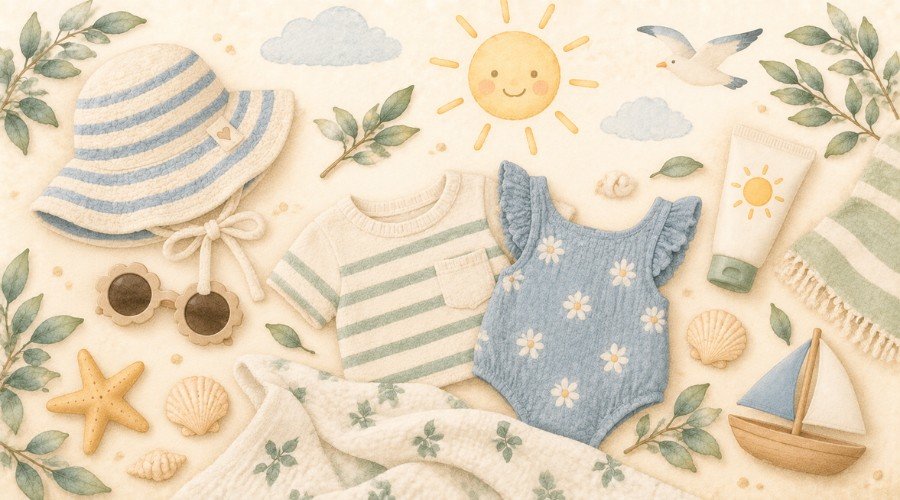
With the arrival of summer, children spend more time outdoors, at the seaside, in the mountains, at the swimming pool and in parks.
For children, however, sun and heat require some specific precautions.
Babies and young children are more vulnerable than adults to the effects of high temperatures and dehydration. Their skin also needs to be protected from direct exposure to ultraviolet rays.
So, managing summer safely involves much more than simply applying sunscreen before going out.
Protection includes several elements:
avoiding exposure in the most critical conditions;
seeking shade;
wearing appropriate clothing;
protecting the head and eyes;
applying sun protection correctly;
managing activities and hydration according to age;
adapting routines during heatwaves;
never leaving a child in a parked car.
The Italian Ministry of Health includes children among those who require particular attention during heatwaves.
Children’s bodies respond to high temperatures differently from adults.
During periods of intense heat, the risk of fluid loss and dehydration increases in particular.
For younger children, it therefore becomes especially important to:
avoid overheated and poorly ventilated environments;
limit exposure to the highest temperatures;
adapt clothing;
reduce physical activity during the hottest hours;
offer fluids according to age and appropriate guidance;
watch for signs of discomfort.
Heat and UV rays are, however, two different risks.
Shade can reduce direct exposure to the sun, but it does not automatically eliminate the risks associated with high temperatures.
Likewise, a breezy day may feel cool while UV exposure remains significant.
The Italian Ministry of Health states that babies under six months should not be exposed directly to the sun.
The main protection should therefore come from:
shade;
appropriate coverage;
correct use of the pram;
a suitable hat when needed;
lightweight clothing;
organising outings at more favourable times of day.
This also applies at the seaside.
Do not assume that staying under a beach umbrella automatically makes a long stay during the hottest hours safe.
Sand, water and surrounding surfaces can also contribute to indirect UV exposure.
No. A beach umbrella provides shade, but it should not be considered complete protection from heat and UV rays.
A child may still be exposed to:
ambient temperature;
scattered radiation;
rays reflected by water, sand and other surfaces.
For this reason, shade should be combined with other forms of protection, especially for a newborn. Staying under a beach umbrella during the middle of the day does not mean avoiding the heat.
On very hot days, it is preferable to organise outdoor activities during the cooler parts of the day.
During heatwaves, the Italian Ministry of Health recommends limiting children’s activities during the hottest hours and advises particular caution between 11:00 a.m. and 6:00 p.m., especially for physical activity and prolonged outdoor exposure.
This does not mean that sun protection is unnecessary outside these hours.
UV rays can also be present:
in the morning;
in the late afternoon;
on cloudy days;
in the mountains;
near water.
Time of day should therefore be considered together with temperature, UV index, location and duration of exposure.
The most effective protection comes from combining several measures.
Do not rely on sunscreen alone.
It is useful to combine:
Look for shaded areas, especially during the hottest hours.
Lightweight clothing suited to the temperature can help cover the skin.
It should provide coverage appropriate to the expected exposure.
They should have UV filters that comply with applicable standards, not simply dark lenses.
It should be appropriate for the child’s age, skin and level of exposure. The strategy naturally changes between a very young baby and an older child playing outdoors.
Italian Ministry of Health guidance for children recommends high-protection sunscreen; paediatric information materials indicate SPF 50+.
Protection should cover all exposed areas, including places that are easily forgotten such as:
ears;
lips, with a suitable product;
neck;
backs of the hands;
feet when uncovered.
Sunscreen should not, however, be considered permission to prolong sun exposure.
The following remain essential:
shade;
clothing;
hat;
choosing appropriate times;
reducing direct exposure.
For very young children, it is also important to follow the age indications on the product and, if in doubt, speak to your paediatrician.
Sunscreen should be applied before exposure and reapplied regularly.
Italian Ministry guidance for children suggests reapplying it frequently, approximately every two hours, and after swimming in the sea or pool.
Products labelled water-resistant should still be used according to the instructions on the packaging.
A sun hat should provide useful coverage especially for:
head;
forehead;
face;
and, where possible, neck and ears.
A simple bonnet or knitted hat does not automatically provide certified UV protection.
For prolonged sun exposure, choose a product specifically designed for sun protection and suited to the child’s age.
The hat should also:
stay in place;
not fall over the eyes;
not be too tight;
not cause excessive heat build-up;
be appropriate for the activity.
Children’s eyes should be protected with sunglasses fitted with certified UV filters that meet applicable legal standards.
Very dark lenses do not automatically guarantee correct protection.
For children, choose a model that is:
the correct size;
stable;
durable;
clearly labelled with UV protection;
purchased through a reliable retailer.
At the seaside, on snow and in other environments with strong glare, protecting the eyes becomes particularly important.
Clothing should contribute to protection without becoming a cause of excessive heat.
On hot days, it is generally preferable to choose garments that are:
lightweight;
the correct size;
not excessively tight;
easy to remove;
appropriate for the activity;
made from materials suited to the season.
For more information on garments, materials, layers and everyday situations, read our guide on how to dress children in summer.
Hydration should be managed differently according to age.
The same advice used for older children should not automatically be applied to newborns.
During hot weather, the Italian Ministry of Health recommends breastfeeding breastfed babies more frequently.
For other situations, ages or feeding methods, follow the guidance of the paediatrician.
On hot days, it is useful to offer water frequently without necessarily waiting for the child to ask for a drink.
The Ministry also recommends a diet rich in foods with a high water content, such as fruit and vegetables.
Do not automatically replace water with highly sweetened drinks.
This is an absolute rule.
A child should never be left alone in a car, even for a few minutes.
The temperature inside a vehicle can rise rapidly.
The Italian Ministry of Health notes that hyperthermia can develop very quickly in children and that young children are particularly vulnerable.
This applies even when:
the car is in the shade;
the windows are slightly open;
you expect to be away only briefly;
the weather outside does not seem extremely hot.
Before locking the car, always check the rear seats and child seat.
During hot weather, especially in young children, small spots or blisters may appear in areas where sweat becomes trapped.
So-called heat rash, or miliaria, is associated with blocked sweat ducts and is favoured by hot and humid conditions.
It can appear especially:
in the folds of the neck;
under the arms;
on the chest;
on the back;
under the nappy;
in areas covered by very tight clothing.
Prevention mainly involves keeping the child cool and the skin dry.
It may help to:
reduce layers;
choose lightweight, non-tight clothing;
avoid overheating;
gently dry damp areas;
allow the skin to breathe where possible.
A skin eruption should not automatically be diagnosed as heat rash.
If the rash is concerning, persists, worsens, shows signs of infection, or is associated with fever or general discomfort, contact the paediatrician.
On very hot days, the Italian Ministry of Health recommends refreshing babies and young children with lukewarm water, avoiding sudden temperature changes.
This does not mean using cold water.
For information about temperature, safety and bathing frequency, read our guide to bathing a newborn in summer.
Air conditioning can help maintain a comfortable indoor environment during very hot days.
However, it is important to avoid:
excessively cold rooms;
strong temperature changes between indoors and outdoors;
direct airflow onto the child;
remaining in wet or very sweaty clothes.
When entering an air-conditioned environment, it may be useful to have a lightweight extra layer available, but without dressing the child heavily all day in anticipation of air conditioning.
Before leaving, check:
the weather forecast;
any heat warnings;
activity times;
availability of shaded areas;
access to drinking water;
availability of cooler indoor spaces;
how long you will be outdoors.
For holidays and longer stays, you can also read our guide on what to pack in children’s suitcases for the holidays.
During hot days, pay attention to unusual changes in the child’s behaviour.
Signs that deserve attention may include:
marked weakness;
unusual sleepiness;
significant irritability;
dizziness in older children;
severe headache;
nausea or vomiting;
very hot skin;
a significant reduction in activity;
signs of dehydration.
A young child may not always be able to clearly communicate how they feel, so it is also important to observe:
behaviour;
feeding;
fluid intake according to age;
temperature;
general condition.
If a child appears seriously unwell or has significant symptoms, do not rely only on shade, water or home cooling measures.
Altered consciousness, fainting, seizures, severe difficulty breathing or a worrying general condition require urgent medical attention.
For less severe but persistent symptoms, concerns about dehydration, skin rashes or reactions after sun exposure, contact the paediatrician.
It reduces direct exposure but does not eliminate heat or reflected radiation.
The Italian Ministry of Health recommends avoiding this.
Protection should also include shade, clothing, a hat and appropriate timing.
Swimming, sweating and towel drying can reduce the protective film.
Not all styles are designed or certified for this purpose.
Protection depends on certified UV filters, not simply on how dark the lenses are.
Too many layers can increase discomfort in hot weather.
Activities should be adapted to environmental conditions.
Temperature and UV radiation are not the same thing.
It is not safe, regardless of shade or open windows.
Rashes can have different causes. If there is any doubt, contact the paediatrician.
The Italian Ministry of Health recommends not exposing babies under six months directly to the sun. Protection should rely mainly on shade, appropriate clothing and carefully planned outings.
No. It reduces direct exposure, but some radiation can still reach the child and heat remains a factor.
Italian Ministry guidance for children recommends high-protection products and indicates SPF 50+ in paediatric information materials.
Approximately every two hours and after swimming, as well as according to the product instructions.
No. It should be used together with shade, appropriate clothing, a hat and careful management of sun exposure.
Choose a model that adequately protects the head and, where possible, the face, ears and neck. A normal hat does not automatically provide certified UV protection.
When exposed to the sun, it is important to protect their eyes with age-appropriate sunglasses fitted with certified UV filters.
On very hot days, exposure and activity should be limited during the central hours. During heatwaves, the Italian Ministry recommends particular caution between 11:00 a.m. and 6:00 p.m.
For older children, it is important to offer water frequently. For newborns and babies, follow age-appropriate guidance according to the feeding method.
During hot weather, lukewarm water can be used, avoiding sudden temperature changes.
It is a skin condition linked to blocked sweat ducts, more common in hot and humid conditions and in young children.
Reducing overheating, choosing lightweight and non-tight clothing and keeping the skin cool and dry can help.
If the rash is concerning, persists, worsens, appears infected or is associated with fever or general discomfort.
No. A child should never be left alone in a car, even briefly.
Protecting babies and children from the sun and heat does not mean giving up days outdoors.
It means organising them according to age and environmental conditions.
The fundamental rules are simple:
no direct sun exposure for babies under six months;
take care during the hottest hours;
use shade without considering it complete protection;
choose lightweight, appropriate clothing;
use a suitable hat;
use sunglasses with UV filters;
choose high-protection sunscreen;
include breaks and age-appropriate hydration;
adapt physical activity to the temperature;
never leave a child alone in a car.
The best protection does not come from one single product, but from combining timing, shade, clothing, sunscreen and attention to the child’s condition.
For more information specifically about garments and materials, read how to dress children in summer.

Spedizione veloce e gratuita (>75€)
Filati naturali e pregiati
Design essenziale e senza tempo

Assistenza clienti online
Artigianalità made in Italy dal 1975
Resi facili e veloci