Woollen-spun Ultrafine Merino Wool combines an exceptionally fine fibre with a spinning system that creates a soft, full and enveloping surface.
The word Ultrafine refers to fibre diameter, measured in microns.
The term woollen-spun, on the other hand, describes the way in which the fibres are prepared and spun.
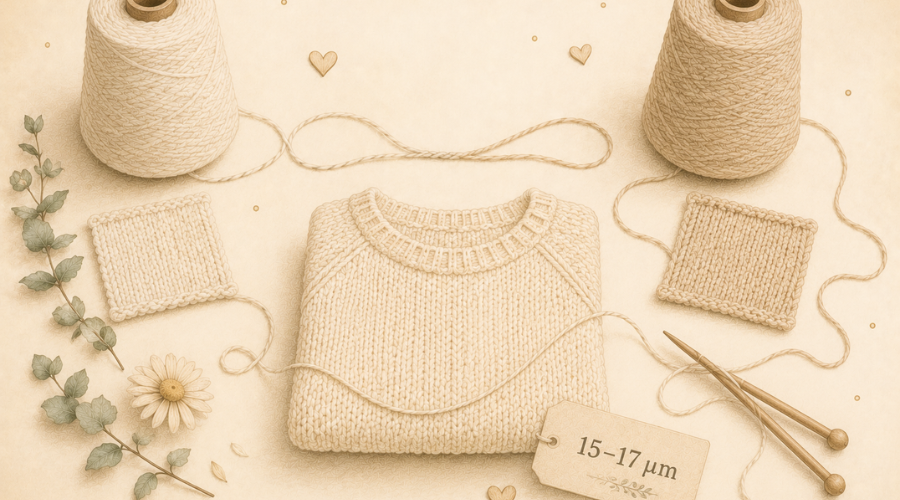
The Ultrafine Merino Wool used by Maglificio di Verona has a diameter of between 15 and 17 microns. These are therefore extremely fine fibres, selected to create soft, lightweight knitwear that is pleasant to wear.
However, Ultrafine and woollen-spun describe two distinct characteristics.
A yarn can be:
The final result therefore depends not only on micron count, but on the combination of:
To learn about Merino fibre as a whole first, read our guide to Merino Wool, its characteristics and properties.
Ultrafine Merino Wool comes from the fleece of Merino sheep and is selected for the particularly small diameter of its fibres.
The two terms provide different information:
Not all Merino Wool is therefore Ultrafine.
Even within the same breed, the following may vary:
Before becoming a yarn suitable for knitwear, wool also goes through several stages: shearing, sorting, washing, carding, possible combing and spinning.
To explore this process in more detail, read how wool is made, from fleece to yarn.
The term Ultrafine indicates a particularly high level of fibre fineness.
Wool diameter is measured in microns, also called micrometres.
One micron equals:
The lower the value, the finer the fibre.
The woollen-spun Ultrafine Merino Wool used by Maglificio di Verona has fibres measuring between 15 and 17 microns in diameter.
This is an important technical specification because it describes the actual fineness of the raw material selected for our garments.
Fibres this fine tend to bend easily when they come into contact with the skin. This flexibility contributes to a feel that is:
However, micron count should not be considered the only indicator of quality.
Other factors include:
A very fine fibre processed in an unsuitable way does not automatically produce a better garment.
The value of 15–17 microns therefore describes fibre fineness, while the final result depends on the entire design of the yarn and knitted garment.
The itchy sensation associated with some types of wool is mainly linked to the rigidity of the fibre ends that come into contact with the skin.
A fine fibre tends to bend more easily.
A fibre with a larger diameter may offer greater resistance and create a more noticeable sensation.
For this reason, Merino Wool measuring between 15 and 17 microns is particularly interesting for:
Fineness alone, however, does not make it possible to guarantee that a garment will never cause discomfort.
Perception also depends on:
The diameter of between 15 and 17 microns makes the fibres extremely fine and flexible, contributing to the distinctive softness of our Ultrafine Merino Wool.
Carding is a stage in the preparation of wool before spinning.
After washing, the fibres are still in the form of tufts and small, disorganised clusters.
During carding, the wool passes through cylinders covered with metal teeth that help to:
Carding does not “extract the fuzz” from the wool, nor does it simply bring the finest fibres to the surface.
Its purpose is to open, separate, blend and organise the fibre mass before it is transformed into yarn.
Carding may be present both in the woollen-spinning system and in the initial stages of the worsted-spinning system.
When we refer to a woollen-spun yarn, we generally mean a woollen system in which carding is not followed by the complete combing of the fibres.
In the worsted system, on the other hand, the initial carding stages are followed by further processes that:
This distinction is important because it helps explain that “woollen-spun” does not mean unprocessed or lower-quality wool.
It describes a system designed to achieve a different result.
In the woollen-spinning system, fibres remain less parallel than in a worsted yarn and may include different lengths.
After carding, they are transformed into rovings and then spun.
During spinning, the fibres are:
The resulting yarn generally tends to be:
The less parallel fibres and more open structure of the yarn help create volume and trap air.
Woollen-spun yarns are often chosen for knitwear, scarves, blankets and garments where a soft feel and more textured surface are desired. Worsted yarns, on the other hand, generally create smoother, more compact and more defined surfaces.
Woollen-spun and worsted do not represent two absolute levels of quality.
They are two systems used to achieve different characteristics.
| Characteristic | Woollen-Spun Yarn | Worsted Yarn |
|---|---|---|
| Fibre arrangement | Less parallel | More parallel |
| Short fibres | May remain in the yarn | Are largely removed |
| Surface | Soft and fluffy | Smooth and regular |
| Volume | Generally more pronounced | Generally more compact |
| Stitch definition | Softer | Sharper |
| Appearance | Textured and enveloping | Clean and uniform |
| Perceived weight | Can look full even at a relatively low weight | More dependent on density and yarn count |
| Common uses | Jumpers, blankets, scarves and accessories | Fine knitwear and garments with a smooth surface |
| Pilling | Possible, particularly with surface fibres | Possible, depending on fibre, twist and use |
In the worsted system, fibres are more closely aligned and many of the shorter fibres are removed.
This generally makes it possible to obtain yarns that are:
Woollen-spun yarn instead emphasises:
Neither system is universally better. The choice depends on the garment you want to create.
No.
This is the most important distinction:
Ultrafine describes fibre diameter. Woollen-spun describes the system used to prepare and spin the fibres.
In our yarn:
An extremely fine fibre can therefore produce a yarn that appears full and soft.
Fineness contributes to flexibility and softness against the skin.
Carding and the woollen-spinning system contribute to:
The actual behaviour always depends on the finished garment, but woollen-spun Ultrafine Merino Wool has several particularly recognisable characteristics.
The diameter of between 15 and 17 microns makes the fibres extremely fine and flexible.
Carding also contributes to creating a soft, fluffy surface.
Final softness also depends on:
A woollen-spun yarn can look full and substantial without necessarily being very heavy.
Fibres arranged less parallel to one another create a more open structure in which a greater amount of air remains trapped.
Volume and weight are therefore not the same thing.
A knitted garment can feel soft and enveloping while maintaining a sensation of lightness.
Merino Wool has a natural crimp.
This structure, together with the volume of the woollen-spun yarn, creates small air spaces that contribute to insulation.
The actual warmth still depends on:
A stockinette jumper and a cable-knit blanket can both be made from woollen-spun Ultrafine Merino, but they will not provide the same level of insulation.
Wool is a hygroscopic fibre: it can absorb water vapour into its structure and release it gradually when conditions change.
This behaviour can contribute to managing the microclimate between the skin and the garment, limiting the build-up of moisture on the surface.
This does not mean that wool prevents sweating or automatically keeps the body at a perfectly constant temperature.
To understand more about the relationship between fibre, weight and temperature, read our guide to wool during transitional seasons and thermoregulation.
The natural crimp of wool contributes to the yarn’s ability to flex and recover its shape.
The final result, however, also depends on:
Even an elastic fibre can become distorted when the garment is hung while wet, washed incorrectly or purchased in the wrong size.
Compared with many worsted yarns, woollen-spun yarn generally has a surface that is:
These characteristics make the yarn particularly suitable for knitted constructions designed to emphasise softness.
Not necessarily in every garment.
Woollen-spun yarn can trap air and create an insulating structure, but the amount of warmth also depends on:
A cable-knit garment made with several strands of woollen-spun Ultrafine Merino will generally be warmer than a thin stockinette garment.
Fibre composition alone is therefore not enough to determine seasonality.
The individual product, its weight and its knitted construction should always be checked.
Wool does not prevent sweating.
The body may produce sweat when:
The fibre can contribute to managing water vapour and keeping it less concentrated on the surface of the skin, but it does not eliminate the body’s normal physiological response.
Ultrafine Merino Wool can absorb and release water vapour, contributing to the management of the microclimate close to the skin.
The diameter of between 15 and 17 microns, together with the soft surface of the woollen-spun yarn, makes our Ultrafine Merino Wool particularly interesting for newborn knitwear.
The fineness allows the fibres to bend easily when they come into contact with the skin, while carding gives the yarn volume and an enveloping feel.
However, composition alone is not enough to determine the quality and practicality of the garment.
For newborn knitwear, it is also important to consider:
Maglificio di Verona uses Ultrafine Merino Wool for rompers, cardigans, jumpers, sets, accessories and other garments designed for the first months. The current website categories and product pages include several products made from 100% Ultrafine Merino Wool.
You can see the available models in our selection of newborn knitwear in Pure Ultrafine Merino Wool.
Ultrafine Merino Wool can also be used for jumpers, cardigans, gilets and accessories for older children.
In this case, it is important to consider how the garment will actually be used.
At school and in everyday life, knitwear may be exposed to friction caused by:
A woollen-spun and particularly soft surface may require greater care than a smoother and more compact yarn.
For styles designed for boys and children, explore our children’s jumpers in Ultrafine Merino Wool.
For the girls’ collection, explore our girls’ jumpers in Ultrafine Merino Wool.
The volume of woollen-spun yarn can also be highlighted in the creation of:
However, using the same yarn does not make all blankets equivalent.
Before purchasing, consider:
A stockinette blanket and a cable-knit construction can provide different sensations and levels of insulation even when they have the same fibre composition.
You can compare models and sizes in our section dedicated to blankets in Pure Ultrafine Merino Wool.
Extrafine and Ultrafine both belong to the family of fine Merino Wools, but they do not indicate the same fibre diameter.
The woollen-spun Ultrafine Merino Wool used by Maglificio di Verona measures between 15 and 17 microns.
Its fibres are processed using a woollen-spinning system to create a soft, full and fluffy surface.
Extrafine Merino Wool, on the other hand, has a different fineness and construction and is chosen for versatile, elastic garments with a generally cleaner and more regular surface.
| Characteristic | Extrafine Merino Wool | Woollen-Spun Ultrafine Merino Wool |
|---|---|---|
| Fineness | Fine fibre | 15–17 micron fibre |
| Processing | Depends on the yarn used | Woollen-spinning system |
| Surface | Generally cleaner and more regular | Softer and fluffier |
| Volume | Balanced | Generally more pronounced |
| Stitch definition | Sharper | Softer outlines |
| Appearance | Essential and versatile | Enveloping and textured |
| Use | Wide variety of everyday garments | Soft knitwear, blankets and accessories |
| Friction | Depends on yarn and stitch | The surface may require greater care |
| Pilling | Possible | Possible, particularly in areas exposed to friction |
| Seasonality | Depends on the garment | Depends on the garment, often chosen for colder seasons |
This comparison describes general characteristics. The actual result varies according to yarn count, number of strands, stitch and the weight of the individual product.
To learn more about the other yarn in detail, read our guide to Extrafine Merino Wool, its characteristics and uses.
There is no single best solution for every situation.
The choice should start from the garment and its intended use, rather than from the assumption that a lower micron count is always better.
No.
Ultrafine indicates a fibre with a smaller diameter.
It does not automatically mean:
A 15–17 micron fibre can be particularly suitable when softness and flexibility are desired.
Extrafine may be preferable when the design requires a different balance between:
Quality comes from matching the yarn correctly to the garment and its intended use.
Ultrafine Merino Wool and Cashmere are not the same fibre.
Merino comes from sheep, while Cashmere is obtained from the undercoat of the Cashmere goat.
Even when both have very fine diameters, they retain differences in:
Merino Wool generally has greater natural elasticity.
Cashmere, on the other hand, is particularly valued for:
Neither fibre is better for every possible use.
For a more detailed comparison, read Merino Wool or Cashmere: differences and which one to choose.
Each word provides a different piece of information.
| Term | Meaning |
|---|---|
| Pure or 100% | The garment is made from a single textile fibre |
| Wool | Fibre obtained from sheep fleece |
| Virgin | It does not come from the recovery of a previously finished product |
| Merino | Identifies the sheep breed |
| Ultrafine | Indicates fibre fineness: in our case 15–17 microns |
| Woollen-spun | Describes the preparation and spinning system |
The word virgin does not mean that the wool has not undergone processing.
It can be:
“Virgin” refers to the previous history of the fibre, not to the absence of production processes. Fibre composition and virgin-wool terminology are governed by European textile-labelling regulations.
To understand these definitions correctly, read our guide to Pure Virgin Wool and how to read the label.
Maglificio di Verona product pages state OEKO-TEX® STANDARD 100, Product Class I certification for the Ultrafine yarn.
OEKO-TEX® STANDARD 100 is a testing system that can apply to fabrics, yarns, materials and accessories.
Product Class I concerns articles and materials intended for babies and children up to 36 months and is subject to the requirements established for this specific intended use.
A garment made from woollen-spun Ultrafine Merino Wool can also develop small pills on its surface.
This phenomenon is called pilling and occurs when some fibres work their way out of the yarn, are moved by friction and become tangled together.
It can be encouraged by:
In the worsted system, many short fibres are removed through combing; this can help create a smoother and more stable surface, but it does not automatically make every worsted yarn immune to pilling.
The initial appearance of a few pills does not necessarily mean that the garment is poor quality.
It is useful to consider:
To remove pills gently:
Do not pull pills off with your fingers, as this can stretch or break the knitted fibres.
Fineness does not automatically make a yarn fragile, but a soft and fluffy surface can be more exposed to friction.
Durability depends on:
To help preserve the garment, it is useful to:
Before purchasing, check several aspects.
Check whether the product is:
In the case of the yarn used by Maglificio di Verona, the diameter is between 15 and 17 microns.
The term woollen-spun should genuinely refer to the yarn used.
A voluminous knitted garment is not necessarily heavy.
The product page should indicate the recommended season and intended use.
Check whether the garment is made in:
Size and proportions should suit the child and the layers that will be worn underneath.
Consider whether the garment will be used for:
Always check:
The care label of the individual garment should always be the main reference.
In general, it is important to:
The woollen-spun surface should be treated particularly gently to limit:
For complete instructions, read our guide on how to wash, dry and store Merino Wool.
Ultrafine indicates diameter. Woollen-spun describes the processing system.
A micron is one millionth of a metre, or one thousandth of a millimetre.
Carding opens, separates, blends and prepares the fibres for spinning.
In the woollen-spinning system, the fibres remain less parallel and create a more open and voluminous structure.
They are two yarns designed to achieve different results.
Seasonality depends on weight, stitch and construction.
OEKO-TEX® STANDARD 100 verifies specific requirements, not every characteristic of the product.
A soft surface can be exposed to friction and pill formation.
It is wool from Merino sheep, selected for the very small diameter of its fibres and processed using a woollen-spinning system.
The woollen-spun Ultrafine Merino Wool used by Maglificio di Verona has fibres measuring between 15 and 17 microns in diameter.
Ultrafine refers to a class of fibres with a particularly small diameter. In our yarn, the value is between 15 and 17 microns.
One micron equals one millionth of a metre, or one thousandth of a millimetre.
Fibres this fine tend to bend easily when they come into contact with the skin, contributing to a less rigid and softer sensation.
It means that the fibres have been opened, separated, blended and prepared for spinning through carding and the woollen-spinning system.
No. They are two different systems. Woollen-spun yarns generally create greater volume and softness, while worsted yarns produce smoother and more regular surfaces.
No. Ultrafine describes fibre diameter; woollen-spun describes the processing system.
The Ultrafine Merino used by Maglificio di Verona measures 15–17 microns. However, the final result also depends on carding, twist, stitch and garment weight.
No. The choice depends on the product. Ultrafine may be preferred for a particularly soft surface; Extrafine for versatility, structure and definition.
Fineness contributes to making the fibres flexible and generally comfortable. Perception still depends on the finished garment and individual sensitivity.
The 15–17 micron diameter makes the fibres particularly fine. However, the garment should also be assessed in terms of weight, seams, openings, fit and care.
It can provide good insulation thanks to its voluminous structure, but warmth depends on the weight and construction of the individual garment.
It does not prevent sweating. It can contribute to managing water vapour close to the skin.
It can develop pills, particularly in areas exposed to friction. This does not automatically indicate poor quality.
They are different fibres. Softness depends on diameter, length, spinning and processing, so it is not correct to declare an absolute winner based only on the fibre name.
Product Class I concerns articles, materials and accessories intended for babies and children up to 36 months.
Only when permitted by the garment care label, using the recommended programme, temperature and detergent.
The woollen-spun Ultrafine Merino Wool used by Maglificio di Verona has fibres measuring between 15 and 17 microns in diameter.
It is an extremely fine fibre selected to create knitwear that is soft, flexible and pleasant against the skin.
The woollen-spinning system gives the yarn a softer, fluffier and more enveloping surface than many worsted yarns.
However, Ultrafine and woollen-spun describe two different aspects:
Micron count alone is therefore not enough to evaluate the material correctly.
It is also necessary to consider:
Compared with Extrafine Merino Wool, woollen-spun Ultrafine can provide a fluffier surface and a particularly enveloping appearance.
Extrafine, on the other hand, retains great versatility and can be used for knitwear with a cleaner and more defined appearance.
Neither is universally better.
The correct choice is the one that matches the fibre to the garment being created, the season and the way it will actually be used.
It is this balance between raw material, spinning and artisan craftsmanship that transforms a 15–17 micron fibre into soft, functional knitwear designed to accompany babies and children. 🧶🤍
Spedizione veloce e gratuita (>75€)
Filati naturali e pregiati
Design essenziale e senza tempo

Assistenza clienti online
Artigianalità made in Italy dal 1975
Resi facili e veloci