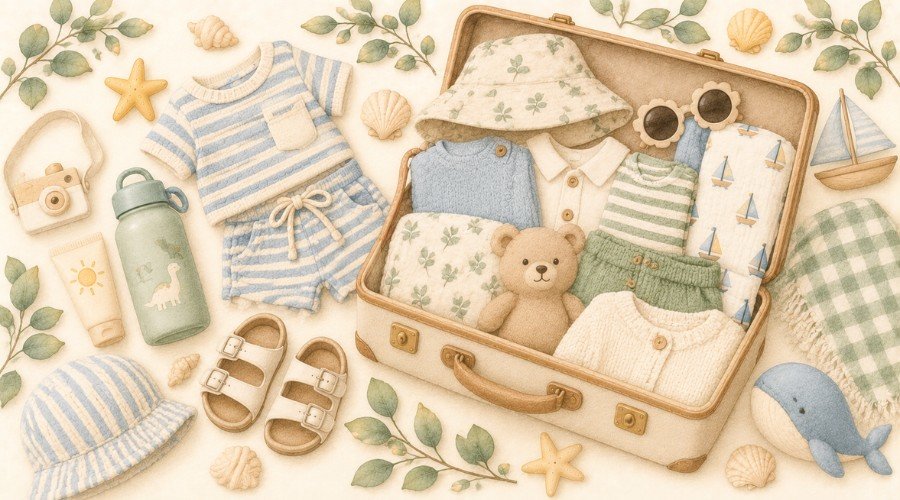
Preparing the children’s suitcase for the holidays can seem complicated: on the one hand, there is the fear of forgetting something; on the other, the risk of leaving with far more clothes than necessary.
The solution is not to follow the same list for every family.
Preparing the children’s suitcase for the holidays can seem complicated: on the one hand, there is the fear of forgetting something; on the other, the risk of leaving with far more clothes than necessary.
The solution is not to follow the same list for every family.
Before you begin, it is useful to consider five elements:
the child’s age;
length of the holiday;
destination;
planned activities;
whether you will be able to wash clothes during your stay.
The aim is to create a suitcase that is complete but flexible, with garments that can easily be combined with one another.
The aim is therefore to create a suitcase that is complete but flexible, with garments that can easily be combined with one another.
Before even opening the wardrobe, think about how the days will actually be spent.
Consider:
seaside, mountains or city;
expected weather;
excursions;
sporting activities;
days at the beach;
restaurants or special occasions;
whether there is a swimming pool;
travelling by car, train or plane;
whether you will be able to do laundry.
This helps avoid one of the most common mistakes: packing for every possible situation instead of the situations that are actually planned.
There is no universal number of changes of clothes that works for every holiday.
The amount depends mainly on:
number of travel days + possibility of doing laundry + age + type of activity.
A younger child who gets dirty frequently may need more changes of clothes than an older child.
At the same time, having access to a washing machine can considerably reduce the number of garments you need to pack.
A good strategy is to create a basic selection consisting of:
tops that are easy to coordinate;
bottoms that work with several tops;
one or two additional layers;
underwear and socks;
at least one change of clothes that is easy to reach.
There is no need to create a completely different outfit for every day.
To reduce the volume of the suitcase, choose colours and styles that can be combined with one another.
For example, three tops can be worn with the same two pairs of shorts.
A cardigan can be used in the evening, while travelling, in an air-conditioned restaurant or on a cooler day.
The more interchangeable the garments are, the fewer items you will need to pack.
To discover which clothes are most practical during the warmer months, read our guide on how to dress children in summer.
For a seaside holiday, the priority is to have lightweight clothes that are easy to change and suitable both for the beach and for the rest of the day.
You can include:
lightweight tops or polo shirts;
shorts;
skirts or dresses;
underwear;
socks when needed;
a cardigan or lightweight jumper for evenings and air-conditioned environments;
an additional change of clothes for more active days.
Add what is needed according to the child’s age and planned activities:
swimwear;
towel;
flip-flops or suitable footwear;
an appropriate hat;
a dry change of clothes;
a bag for wet swimwear and clothing.
For more information, read our dedicated guide to children and sun safety.
In the mountains, the key word is layering.
Even during summer, temperature, wind, altitude, exposure and weather conditions can change quickly.
For this reason, it can be useful to pack garments of different weights without filling the suitcase with duplicates.
A practical basic selection can include:
lightweight tops;
one or more long-sleeved tops;
long trousers and shorts;
a cardigan or sweatshirt;
a jacket suited to the expected conditions;
socks appropriate for the planned activities;
a hat;
specific clothing for any excursions.
For trekking and sporting activities, the technical equipment required for the activity should be added rather than replaced with ordinary everyday clothing.
A city holiday mainly requires versatile garments.
During the same day, children may move between outdoor walks, museums, public transport, restaurants, cars and hotels.
A practical base can therefore include:
a top or polo shirt;
shorts, a skirt or lightweight trousers;
comfortable shoes;
a lightweight cardigan in the backpack.
For this type of trip, a few garments that can easily be mixed and matched are often more useful than many complete outfits.
There is no need to prepare a different outfit for every evening.
One or two more polished garments can be combined with clothes already packed in the suitcase.
For example: a polo shirt, cardigan, dress, skirt, trousers or a more elegant top.
The amount will depend on the type of holiday: a week at a campsite will have different requirements from a holiday with planned dinners and events.
Even on a summer holiday, it can be useful to have a layer that is easy to remove.
It may be useful on a plane, on a train, in air-conditioned environments, in the evening, in the mountains or on a windy day.
Ideally, choose a style that is lightweight, easy to fold, simple to coordinate and not too bulky.
It does not necessarily need to be worn: often, simply having it in the backpack is enough.
Hand luggage should contain what may be needed during the journey or during the first few hours in the event of an unexpected situation.
A practical basic selection can include:
a complete change of clothes;
underwear;
a lightweight top;
a sweatshirt or cardigan, if needed;
a bag for dirty clothes;
tissues or wipes as needed;
snacks suitable for the child’s age and the journey;
a water bottle or drink according to the rules of the mode of transport being used;
a toy, book or activity;
necessary documents.
For younger children, it may be useful to add the items they normally use while travelling.
Permitted baggage weight, dimensions and number of items vary according to the airline, fare, route, child’s age and any additional services purchased.
Before packing, always check the airline’s conditions directly.
The same applies to:
pushchairs;
car seats;
liquids;
food;
the child’s baggage allowance.
Before filling the suitcase, lay all the clothes out on the bed.
Divide them by function:
tops;
bottoms;
underwear;
additional layers;
evening clothes;
shoes;
seaside or activity-specific items.
Then remove duplicates. This simple step makes it easy to see whether you are packing, for example:
too many similar tops;
too many pairs of trousers;
several cardigans serving the same purpose;
shoes that probably will not be worn.
Before filling the suitcase, lay all the clothes out on the bed.
Divide them by function:
tops;
bottoms;
underwear;
additional layers;
evening clothes;
shoes;
seaside or activity-specific items.
Then remove duplicates.
This simple step makes it easy to see whether you are packing, for example:
too many similar tops;
too many pairs of trousers;
several cardigans serving the same purpose;
shoes that probably will not be worn.
Both methods can work. More important than the technique itself is keeping categories easy to identify.
You can use:
packing cubes;
fabric bags;
small dividers.
It is one of the simplest and most useful things to pack.
It allows you to separate immediately:
worn clothes;
underwear;
stained garments;
damp clothing.
For swimwear or garments that are still wet, use a suitable container instead, avoiding leaving damp fabrics sealed together with dry clothing for long periods.
The contents vary according to age and habits.
It may include products normally used for:
hygiene;
teeth;
hair;
skin;
any personal needs.
Avoid packing many new products that the child has never used before simply because you are going on holiday.
For sun protection and insect-repellent products, choose formulations appropriate for the child’s age and follow the product instructions.
It is better not to prepare a paediatric medicine kit based on a generic list found online.
The choice depends on:
age;
weight;
health conditions;
any ongoing treatments;
destination;
length of the trip;
availability of healthcare.
Medicines regularly prescribed to the child should be organised in advance according to the doctor’s instructions.
For international travel or particular destinations, it may be useful to speak to the paediatrician or a travel medicine service before departure.
Medicines should also be stored out of children’s reach during the journey and at the accommodation.
The required documents depend on the destination and mode of transport.
Before leaving, check:
identity documents;
any health documents;
bookings;
documentation required for international travel;
any necessary authorisations;
travel insurance, when applicable.
For international travel, always check up-to-date official sources relating to the destination.
Pack garments that can be combined rather than many complete coordinated outfits.
A holiday with access to a washing machine requires fewer changes of clothes than a stay where laundry is not possible.
Shoes are among the bulkiest items.
It may be useful while travelling, in the evening or in air-conditioned environments.
Children mainly need clothes that are suitable for the planned activities.
It is better to use products the child already knows, unless there is a specific reason to do otherwise.
The medical kit should be personalised with the help of the paediatrician when necessary.
A small unexpected event during the journey can make an easily accessible change of clothes extremely useful.
Actual temperatures may change what you really need to pack.
A basic suitcase includes clothing suitable for the destination, underwear, pyjamas, shoes, an additional layer, toiletries, documents and an easily accessible change of clothes. The amount depends on the length of the holiday, the child’s age and whether laundry facilities are available.
There is no fixed number. Consider the length of the stay, the child’s age, planned activities and whether clothes can be washed.
Choose tops and bottoms that can be combined with one another and limit garments that serve the same purpose.
Lightweight clothing, swimwear, a towel, suitable footwear, a hat, a dry change of clothes and a lightweight layer for the evening or air-conditioned environments.
Adaptable layers are useful: lightweight and long-sleeved tops, shorts and long trousers, a cardigan or sweatshirt and garments suited to the planned activities.
It can be useful in the mountains, in the evening, while travelling or in air-conditioned environments. On hot days, it can simply stay in the backpack.
It depends on the activities. A few genuinely useful pairs are better than several pairs serving the same purpose.
A change of clothes, underwear, a lightweight layer, any items needed during the journey, documents, suitable snacks and an activity to keep the child entertained can form a good basic selection.
There is no universal list. Treatments already prescribed should be organised correctly and, for other medicines or particular journeys, it is advisable to speak to the paediatrician.
For longer stays, being able to do laundry generally allows you to reduce the volume of the suitcase considerably.
Share items that can be used by both children and keep clothes and underwear separate using recognisable packing cubes or bags.
Preparing the children’s suitcase for the holidays does not mean planning for every possible unexpected event.
A well-organised suitcase starts with four questions:
where are we going?
how many days are we staying?
what will we be doing?
can we wash clothes?
From these answers, you can create a temporary wardrobe made up of a few mix-and-match garments, one additional layer, genuinely useful shoes and an easily accessible change of clothes.
For the seaside, lightweight clothes will be the priority; in the mountains, layering becomes more important; in the city, it is useful to manage the transition between outdoors and air-conditioned environments.
The principle always remains the same: pack what will actually be used, not everything that could theoretically be useful.
To complete your summer suitcase, explore our selections of short-sleeved tops for boys and short-sleeved tops and girls’ tops.
Spedizione veloce e gratuita (>75€)

Filati naturali e pregiati
Design essenziale e senza tempo

Assistenza clienti online
Artigianalità made in Italy dal 1975
Resi facili e veloci