

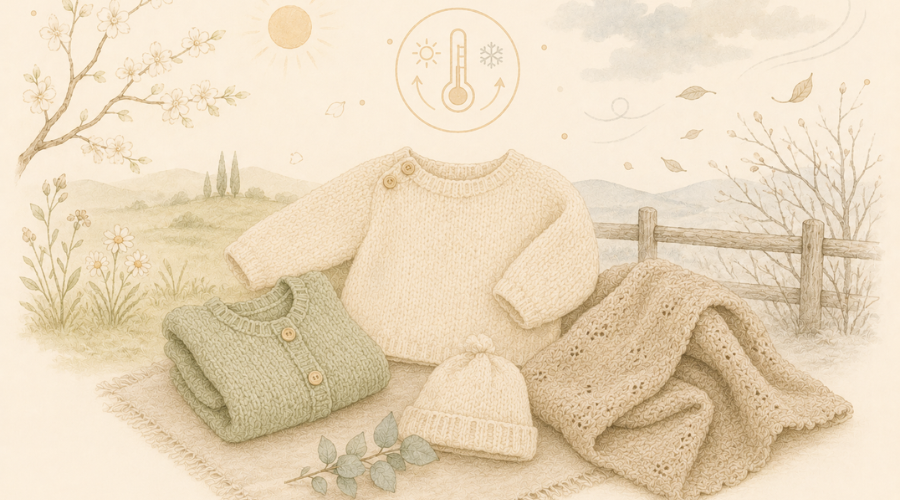
When we think of wool, we almost always imagine heavy jumpers, cold days and winter landscapes.
Wool, however, does not identify just one type of garment. The same fibre can be worked in very different thicknesses, stitches and gauges, creating anything from a warm, structured jumper to a lightweight garment for transitional seasons.
For this reason, a wool garment is not automatically “too warm” for spring.
On days when the morning is cool, the afternoon milder and indoor temperatures differ from those outside, a lightweight, breathable Merino Wool garment can become a practical and easy-to-manage layer.
This does not mean, however, that wool always keeps the body at a perfect temperature or that every jumper can be worn all year round.
Comfort depends on the combination of:
fibre diameter;
yarn count;
garment weight;
construction;
fit;
layers worn;
temperature;
humidity;
activity level.
To understand when to choose wool in spring, it is therefore important to start from how it actually works, avoiding overly absolute claims.
To learn about the fibre as a whole first, read our guide to Merino Wool, its characteristics and properties.
The term thermoregulation refers to the body’s ability to maintain its thermal balance through mechanisms such as heat production and dissipation, perspiration and changes in circulation.
A fabric does not independently regulate body temperature and does not work like a thermostat.
It can, however, influence the microclimate created between the skin, clothing and environment, helping to manage:
heat loss;
insulation;
water-vapour transfer;
moisture close to the skin;
the sensation of warmth or cold;
changes between activity and rest.
Merino Wool is considered particularly interesting precisely because it interacts with air and moisture, contributing to a more stable microclimate close to the body. It does not impose a constant temperature, but it can help accommodate changes better than materials and garments less suited to the situation.
The thermal properties of wool depend on the structure of the fibre and on how it is transformed into yarn and knitted fabric.
Before reaching the knitting machines, the fibre undergoes several processes: discover how wool is made, from fleece to yarn.
Two characteristics are particularly important:
the natural crimp of the fibre;
its ability to absorb and release water vapour.
Wool fibre is not perfectly straight. It has a natural waviness called crimp.
When the fibres are gathered into yarn and knitted fabric, this structure helps create small pockets of still air.
The air trapped between the fibres forms an insulating layer that slows heat exchange with the outside environment.
It is important to correct a misconception often found in older articles about wool: the fibres do not perform this function because they are hollow. Their ability to trap air depends mainly on crimp, fibre arrangement, yarn volume and garment construction.
The more air a textile structure can trap, the greater its potential insulating ability. However, the result also changes according to construction.
A voluminous, loosely twisted yarn can trap more air than a very compact one; a thick cable-knit garment will behave differently from a lightweight stockinette construction.
Wool is a hygroscopic fibre: it can absorb water vapour from the environment and from the microclimate close to the skin.
Moisture does not remain only on the surface but can enter the internal structure of the fibre. It is then gradually released when conditions change.
This behaviour can help to:
limit moisture build-up close to the skin;
reduce the sensation of fabric clinging to the body;
make changes in the microclimate more gradual;
support transitions between activity and rest;
encourage vapour transfer towards the outside.
Woolmark states that wool can absorb significant amounts of vapour before feeling wet and that its dynamic moisture management contributes to thermal comfort.
This does not mean that a wool garment always remains dry or that it can replace changing a wet item of clothing. When a garment becomes very damp from perspiration, rain or other liquids, it should still be removed and allowed to dry.
The most accurate answer is: it depends on the garment and the conditions in which it is used.
Wool is known for its insulating ability and can help reduce heat loss when temperatures are low.
When temperatures rise, however, a lightweight garment can support the transfer and evaporation of water vapour, helping to reduce the sensation of moisture close to the skin.
This is why wool is often said to “keep you warm when it is cold and cool when it is hot”.
However, this is a simplification.
Wool does not cool the body like an air-conditioning system. Comfort in mild weather depends on the ability to:
allow vapour to pass through;
avoid excessive moisture build-up;
use a sufficiently lightweight garment;
allow heat to dissipate;
add or remove layers easily.
A lightweight Merino jumper may be suitable for a spring day. A heavy cable-knit jumper made from the same fibre could instead be excessive.
The fibre provides certain properties; the design of the garment determines how they are actually perceived.
Spring is characterised by frequent changes.
You may leave home in the morning when it is cool, spend several hours in a heated environment and then find much milder weather in the afternoon.
Wind, shade, humidity and sudden weather changes can also quickly alter the perceived temperature.
In these conditions, a lightweight Merino Wool garment can be useful because it:
adds insulation without necessarily requiring much volume;
manages water vapour produced by the body;
can be used as a mid-layer;
is easy to combine with a lightweight jacket;
allows clothing to be adjusted throughout the day;
can provide comfort when moving between indoor and outdoor environments.
Its use should still be appropriate for the actual weather.
On already warm days, a very lightweight garment or another fibre may be preferable. On cool mornings or in locations with large temperature changes, wool can instead be a practical option.
Talking generically about “spring wool” is not enough.
The fibre composition on the label alone cannot tell you how warm a garment will be.
At least five characteristics should be considered.
A fine fibre can be used to create soft yarns suitable even for lightweight garments worn close to the skin.
Extrafine and Ultrafine Merino Wools are chosen precisely because they can be used to create lightweight, soft and low-bulk knitwear.
Micron count, however, describes fibre diameter, not the overall warmth of the garment.
Yarn count indicates, according to the system used, the relationship between the length and weight of the yarn.
The number of plies, level of twist and volume of the yarn also change the final result.
Two yarns both made from Pure Merino Wool can therefore produce knitted garments that differ greatly in weight, compactness and feel.
A high-gauge knitting machine generally allows finer yarns to be worked and lighter surfaces to be created.
A lower gauge is more often associated with bulkier yarns and structured knitwear.
Machine gauge does not determine seasonality on its own, but it contributes significantly to garment thickness.
The stitch used influences volume, elasticity and the amount of air trapped.
A very close-fitting garment behaves differently from a loose one.
The fit should allow freedom of movement and, where intended, enough space for the layer underneath.
An excessively large garment, however, can create impractical bulk and openings through which more air enters than intended.
Both can be used to create garments suitable for transitional seasons, but the choice should not be based solely on the name.
Extrafine and Ultrafine refer to fibre fineness. Garment behaviour will then depend on:
spinning;
yarn count;
number of yarn strands;
carding or combing;
machine gauge;
stitch;
overall weight.
Ultrafine Merino Wool can be worked into a voluminous yarn, just as Extrafine can become a very lightweight knitted fabric.
To choose correctly, it is therefore important to read the individual product page and not automatically consider Ultrafine “more summery” or Extrafine “more wintry”.
In our dedicated articles, we explore separately the characteristics of Extrafine Merino Wool and woollen-spun Ultrafine Merino Wool.
In some situations, yes, but not every wool garment and not on every day.
Fine Merino Wool worked into a lightweight garment can be used:
on cool evenings;
in the mountains;
in places with large temperature changes;
while travelling;
in air-conditioned environments;
as a lightweight technical base layer;
on milder summer days.
In intense heat, especially when humidity is high, a very lightweight garment in cotton, linen, eucalyptus or other fibres suited to the season may instead be preferable.
Woolmark also presents lightweight Merino garments intended for mild temperatures and summer activities, while specifying that thickness, coverage and construction should be chosen according to climate and use.
The answer is therefore not:
Wool is always suitable.
But rather:
A wool garment can also be suitable outside winter when yarn, construction and weight are appropriate for the temperature.
Babies and children often move between very different environments during the same day:
home;
car;
pram;
pushchair;
school;
park;
shops;
heated or air-conditioned environments.
A lightweight Merino Wool garment can become a useful layer because it can be added or removed without completely changing the outfit.
For a broader overview of layers, materials and temperatures, read our guide on how to dress a newborn during the first months.
For newborns, however, particular care should be taken to avoid overdressing.
Health guidance recommends assessing comfort mainly by checking the chest or back of the neck and removing hats and additional layers when entering warm environments. Cool hands and feet do not necessarily mean that a baby is cold.
Wool can contribute to managing the microclimate, but it does not replace observing the baby and adapting layers to the actual temperature.
During transitional seasons, clothing can be built around:
a lightweight garment against the skin;
a romper, jumper or set;
a cardigan, gilet or lightweight crew-neck jumper;
an outer jacket suited to the weather;
a removable blanket when needed.
Not all layers need to be used at the same time.
The advantage is precisely the possibility of:
removing the cardigan when entering a warm environment;
adding the blanket when the wind picks up;
opening the cardigan when the temperature rises;
avoiding a single garment that is too heavy and difficult to manage.
To organise layers during walks and journeys, also read our guide on how to dress a newborn outdoors.
You can choose:
a bodysuit or lightweight top;
a romper or trousers;
a lightweight Merino Wool cardigan;
an outer jacket.
The cardigan can be opened or removed when the temperature rises.
It may be enough to wear:
a lightweight layer;
a fine crew-neck jumper or gilet;
suitable trousers or skirt;
the jacket kept in the bag.
Wind can alter perceived temperature.
In this case, it may be useful to have:
a lightweight wool garment;
a suitable windproof jacket;
a removable blanket for the baby;
a hat only when necessary.
Once indoors, it is important to remove the outer layer and assess whether the wool garment is still needed.
The fact that wool manages water vapour does not make overheating impossible when a child is wearing too many layers.
Before purchasing, check several elements.
The percentage of wool indicates composition, but cannot by itself determine the weight or seasonality of the garment. When the label includes the term Pure Virgin Wool, it is also important to understand its meaning correctly and not confuse it with weight, fineness or type of construction.
Check whether it is:
Extrafine Merino Wool;
Ultrafine Merino Wool;
woollen-spun yarn;
worsted yarn;
pure wool or a blend with other fibres.
Check whether the style features:
stockinette stitch;
ribbing;
cables;
jacquard;
openwork construction;
double layer.
Check whether the garment is:
slim;
regular;
oversized.
The next size up should not automatically be chosen, especially when the style is already designed with a loose fit.
Before purchasing, compare the child’s height and measurements using our size guide for babies and children.
Ask yourself whether the garment will be used:
over a bodysuit;
as the main top;
as a cardigan;
under a jacket;
during outings;
indoors.
When buying for a child, consider the size they will be when they actually wear the garment.
A jumper purchased at the end of winter may be worn several weeks later, when both size and temperature have changed.
Wool can absorb vapour produced by the body and help limit moisture build-up in the microclimate close to the skin.
However, this does not mean that it prevents perspiration.
Perspiration is a natural body mechanism and can occur even while wearing the most breathable fibre when:
the temperature is high;
there are too many layers;
the child is very active;
the garment is heavy;
the environment is humid;
the fit limits ventilation.
The fibre can manage some of the vapour and release it gradually, but a wet garment should still be changed.
The correct approach is therefore to reduce the risk of build-up through appropriate weight, construction and number of layers rather than expecting wool to eliminate moisture completely.
This is a term that should be used with great care.
Wool is often described as resistant to odour development because it can absorb some volatile compounds within its structure and manage moisture differently from many synthetic fibres.
This does not mean that every wool garment can generically be described as antibacterial.
A claim of this kind would require specific tests carried out on the product or material in question.
I would not include sun protection among the guaranteed properties of every wool garment.
A fabric’s ability to block ultraviolet radiation depends on:
density;
colour;
thickness;
structure;
condition and wear;
any UPF certification.
Some wool fabrics can provide high levels of protection, but the same value cannot automatically be attributed to every knitted garment.
When a garment does not have a specific certification, it should not be described as a substitute for normal sun-protection measures.
Wool should not be used simply as a matter of principle.
Another fibre may be preferable when:
the day is very hot and humid;
the wool garment is too thick;
the child tends to perspire easily in that situation;
physical activity is intense;
layers cannot be removed;
the child shows discomfort;
the construction is too compact for the season;
an extremely lightweight garment is needed.
Organic cotton, eucalyptus, bamboo, linen and other yarns may be more suitable in certain conditions.
Making a conscious choice does not mean declaring one fibre perfect for everything, but using each material in the context where it works best.
Composition alone does not determine thickness.
There are lightweight wool garments and very heavy cotton garments. Yarn, stitch and construction should always be considered.
The fibre may be suitable, but the individual garment may not be.
A thick, structured jumper does not become suitable for spring simply because wool is thermoregulating.
The thermoregulating properties of wool do not prevent overheating caused by excessive clothing.
When entering a car, home or heated shop, layers should be adjusted to the new temperature.
An excessively loose garment can have impractical sleeves, an unstable neckline and poorly proportioned dimensions.
Cool hands and feet are not always a sign that the baby is cold. It is more useful to check the chest and back of the neck.
A breathable material supports vapour management, but does not prevent the body from producing perspiration.
There is no single jumper automatically suitable for every climate.
Seasonality depends on weight, stitch, style and how the garment is used.
Before dressing your child or purchasing a garment, check:
☐ What is the actual temperature today?
☐ Are temperature changes expected between morning and afternoon?
☐ Is the garment lightweight or structured?
☐ Is the construction stockinette, ribbed, jacquard or cable-knit?
☐ Will it be worn over another layer?
☐ Can it be removed easily?
☐ Will the indoor environment be heated?
☐ Will the child be still or very active?
☐ Are the size and fit correct?
☐ Do the chest and back of the neck feel dry and comfortable?
☐ Do I have an alternative layer available in the bag?
Once you have chosen the right garment, it is important to care for it correctly: discover how to wash, dry and store Merino Wool without altering its shape or softness.
Yes, when the garment is lightweight and appropriate for the temperature. A fine Merino Wool garment can be useful on changeable days, especially in the morning, evening and when moving between outdoor and indoor environments.
Wool does not prevent perspiration, but it can absorb water vapour and contribute to keeping the microclimate close to the skin drier. A garment that is too heavy or too many layers can still feel hot.
No. No fabric can independently maintain an ideal and unchanging body temperature. Wool can help manage air, warmth and moisture, contributing to comfort in changing conditions.
No. Their structure includes an outer cuticle and an inner part called the cortex. The insulating ability depends mainly on the natural crimp of the fibres and the air trapped within the textile structure.
A very lightweight Merino garment can be useful on cool evenings, in the mountains, while travelling or in air-conditioned environments. In intense heat, weight, coverage and humidity should be carefully considered.
It depends on the finished garment. The term describes fibre fineness, but spinning, weight, stitch and construction should also be checked. Both can be used to create lightweight garments.
It is useful to choose lightweight, removable layers and adapt them to the temperature. Check the chest or back of the neck and remove additional layers when entering warm environments. For a complete guide, read our article on how to dress a newborn outdoors.
A cardigan is easier to open and remove when the temperature changes. A crew-neck jumper can work as the main layer, provided it is lightweight enough and easy to put on.
It is not correct to automatically describe every type of wool as hypoallergenic. Tolerability depends on fineness, yarn, construction and individual sensitivity.
Check the chest and back of the neck. If the skin feels very warm or damp, remove a layer. Cool hands alone do not necessarily mean that the child is cold.
Using wool in spring does not mean wearing the same jumpers chosen for winter.
It means recognising that a fibre can be transformed into very different garments and choosing the one best suited to the season.
The natural crimp of the fibres helps trap air, while the internal structure of wool can absorb and release water vapour. These characteristics help manage the microclimate close to the skin, especially when temperature and activity levels change throughout the day.
The result, however, always depends on the finished garment.
A lightweight stockinette Merino Wool jumper will not behave in the same way as a heavy cable-knit crew-neck. Fineness, yarn count, construction, fit and number of layers should all be considered together.
During transitional seasons, cardigans, gilets, lightweight crew-neck jumpers and blankets can provide adjustable protection that is easy to add or remove.
Wool is not a magical fibre and is not automatically perfect for every temperature. It is a natural material with distinctive characteristics that, when worked and used correctly, can accompany babies and children well beyond the coldest days of the year. 🧶🤍
Spedizione veloce e gratuita (>75€)
Filati naturali e pregiati
Design essenziale e senza tempo

Assistenza clienti online
Artigianalità made in Italy dal 1975
Resi facili e veloci