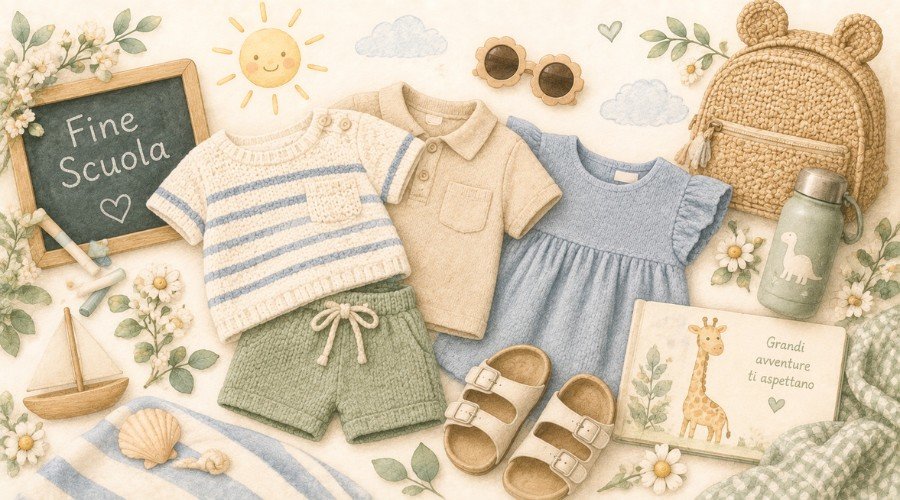
With the arrival of summer, school, routines and daily activities change. Days outdoors, summer camps, walks, holidays and longer evenings call for practical clothing that is easy to manage and suited to the temperature.
But how should children be dressed in summer when, during the same day, they move from outdoor heat to an air-conditioned environment, from active play to a cooler evening?
The answer is not simply to add or remove clothes according to the calendar.
You should consider:
actual temperature;
humidity;
sun exposure;
planned activity;
how long the child will stay outdoors;
air conditioning;
time of day;
material;
garment weight and construction;
whether a change of clothes is available.
On hot days, the Italian Ministry of Health recommends light-coloured, lightweight clothing made from natural fibres, such as cotton and linen, with particular attention to children.
In this guide, we focus on summer clothing for children, rather than complete advice on sun protection or how to pack for a holiday.
On the hottest days, it is useful to choose just a few lightweight garments that are easy to remove or change.
Depending on age and activity, practical options can include:
short-sleeved tops;
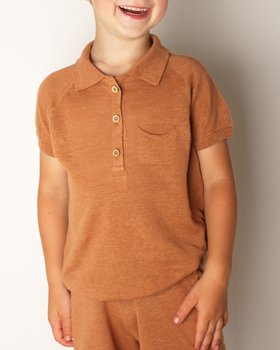
lightweight polo shirts;
tops;
shorts;
skirts;
dresses;
coordinated sets;
gilets;
a cardigan to keep available for air-conditioned environments.
The most useful principle is to avoid overdressing children “just in case”.
An extra garment can be carried in a backpack and used only when the temperature changes.
In hot weather, it can be useful to choose garments that do not fit too tightly against the body.
A comfortable fit allows:
freedom of movement;
less rubbing during play;
easier changing;
more practical management during outdoor activities.
This does not mean buying a larger size: the size should still be correct.
A garment that is too large can:
get in the way during play;
create folds;
slip off the shoulders;
be impractical during sports activities;
be difficult for the child to manage independently.
The distinction is therefore between a comfortable fit and the wrong size.
Composition is important, but it should not be considered in isolation.
Two garments made from the same fibre can behave differently depending on:
yarn count;
number of yarn strands;
density;
stitch;
weight;
structure;
fit.
Cotton is a plant-based fibre widely used for summer clothing.
The result, however, depends on the construction of the garment: a compact cotton cardigan and a short-sleeved top made from the same material will not have the same weight or the same use.
The current Maglificio di Verona collection includes, among other garments, polo shirts, short-sleeved tops and shorts in Pure Organic Cotton for children.
The combination of linen and cotton can be particularly interesting during warmer months because it can be used to create garments with a drier hand feel and a lightweight appearance.
Here too, the following factors matter:
percentage of the two fibres;
weight;
stitch;
compactness;
style.
Knitwear made with eucalyptus fibre can be used to create garments with a smooth, fluid surface against the skin.
This yarn can offer a lightweight, fresh feel during the day, particularly during the warmer weeks of summer.
The combination of bamboo and cotton is used to create soft and lightweight garments.
A yarn designed to offer a delicate and comfortable feel for little ones.
Summer camps call above all for practicality.
During the day, children may:
run;
play;
sit on the grass;
paint;
take part in workshops;
play sports;
eat outdoors;
get wet;
get dirty.
The outfit should therefore be simple to manage.
For example:
a short-sleeved top or polo shirt;
comfortable shorts;
shoes suited to the activity;
a hat appropriate for outdoor activities;
a lightweight cardigan in the backpack when needed;
a complete change of clothes.
It is better to avoid garments that are:
too delicate;
difficult to remove;
designed with complicated fastenings;
excessively long;
very tight;
fitted with elements that restrict movement.
When age allows, children should be able to manage much of their clothing independently.
For a full day, it may be useful to prepare a small change of clothes containing:
a top;
shorts or another bottom;
underwear;
socks;
a bag for dirty or wet clothing.
The amount naturally depends on:
age;
type of activity;
duration;
whether water activities are planned;
instructions from the summer camp.
There is no need to turn the everyday backpack into a suitcase.
When children run or take part in physical activity, their clothing should allow freedom of movement.
Particularly useful are:
correctly sized garments;
fabrics and surfaces that do not create excessive friction;
shorts that do not restrict movement;
tops that stay in place during play;
only a few layers that can be removed easily.
A very elaborate outfit may be less practical when a child needs to run, climb, sit down or use playground equipment.
In these situations, functionality should come before creating a perfectly coordinated outfit.
Air conditioning is one of the reasons summer clothing can become complicated.
Children can quickly move:
from 32 °C outdoors;
into an air-conditioned shop;
into a car;
into a restaurant;
into a museum;
into a hotel.
In these situations, it is useful to have one lightweight additional layer that is easy to put on and take off.
For example:
a lightweight cardigan;
a light sweatshirt;
a lightweight long-sleeved top.
There is no need to build the entire outfit around the lowest temperature a child may encounter for only a few minutes. The additional layer should be adaptable, not permanent.
For a day at the beach, clothing worn while travelling to and from the beach should be:
lightweight;
easy to remove;
easy to store;
appropriate for the temperature;
practical to put on after changing.
Sun exposure involves other specific considerations that we do not explore in detail in this article.
Hats, UV protection, sunscreen and suitable exposure times are covered in our dedicated guide to children and sun safety.
When choosing clothing for a holiday, other variables also need to be considered:
length of the holiday;
possibility of washing clothes;
destination;
seaside or mountains;
journey;
activities;
available space.
For help organising quantities, changes of clothes and different destinations, read our guide on what to pack in children’s suitcases for a holiday.
Before leaving home, check:
☐ What is the actual temperature?
☐ Will the child be outdoors or indoors?
☐ Will they be physically active?
☐ Does the clothing allow freedom of movement?
☐ Are the garments the correct size?
☐ Are there too many layers?
☐ Will there be air conditioning?
☐ Is a lightweight cardigan needed in the backpack?
☐ Is a change of clothes available?
☐ Can the child remove and put on the garments independently?
☐ Are the material and construction suited to hot weather?
☐ Are activities planned that may make the clothes dirty or wet?
It is useful to choose lightweight garments in the correct size and suited to the temperature and activity. In hot weather, short sleeves, shorts, skirts and dresses can be practical, together with an optional lightweight layer to carry with you.
Cotton and linen are among the natural fibres also recommended by the Italian Ministry of Health for hot days. Other plant-based fibres can also be considered, always taking into account the garment’s weight and construction.
A very compact or heavy cotton garment may be less suitable for the hottest days than a lightweight construction.
It is not correct to guarantee that every organic cotton product is hypoallergenic. Tolerability may also depend on dyes, finishes, detergents and individual sensitivity.
A simple outfit consisting of a top or polo shirt, shorts and shoes suited to the activity can be practical, together with a complete change of clothes.
It can be useful in the evening, in the mountains or in air-conditioned environments. On a very hot day, it can simply be carried in the backpack.
It is useful to have a lightweight layer that can be added when needed, avoiding heavy garments throughout the day simply because the child will briefly enter an air-conditioned environment.
It depends on the temperature. Adding a cardigan, lightweight long-sleeved top or more covering trousers may be sufficient.
Adaptable layers are useful because temperature and wind can change quickly. For specific sporting activities, appropriate technical clothing should be chosen.
During very hot weather, lightweight, light-coloured clothing is generally recommended.
It depends on age and activities. One complete change of clothes can be a practical starting point, with additional changes when water games or particularly messy activities are planned.
To dress children in summer, there is no need to create complicated outfits.
The choice should start with:
temperature;
activity;
freedom of movement;
garment weight;
material;
ability to add or remove a layer easily.
On the hottest days, lightweight, comfortable garments with minimal layering are generally preferable.
A lightweight cardigan can stay in the backpack for the evening or for air-conditioned environments.
A complete change of clothes can be useful for summer camps and days outdoors.
Above all, composition should not be considered on its own: cotton, linen, eucalyptus and other fibres can produce different results depending on garment weight, stitch and construction.
To discover our lightweight styles for the season, explore our selection of short-sleeved tops and T-shirts for boys and girls.

Spedizione veloce e gratuita (>75€)

Filati naturali e pregiati
Design essenziale e senza tempo

Assistenza clienti online
Artigianalità made in Italy dal 1975
Resi facili e veloci