Spring is probably one of the most difficult seasons when it comes to deciding how to dress children.
You may leave the house on a cool morning, spend a few hours in a heated indoor environment and then find yourself outside in much milder temperatures later in the afternoon.
Other factors can make the choice even more complicated:
wind;
rain;
humidity;
sunshine;
differences between shaded and exposed areas;
physical activity;
frequent transitions between indoors and outdoors.
For this reason, in spring it is more useful to create a modular outfit made up of a few layers that can easily be added or removed during the day than to look for the “perfect outfit”.
The most practical principle is layering.
This does not mean covering the child in lots of clothes.
It means using layers with different functions, for example:
a lightweight top;
a cardigan, gilet or lightweight jumper;
a jacket suited to the outdoor conditions.
They do not always need to be worn all together.
The real advantage of layering is being able to:
remove the cardigan when the temperature rises;
open the jacket;
leave a layer in the backpack;
put it back on in the evening;
adapt to indoor environments.
The number of garments should therefore depend on the actual temperature, not simply on the fact that the calendar says it is “spring”.
The idea of “dressing in layers” is useful because it describes the concept of layering well.
The risk is interpreting it as: the more layers, the better.
In reality, a layered system works when each garment is:
sufficiently lightweight;
easy to remove;
compatible with the layer underneath;
suited to the activity;
the correct size.
Three very heavy garments are not automatically more practical than two carefully chosen layers.
For a normal spring day, it may be enough to start with a lightweight base and have one additional layer available.
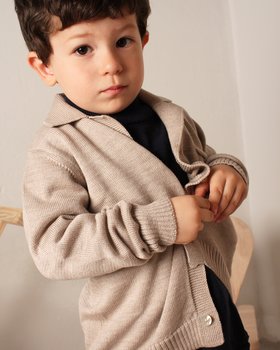
A cardigan is particularly useful during transitional seasons because it can be:
worn closed;
left open;
removed quickly;
folded into a backpack;
worn under a jacket;
put back on in the evening.
Compared with one very heavy garment, it makes it much easier to adapt clothing to changing conditions throughout the day.
The knitted construction also matters.
A thin stocking-stitch cardigan will behave differently from a style that is:
cable-knit;
jacquard;
very compact;
woollen-spun;
made using several yarns.
For this reason, the word “cardigan” alone does not tell you how warm a garment will be.
Both can be used in spring, but they meet slightly different needs.
It is practical when:
the temperature changes frequently;
the child moves between different environments;
an easy-to-open layer is needed;
you want to be able to remove it quickly.
Both can be used in spring, but they meet slightly different needs.
It is practical when:
the temperature changes frequently;
the child moves between different environments;
an easy-to-open layer is needed;
you want to be able to remove it quickly.
It can work well:
as the main layer;
on more stable days;
when the garment does not need to be opened frequently;
under a jacket with enough room.
On highly changeable days, a cardigan is generally easier to manage.
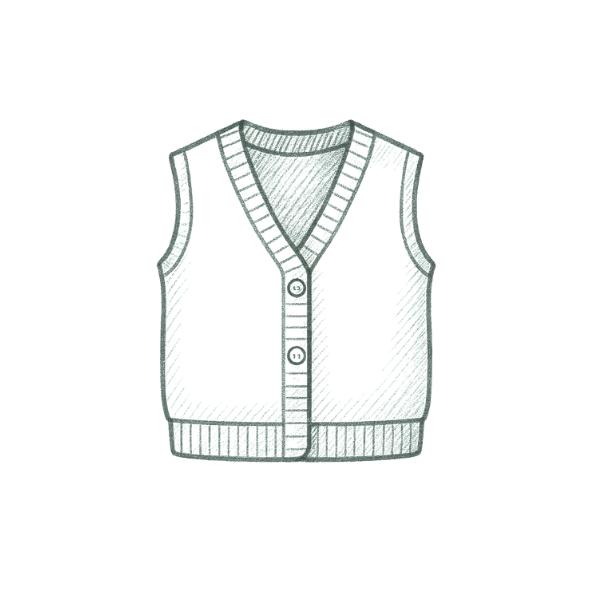
A gilet can be useful when you want to add a layer over the torso while keeping the arms freer.
It can be worn with:
a long-sleeved top;
a shirt;
a polo shirt;
a dress;
a lightweight top.
It is particularly practical on days when a full cardigan would feel excessive but one layer alone is not enough.
Again, weight and construction need to be considered: a thin gilet and a highly structured one will not have the same seasonal use.
The outer jacket should mainly be chosen according to:
wind;
rain;
temperature;
length of time outdoors;
layers worn underneath.
A heavy jacket is not always necessary: on many spring days, a lightweight style that protects against the wind and can easily be removed may be more useful.
If the child is already wearing a top and cardigan underneath, it is also important to check that the jacket:
does not feel restrictive;
allows free arm movement;
does not create excessive bulk;
can be opened easily.
There is no single ideal material for the entire season, because spring includes very different types of weather.
You may therefore move from cotton to Extrafine Merino Wool.
However, it is important not to judge a garment solely by its fibre composition.
The following also matter:
weight;
yarn count;
number of yarns used;
stitch;
density;
fit.
A lightweight wool garment may be suitable for a cool spring morning, while a heavily structured jumper made from the same fibre may be excessive.
Similarly, a very thick cotton garment does not automatically become lightweight simply because it is made from cotton.
Cotton is especially useful because it can be knitted in many different constructions.
However, it is not correct to describe every cotton garment generically as:
hypoallergenic;
completely non-toxic;
always cool;
always suitable for every temperature.
Its behaviour depends on the finished garment, and individual tolerance can vary.
Merino Wool should not automatically be associated only with heavy winter jumpers.
It can also be used for garments that are:
lightweight;
thin;
knitted in stocking stitch;
easy to layer;
suitable for transitional seasons.
The micron count of the fibre, however, does not tell you on its own how warm a garment will be.
Weight, construction and knitted structure remain decisive.
To learn more about how this material behaves during transitional seasons, read our guide to Merino Wool in spring and thermoregulation.
School makes managing layers even more important.
During the same morning, a child may move between:
outdoors;
the car;
the classroom;
the playground;
the gym;
and outdoors again.
The outfit should therefore be easy for the child to manage independently.
A practical combination may include:
a simple top;
comfortable trousers or skirt;
cardigan or gilet;
lightweight jacket.
It is better to avoid combinations that require constant adult help to put on or remove.
A cardigan, for example, can be particularly practical if the child can open and close it independently.
When playing, a child generates more body heat than when standing still.
For this reason, an outfit suited to a quiet walk may become too warm during:
running;
cycling;
playground activities;
sports;
prolonged movement.
Before starting an intense activity, it may be useful to remove a layer that can easily be taken off.
Garments should ideally:
allow freedom of movement;
stay in place while playing;
not have excessively long sleeves;
not be too loose;
be easy to put back on when the child stops moving.
This is probably the most typical spring situation.
A simple solution could be:
Morning
top;
cardigan;
jacket.
Afternoon
top;
cardigan open or removed;
jacket in the backpack.
Evening
cardigan put back on;
jacket when necessary.
This is not a fixed formula, but it demonstrates the advantage of layering: the same garments can be managed differently throughout the day.
It depends on the temperature.
During the cooler first weeks of spring, a long-sleeved top may be practical.
As the days become milder, a short-sleeved top paired with a cardigan can become a particularly versatile combination.
This allows you to:
use the cardigan in the morning;
remove it in the afternoon;
put it back on when the temperature drops.
Towards the end of spring, when temperatures become consistently warmer, the wardrobe can gradually move closer to summer clothing.
For this stage, read our guide on how to dress children in summer.
April can be warmer than May.
What matters is the actual weather that day.
Layering is meant to allow clothes to be added and removed, not to keep every layer on all the time.
Weight and construction change how the garment behaves.
A lightweight Merino garment can be used very differently from a heavy jumper.
When entering a warm indoor environment, reconsider what the child is wearing.
An excessively loose fit can make it more difficult to layer clothing correctly.
Activity level affects comfort.
A lightweight cardigan is often more useful than several spare garments serving the same purpose.
It is useful to use a few layers that are easy to add and remove, choosing them according to the actual temperature, wind, activity and environments the child will be in.
It means using several layers that can be managed separately, not covering the child as much as possible. The advantage is being able to remove or add a garment when the temperature changes.
It depends on wind, sunshine and activity. A possible basic outfit could include a top, trousers, a cardigan or lightweight jumper and a light jacket when necessary.
On mild days, a lightweight outfit may be sufficient, with a cardigan that can be added or removed according to the time of day.
Yes, because it can easily be opened, removed and stored when the temperature rises.
A cardigan also covers the arms and is more versatile on cooler days. A gilet can be useful when you want to add a layer over the torso without creating too much bulk.
Yes, when the garment is sufficiently lightweight and suited to the conditions. Not all wool knitwear has the same weight.
Not necessarily. The result depends on the weight, stitch and construction of the garment. Other fibres can also be suitable for transitional seasons.
It depends on the temperature. On mild days, a short-sleeved top with a cardigan can be a flexible solution; on cooler days, long sleeves may be preferable.
Choose clothes they can manage independently: a top, trousers or skirt, cardigan or gilet and a lightweight jacket when needed.
Not automatically. It is better to check the child’s height and measurements together with the fit specified for the garment.
If the child becomes very hot during activity, sweats or repeatedly tries to remove clothing, it may be necessary to reduce the number of layers and adapt them to the conditions.
Understanding how to dress children in spring mainly means accepting that their outfit may need to change throughout the day.
There is no single perfect garment for transitional seasons.
A small system works better, made up of:
a base layer appropriate for the temperature;
an easily removable mid-layer;
a jacket when conditions require it.
Cardigans, gilets and lightweight tops become particularly useful precisely because they make it easier to adapt to cool mornings, mild afternoons and sudden changes in weather.
Cotton, plant-based fibres and Merino Wool can all have a place in a spring wardrobe, provided that weight, construction and fit are also taken into account.
The most practical rule therefore remains simple: dress the child for the conditions they are actually experiencing, keeping one layer available that can easily be added or removed as the day changes.
Spedizione veloce e gratuita (>75€)

Filati naturali e pregiati
Design essenziale e senza tempo

Assistenza clienti online
Artigianalità made in Italy dal 1975
Resi facili e veloci