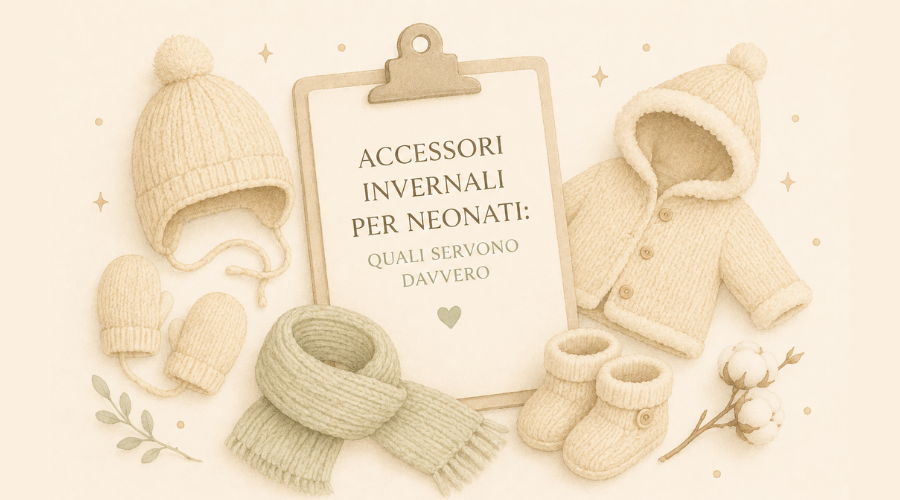
With the arrival of winter, one of the most common questions is how to protect a newborn properly when going outdoors.
Baby hats, socks, booties, mittens and blankets can all seem essential. In reality, there is no single list of winter accessories for newborns that works in every situation.
What is really needed depends on:
the baby’s age;
outdoor temperature;
wind and humidity;
how long the outing will last;
the number of layers already being worn;
whether the baby is in a pram, stroller, baby wrap or carrier;
frequent transitions between outdoors and heated indoor spaces.
Newborns do not regulate their body temperature as efficiently as adults and may be affected both by cold and by excessive clothing. The aim is therefore not to add as many accessories as possible, but to choose a few practical and adaptable items that are easy to put on and remove.
For a normal winter outing, the following may be useful:
a baby hat;
suitable socks;
knitted baby booties, when necessary;
a blanket;
mittens on colder days;
an extra layer to keep in the changing bag.
This does not mean they all need to be used at the same time.
A baby already wearing a bodysuit, sleepsuit, cardigan and padded snowsuit may not also need a very heavy blanket. On the other hand, a newborn lying still in a pram and not benefiting from the adult’s body heat may need an extra layer on colder days.
As a general starting point, the American Academy of Pediatrics recommends dressing babies and young children in one more layer than an adult would wear comfortably in the same environment. However, this is a general guideline that should be adapted according to temperature, mode of transport and the individual baby’s response.
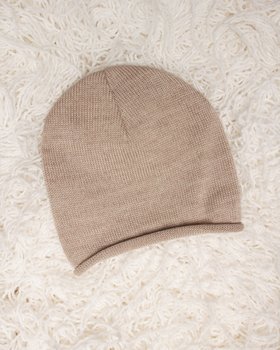
A baby hat is one of the most useful accessories for outings on cold, damp or windy days.
When choosing the right style, pay particular attention to:
head circumference;
fit;
elasticity of the edge;
ear coverage;
yarn weight;
ear flaps or fastening details;
compatibility with a hood and other layers.
The hat should stay securely in place without feeling tight, should not slip over the eyes and should not be purchased excessively large in the hope that it will last longer.
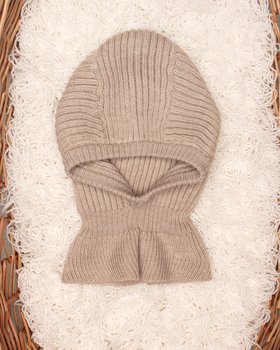
For outdoor use, you can consider simple styles, earflap hats or more enveloping designs according to the temperature and wind.
When entering the home, car or another heated environment, it is important to remove the hat when it is no longer needed. A newborn’s head should also remain uncovered during indoor sleep unless specific medical advice indicates otherwise. NHS and AAP recommendations emphasise the importance of avoiding overheating and removing hats and extra layers indoors.
For more information on sizing, fit, ear flaps, yarns and use, read our guide to wool hats for newborns.
A newborn’s feet also deserve attention, but they should not automatically be covered with multiple layers.
Babies’ hands and feet can feel cooler than the rest of the body without this necessarily meaning that the baby is cold. To assess comfort, it is more useful to check the chest or the back of the neck.
Socks are usually the first layer.
They should be:
soft;
the correct size;
free from excessively tight elastic edges;
positioned correctly;
suitable for the thickness of the sleepsuit or trousers.
Always check that the elastic does not leave deep marks around the ankle and that the toes have enough room.
Wool booties for newborns can be worn directly against the skin or as an additional layer over socks, especially when the sleepsuit does not cover the feet or during colder outings.
They are not designed to support the foot like walking shoes. Their main purpose is to provide soft protection and complete the baby’s clothing. The choice should therefore depend on the other layers already being worn and the actual temperature, rather than on an automatic need to “cover the baby’s feet”.
Choose styles that are:
lightweight and flexible;
easy to put on;
free from rigid parts;
sufficiently secure;
designed with edges that do not feel tight;
the correct length.
Again, more layers do not automatically mean greater comfort. If the sleepsuit already has enclosed feet and the baby is protected by a blanket or snowsuit, booties may not be necessary.
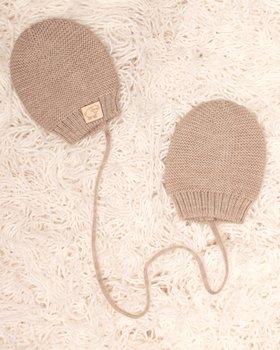
Baby mittens can be useful on particularly cold days, during longer walks or when the hands remain exposed.
However, they are not essential for every outing.
For a very young baby, choose mittens that are:
soft;
the correct size;
suitable for the season;
free from rigid parts;
without long cords;
easy to remove;
not too tight around the wrist.
Check regularly that both mittens are still in place and that they do not excessively restrict finger movement.
Slightly cool hands alone do not mean that the baby is cold. Before adding another layer, always check the chest or the back of the neck and observe the baby’s overall behaviour.
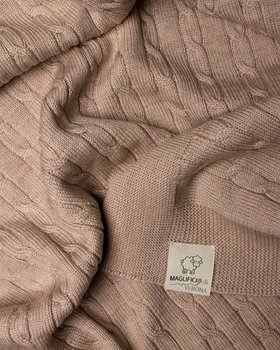
A baby blanket is one of the most versatile accessories because, unlike an item of clothing, it can easily be added, opened or removed when the temperature changes.
During outings, it can be used:
in the pram;
in the stroller;
while travelling;
as an extra layer when it is genuinely needed.
When choosing the right blanket, consider:
material;
size;
weight;
knit construction;
temperature;
clothing already being worn;
available space in the pram.
A very heavy or structured blanket is not automatically the best option. If the newborn is already wearing several layers or frequently moves between outdoor and heated environments, a blanket that can easily be adjusted may be more practical.
During the colder months, a Merino Wool blanket with a weight and knit construction suitable for the temperature may be considered.
To understand how to choose the right size, stitch pattern, Extrafine or Ultrafine yarn, read our guide on how to choose a Merino Wool baby blanket.
For a complete comparison between wool, cotton and other materials, read our general guide on how to choose a baby blanket.
A blanket used during a walk should not automatically be considered suitable for a baby’s sleeping area.
AAP safe sleep recommendations advise keeping loose blankets, pillows and other soft objects out of the sleep area; suitable layered clothing or an appropriate sleeping bag can instead be used for warmth.
Merino Wool is used for hats, booties, mittens and blankets because it can be spun into soft, elastic yarns with different weights.
The final result, however, depends on:
fibre fineness;
spinning;
number of plies;
stitch structure;
density;
style;
fit.
For this reason, two accessories both labelled “100% Merino Wool” can have very different levels of volume, texture and intended use.
Our collections also include Extrafine Merino Wool and Ultrafine Carded Merino Wool. The latter is made with fibres measuring between 15 and 17 microns in diameter.
To learn more about the material, read our guide to Merino Wool.
To understand whether your baby is dressed appropriately, do not rely only on their hands and feet.
Check:
chest;
back of the neck;
presence of sweat;
excessively warm skin;
damp clothing;
skin colour and overall behaviour.
If the chest or back of the neck feels very warm or damp, the baby may be wearing too many layers. In this case, remove one layer and check again after a few minutes. Cool hands and feet, on the other hand, can be normal.
Signs such as sweating, a very warm chest, damp hair or pronounced redness may indicate that the baby is overdressed. The baby’s overall behaviour should always be considered, and if anything causes concern, a paediatrician should be consulted.
Checking the hands may lead to adding too many layers.
A newborn’s peripheral circulation is still immature, so hands and feet may feel cool even when the body temperature is comfortable.
It is therefore better to touch the chest or the back of the neck and assess the clothing as a whole.
The way the baby is transported affects how much protection is needed.
A newborn remains mostly still and may be more exposed to cold air.
It may be useful to have:
a baby hat;
socks or booties;
a blanket;
protection from the wind;
an extra layer in the changing bag.
However, the cover should never block airflow or completely enclose the pram.
In a stroller, the child is more exposed to the outdoor environment.
You can adjust:
the hat;
blanket;
footmuff;
mittens;
rain cover, only when necessary and according to the manufacturer’s instructions.
When entering a warm place, open or remove the outer layers so that the baby does not remain excessively covered.
When a baby is carried against an adult’s body, they also receive some of the adult’s body heat.
They should therefore not be dressed in the same way as if they were lying alone in a pram.
Check that:
the face always remains uncovered;
the nose and mouth are visible;
the chin is not pressed against the chest;
the baby is not excessively covered;
the hat and clothing do not interfere with breathing;
the carrier is used according to the manufacturer’s instructions.
The baby’s position and airway safety take priority over the number of layers. NHS guidance notes that newborns have limited neck control and that the head should not fall forward while being carried.
In the car, it is important not to use excessively padded clothing underneath the car seat harness.
Very bulky jackets and padded snowsuits can compress during an impact and leave too much space between the baby and the harness.
It is preferable to dress the newborn in thin layers, secure the harness correctly and then place a blanket over the straps without interfering with the restraint system.
During winter, it can be useful to carry a few extra items, but there is no need to take the baby’s entire wardrobe.
You can prepare a small pouch containing:
a spare baby hat;
a pair of socks;
booties;
mittens;
a dry muslin cloth;
a cardigan;
a bag for wet clothing.
The blanket can be stored underneath the pram or in a separate bag.
When you return home:
check whether the accessories are damp;
allow them to dry completely;
replace the items that have been used;
check that the size is still correct;
prepare the bag again for the next outing.
For a complete guide, read our article on what to pack in a baby changing bag.
Continually adding layers can increase the risk of overheating.
It is more useful to choose adjustable accessories, regularly check the chest and back of the neck and adapt the baby’s clothing when changing environments.
A hat worn outdoors should be removed when the baby enters a warm environment or falls asleep indoors.
Buying a larger size so that it can be used for longer is not always the best solution.
A hat that is too large can slip over the face, while booties and mittens may come off easily.
Check that socks, booties, mittens and hats do not leave deep marks on the skin.
The accessory should remain secure without compressing.
Long scarves, cords and dangling decorations are not suitable for newborns.
It is preferable to choose simple styles with short and secure fastening details.
The inside of a car can warm up quickly.
Remove the hat and unnecessary layers when needed, and do not place padded clothing between the baby and the car seat straps.
Every outing is different.
Temperature, duration, clothing and mode of transport determine which items are genuinely useful.
Before going out, check:
☐ Outdoor temperature
☐ Wind and humidity
☐ Expected duration of the outing
☐ Number of clothing layers
☐ Correctly sized baby hat
☐ Socks or booties, if needed
☐ Mittens on colder days
☐ A blanket suitable for the temperature, if needed
☐ Complete change of clothes in the bag
☐ An extra lightweight layer
☐ Bag for wet clothing
☐ Ability to remove layers easily
☐ Car seat harness free from bulky padded clothing
Not necessarily. It depends on the temperature, wind, type of outing and other layers being worn. It is generally useful outdoors on cold days but should be removed when entering heated environments or when the baby sleeps indoors. For sizing, fit and yarn selection, read our guide to wool hats for newborns.
They are not needed to support the foot, but they can provide an additional soft layer on cold days. Their usefulness depends on the sleepsuit, socks, blanket and temperature.
No. They can be useful when the weather is particularly cold or during longer outings, but they should not automatically be added. They should be soft, correctly sized and free from long cords.
It depends on the temperature, weight and construction of the blanket. A Merino Wool blanket may be useful on colder days, while lighter options may be more suitable in milder temperatures. For a complete comparison of materials, read our guide to baby blankets.
Check the chest and back of the neck in particular. If they feel very warm or sweaty, removing one layer may be helpful. Cool hands and feet do not automatically mean that the baby is cold.
It is preferable to avoid long scarves, cords and loose items around the neck. For older children, a short neck warmer in the correct size and without dangling parts may be considered.
In addition to the usual essentials, you can bring socks, a baby hat, cardigan, mittens, a dry muslin cloth and a blanket. The amount should be adapted to the duration of the outing.
Use thin, close-fitting layers and avoid thick coats or heavily padded snowsuits underneath the harness. Once the baby has been secured correctly, a blanket can be placed over the straps.
Choosing the right winter accessories for a newborn does not mean adding every item that can provide warmth.
It means observing the temperature, considering the layers the baby is already wearing and choosing accessories that are easy to add or remove.
Baby hats, socks, booties, mittens and blankets can all be useful for winter outings, but they are not all necessary at every moment. Their usefulness depends on the baby’s age, the length of the outing and how the baby is being transported.
Material, weight and knit construction should always be considered together. Even an accessory made from a high-quality yarn can be impractical if it is too heavy, the wrong size or unsuitable for the temperature.
The most useful approach is therefore to create a small modular system: a few correctly sized accessories that are easy to add or remove as the environment and temperature change.
Protecting a newborn from the cold does not mean covering them as much as possible, but choosing the right layers for the situation in which they will actually be used.
🤍❄️
Spedizione veloce e gratuita (>75€)

Filati naturali e pregiati
Design essenziale e senza tempo

Assistenza clienti online
Artigianalità made in Italy dal 1975
Resi facili e veloci