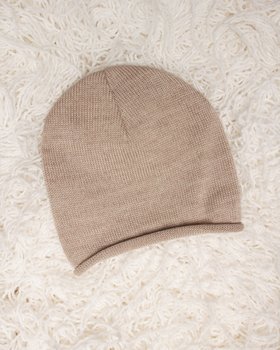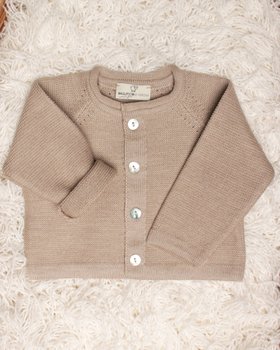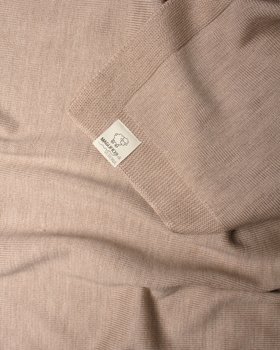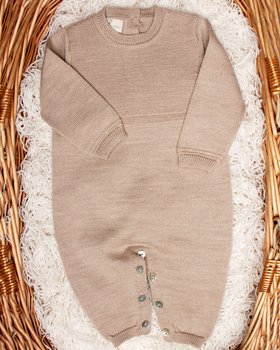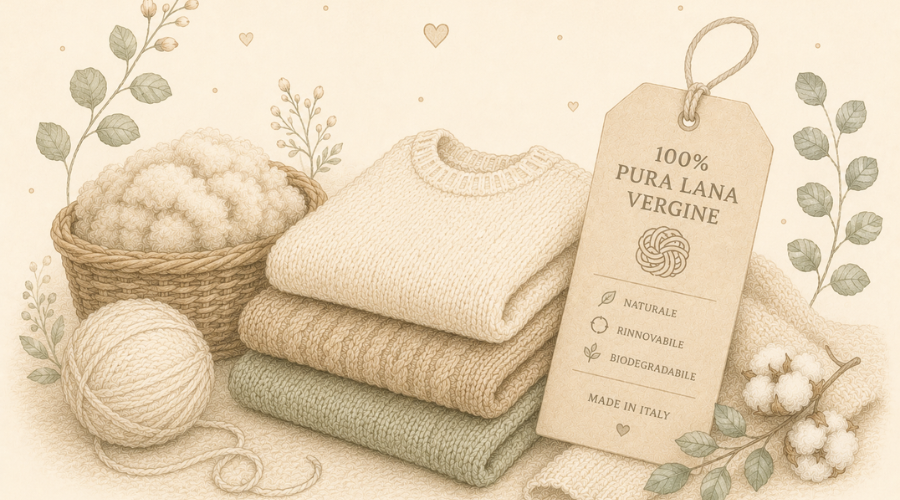
When buying a jumper, romper or blanket, the label may include wording such as:
100% Pure Virgin Extrafine Merino Wool
At first glance, this may look like a long sequence of terms used simply to enhance the product. In reality, each word provides a different piece of information.
100% or pure refers to the composition;
wool identifies the textile fibre;
virgin describes the previous history of the fibre;
Merino identifies the sheep breed from which it comes;
Extrafine refers to its fineness;
any certifications concern additional aspects and should be stated separately.
Understanding these differences makes it easier to evaluate what you are buying and avoid attributing information to the label that it does not actually contain.
To learn about Merino fibre as a whole, read our guide to Merino Wool, its characteristics and properties.
The term Pure Virgin Wool indicates, in short, a product made exclusively from wool that has not previously been incorporated into a finished product and then recovered for further processing.
The two parts of the expression do not mean the same thing:
It indicates that the textile composition consists of a single fibre.
In the case of Pure Virgin Wool, that fibre is wool.
It indicates that the wool does not come from the recovery of a previously used finished garment or textile product.
The fibre may still have been:
washed;
carded;
combed;
spun;
dyed;
twisted;
knitted;
subjected to the treatments required for production.
“Virgin” therefore does not mean raw, untreated or free from industrial processing.
Under the European Regulation on textile fibre names, the terms virgin wool and fleece wool may be used when the fibre has not previously been incorporated into a finished product, has not undergone spinning or felting processes other than those required to manufacture the product, and has not been damaged through previous use or treatment.
No.
It is not correct to state that a garment can be described as Pure Virgin Wool if it contains only 92.7% wool.
European legislation reserves the expressions:
100%;
pure;
all;
entirely;
for products composed of a single textile fibre.
Limited tolerances exist for technically unavoidable foreign fibres introduced during production, but these must not result from systematic addition.
For products specifically described as virgin wool, the rules provide for an even stricter tolerance: technically unavoidable foreign fibres must not exceed 0.3% by weight.
The term therefore cannot be used to describe a garment normally composed of:
92.7% wool and 7.3% acrylic;
95% wool and 5% polyamide;
90% wool and 10% Cashmere;
80% wool and 20% other fibres.
In these cases, the label must state the individual fibres and their respective percentages.
A complete description can be broken down word by word.
| Term | What It Indicates |
|---|---|
| 100% | The product is composed of a single textile fibre |
| Pure | Reinforces the indication of exclusive fibre composition |
| Wool | The textile fibre used |
| Virgin | The wool does not come from the recovery of a previously finished product |
| Merino | The fibre comes from Merino sheep |
| Extrafine or Ultrafine | The fineness class of the fibre, to be assessed together with the micron count |
| Carded or combed | The system used to prepare the fibres before spinning |
| Made in Italy | The place and production process of the garment, not the fibre composition |
The complete phrase therefore provides several levels of information, but it does not automatically tell us everything about the product.
In the context of textile composition, these expressions communicate that the product is made from a single fibre.
Equivalent examples include:
100% wool;
pure wool;
all wool.
The word “pure” does not necessarily indicate superior quality.
A garment made from pure wool consists exclusively of wool, but its overall quality can vary according to:
sheep breed;
fibre diameter;
length;
uniformity;
spinning system;
twist;
construction;
stitch;
finishing.
Composition tells us which fibre is present, but it is not enough to describe how that fibre was selected and transformed.
The difference lies in the word virgin.
It indicates that the product is composed entirely of wool.
On its own, the wording does not necessarily specify whether the fibre is new or has been recovered from previous textile processing.
It indicates that the composition is entirely wool and that the fibre meets the requirements for being described as virgin.
In simple terms:
All Pure Virgin Wool is wool, but the term “pure wool” does not automatically provide the same information about the fibre’s previous history.
No.
The two expressions answer different questions.
Has the fibre already been used in a previous finished product?
Which sheep breed does the wool come from?
A garment can therefore be:
made from Pure Virgin Merino Wool;
made from Pure Virgin Wool from another sheep breed;
made from Merino Wool without the word “virgin” being stated;
made from a blend of Merino Wool and another fibre.
The word Merino does not replace the fibre-composition declaration and does not automatically make the wool virgin.
Merino identifies a sheep breed known for producing fibres that are generally finer than many traditional wools.
However, not all Merino Wool is identical.
It may vary in terms of:
micron count;
length;
uniformity;
strength;
origin;
selection;
carding or combing;
yarn count;
twist;
finishing.
The word Merino should therefore be read together with the other information provided on the garment product page.
Extrafine describes the fineness of the fibre, not the percentage of wool present.
A finer fibre tends to bend more easily when it comes into contact with the skin and can be particularly suitable for soft, lightweight knitwear.
However, the term should be assessed together with the micron count declared by the yarn manufacturer.
Final quality also depends on:
fibre uniformity;
length;
spinning;
twist;
weight;
stitch;
finishing.
For more information, read our guide to Extrafine Merino Wool, its characteristics and micron count.
Ultrafine indicates an even finer fibre according to the classification used for the yarn.
Even in this case, the word alone does not tell us:
how warm the garment will be;
how heavy it will be;
whether the yarn will be voluminous;
whether the surface will be smooth;
whether the wool is carded or combed.
Ultrafine Merino Wool can be used in a thin, compact knitted garment or in a more voluminous woollen-spun yarn.
To understand this difference, read our guide to woollen-spun Ultrafine Merino Wool.
The difference concerns the history of the raw material.
It has not previously been incorporated into a finished product and then recovered.
It comes from recovered textile remnants, yarns, fabrics or garments that are sorted and reprocessed to obtain new raw material.
Recycled wool may come from:
pre-consumer waste;
production surpluses;
unused fabrics;
post-consumer garments;
recovered textile materials.
Recycling can reduce the need for new raw material, but the process can shorten the fibres. For this reason, recycled wool is sometimes blended with new fibres or other materials to improve stability and strength.
“Virgin” and “recycled” are not absolute judgements of value.
They describe two different origins:
virgin wool makes use of fibre that has not previously been used;
recycled wool makes use of material that already exists.
The choice should depend on the product, the desired performance and the transparency of the supply chain.
Not necessarily in every context.
Virgin wool may offer:
longer fibres;
greater uniformity;
better control over fineness;
the possibility of creating very fine yarns;
greater versatility in product design.
Recycled wool may instead offer:
recovery of existing materials;
reduction of waste;
distinctive colour and texture effects;
use in products that do not require extremely fine fibres.
The assessment should not be based only on the words “virgin” or “recycled”.
Consider:
intended use;
quality of the raw material;
complete composition;
fibre length;
strength;
spinning;
construction;
expected product life.
No.
Wool in the strict sense comes from the fleece of sheep and lambs.
Cashmere, on the other hand, is obtained from the undercoat of the Cashmere goat.
Other animal fibres also have different origins:
| Fibre | Origin |
|---|---|
| Wool | Sheep or lamb |
| Merino Wool | Merino sheep |
| Cashmere | Cashmere goat |
| Mohair | Angora goat |
| Angora | Angora rabbit |
| Alpaca | Alpaca |
| Vicuña | Vicuña |
It is therefore not correct to use “wool” as an interchangeable synonym for every animal fibre.
A label containing more than one fibre must state the fibre names and percentages.
For a more detailed comparison, read Merino Wool or Cashmere: differences and which one to choose.
Yes, under certain conditions.
European legislation allows the term virgin wool to be used for the wool portion of a blend provided that:
all the wool present meets the requirements for virgin wool;
it represents at least 25% of the total weight;
in the case of an intimate blend, it is combined with only one other fibre;
the complete percentage composition is stated.
A label could therefore state, where the relevant conditions are met:
70% Virgin Wool – 30% Cashmere
This product contains virgin wool, but it cannot be described as Pure Virgin Wool, because it is made from two fibres.
It means that:
the composition is entirely wool;
the wool meets the requirements for being described as virgin;
it comes from the Merino breed.
It does not automatically indicate the micron count.
It means that:
the garment is entirely made from Merino Wool.
The wording alone does not necessarily specify that it is virgin wool.
It means that:
the garment is entirely wool;
the wool is virgin;
it comes from Merino sheep;
the fibre is classified as Extrafine.
To assess its actual fineness, the technical specification of the yarn is required.
It means that:
the garment is a blend;
the Merino portion meets the stated requirements;
30% is Cashmere;
it is not pure wool.
It means that:
half of the composition is wool;
half is acrylic fibre;
the product cannot be described as pure wool.
It means that:
the fibre composition is entirely wool;
the declared raw material comes from a recovery process.
The reliability of a recycled-content claim should be supported by documentation and, where available, specific certifications.
The wording provides important information, but it does not describe the entire garment.
It does not automatically indicate:
The technical specification of the yarn is required to know the average fibre diameter.
In the absence of the word Merino or another specific indication, “virgin wool” alone does not identify the sheep breed.
Two Pure Virgin Wool garments can have very different weights.
Thermal comfort depends on yarn, stitch, density, volume and fit.
For more information, read our guide to wool during transitional seasons and thermoregulation.
Wool can be carded or combed, producing different results.
It depends on fineness, uniformity, twist, stitch and finishing.
Composition does not automatically indicate the country in which the sheep were raised.
“Pure Virgin Wool” does not automatically mean Made in Italy.
The term alone does not certify specific animal-welfare standards.
Specific and verifiable supply-chain information is required to make this claim.
Virgin wool does not automatically mean organic wool.
The fibre may be washed, dyed, spun and subjected to finishing treatments.
The wording does not guarantee that the garment will be suitable without exception for every type of skin.
The word “certified” should be accompanied by the name of the certification and an explanation of what has been verified.
No.
To become a yarn suitable for knitwear, the fibre must undergo several processes.
The process may include:
shearing;
sorting;
washing;
carding;
possible combing;
spinning;
twisting;
dyeing;
knitting;
garment washing and finishing.
The word virgin refers to the absence of previous use in a finished product, not to the absence of manufacturing processes.
To learn about the entire process, read how wool is made, from fleece to yarn.
No.
Composition and place of production are two different pieces of information.
Describes the fibre and its previous history.
Refers to the place and stages through which the product acquired its production origin.
A garment can be:
made from Pure Virgin Wool and manufactured in Italy;
made from Pure Virgin Wool and manufactured in another country;
manufactured in Italy using yarn made from fibre originating abroad.
The origin of the animal, yarn production and garment manufacturing may take place in different locations.
For this reason, the product page should clearly distinguish between:
composition;
yarn characteristics;
certifications;
place of garment production.
No.
Pilling is the formation of small surface pills caused by some fibres working their way out and becoming tangled together.
It can depend on:
fibre length;
yarn twist;
volume;
stitch;
friction;
use;
washing;
contact with bags, belts and car seats.
A Pure Virgin Wool garment can also develop pilling.
The presence of a few pills does not automatically indicate poor quality, particularly with very soft yarns. However, it is important to assess the intensity, frequency and behaviour of the garment over time.
Not necessarily.
The sensation of itchiness depends mainly on:
fibre diameter;
uniformity;
presence of coarser fibres;
spinning;
finishing;
individual sensitivity.
Extrafine or Ultrafine Merino Wool generally tends to be more flexible and comfortable than wool with a larger fibre diameter.
However, the word “virgin” does not describe fineness.
A wool can be virgin but relatively coarse; similarly, a very fine fibre may have a different production history.
No.
It is not correct to automatically describe a garment as hypoallergenic simply because it is made from Pure Virgin Wool.
Tolerability depends on:
fineness;
uniformity;
dyeing;
finishing;
detergents;
garment construction;
seams;
individual sensitivity;
any skin conditions.
Itchiness caused by a coarse fibre also does not necessarily correspond to an allergic reaction.
In the case of known allergies, dermatitis or particular sensitivities, follow the advice of a doctor or paediatrician.
The label is the starting point, not the end of the assessment.
Before purchasing, check several aspects.
Check whether the garment is:
100% wool;
a blend;
virgin wool;
Merino Wool;
Extrafine or Ultrafine Merino Wool.
The word Merino adds information about the sheep breed.
Extrafine and Ultrafine add information about fineness.
Where available, this helps you better understand the average diameter of the fibres.
Carded and combed systems produce yarns that differ in volume, regularity and appearance.
Stockinette stitch, ribbing, cables and jacquard do not provide the same weight or insulation.
A garment should suit the proportions of the person who will wear it.
A romper, an everyday cardigan and a blanket require different characteristics.
They should be stated by their full name and clearly refer to the fibre, yarn, process or finished product.
They should be compatible with the family’s needs and the expected frequency of use.
A natural composition can be an excellent starting point, but knitwear for younger children should always be assessed as a complete garment.
Also important are:
yarn fineness;
weight;
softness;
seams;
openings;
buttons;
internal labels;
fit;
ease of changing;
care.
A romper made from Pure Virgin Extrafine Merino Wool will have different requirements from a heavy blanket or a large cable-knit jumper.
To explore the available styles, see our newborn knitwear in Pure Merino Wool.
If you are looking for a layer for the cot, pram or pushchair, explore our blankets in Pure Extrafine Merino Wool.
Composition alone does not determine the washing method.
Always follow the care label of the individual product, because yarn, stitch, dyeing and finishing may require different instructions.
In general, it is important to:
use a detergent specifically formulated for wool;
avoid high temperatures;
limit friction;
do not rub;
do not wring the garment;
avoid sudden temperature changes;
support the knitted garment when wet;
dry flat where indicated;
do not hang the garment while damp;
gently reshape it.
Washing in cold water is not automatically the best solution for every product: the temperature indicated on the care label should be followed, with particular attention to avoiding sudden temperature changes and aggressive movement.
For complete instructions, read our guide on how to wash, dry and store Merino Wool.
The term Pure Virgin Wool does not describe an ordinary blend containing more than 7% of other fibres.
The fibre can be washed, dyed, spun and finished.
Merino identifies the breed; virgin refers to the previous use of the fibre.
The percentage alone does not describe fineness, spinning, stitch and finishing.
Cashmere, mohair, angora and alpaca have specific origins and fibre names.
Organic origin must be stated and documented separately.
A certification should be named and explained.
The place where the garment is made and the origin of the animal may be different.
The phenomenon depends on fibre, yarn, stitch and friction.
The correct reference is the care label of the individual product.
Before purchasing, check:
☐ Is the complete percentage composition stated?
☐ Does it say “100%”, “pure” or is it a blend?
☐ Is the word “virgin” present?
☐ Is the Merino breed specified?
☐ Are Extrafine or Ultrafine stated?
☐ Is the micron count declared?
☐ Is it specified whether the yarn is carded or combed?
☐ Are certifications clearly named?
☐ Is the place of garment production stated?
☐ Are the washing instructions legible?
☐ Are the weight and construction suitable for the intended use?
☐ Does the product page distinguish verifiable facts from simple promotional expressions?
It indicates a product composed exclusively of wool that has not previously been incorporated into a finished product and then recovered for further processing.
Yes. The expressions “pure” and “100%” are reserved for products made from a single fibre, except for very limited technically unavoidable impurities permitted by legislation.
No. A garment normally containing 92.7% wool and 7.3% of another fibre must state both percentages and cannot be described as Pure Virgin Wool.
It means that the wool has not previously been incorporated into a finished product and then recovered.
No. It may be washed, carded, combed, dyed, spun and subjected to the processing required to make the garment.
Pure wool indicates a composition entirely made from wool. The word virgin adds information about the previous history of the fibre.
No. Merino identifies a sheep breed. Wool can be virgin without being Merino.
Not necessarily. Extrafine is an additional indication relating to fibre fineness.
Virgin wool has not been used in a previous finished product. Recycled wool comes from the recovery and reprocessing of textile materials.
Yes, when the relevant conditions are met and the complete percentage composition is stated. However, a blend cannot be described as “pure”.
Cashmere is a distinct fibre obtained from the Cashmere goat. It is not Merino Wool and should be correctly identified in the fibre composition.
No. Fibre composition and the place where the garment is made are different pieces of information.
No. Organic origin requires a specific declaration or certification.
No. Mulesing-free status should be verified through specific supply-chain information or certifications.
No. Tolerability depends on fineness, processing, treatments and individual sensitivity.
Yes. Pilling can also occur on high-quality yarns due to friction affecting surface fibres.
Follow the care label of the individual garment, use a suitable detergent and limit heat, friction and sudden temperature changes.
The term Pure Virgin Wool is not simply a promotional expression.
It provides two precise pieces of information:
the garment is composed of a single textile fibre;
the wool does not come from the recovery of a previously finished product.
However, it does not automatically indicate:
Merino breed;
micron count;
softness;
weight;
warmth;
organic origin;
animal welfare;
mulesing-free status;
certifications;
Made-in-Italy production;
absence of pilling.
To truly understand a garment, it is necessary to read the label as a whole and connect the composition with the information provided on the product page.
A description such as:
100% Pure Virgin Extrafine Merino Wool
tells us that the garment is entirely made from virgin wool, that the fibre comes from Merino sheep and that it belongs to a specific fineness class.
To assess the final result, however, we also need to consider spinning, twist, stitch, weight, shaping, finishing and garment construction quality.
Understanding the label means going beyond the name of the material and recognising the process that transforms the fibre into a garment designed to be worn, cared for and preserved over time. 🧶🤍
Spedizione veloce e gratuita (>75€)
Filati naturali e pregiati
Design essenziale e senza tempo
Assistenza clienti online
Artigianalità made in Italy dal 1975
Resi facili e veloci