

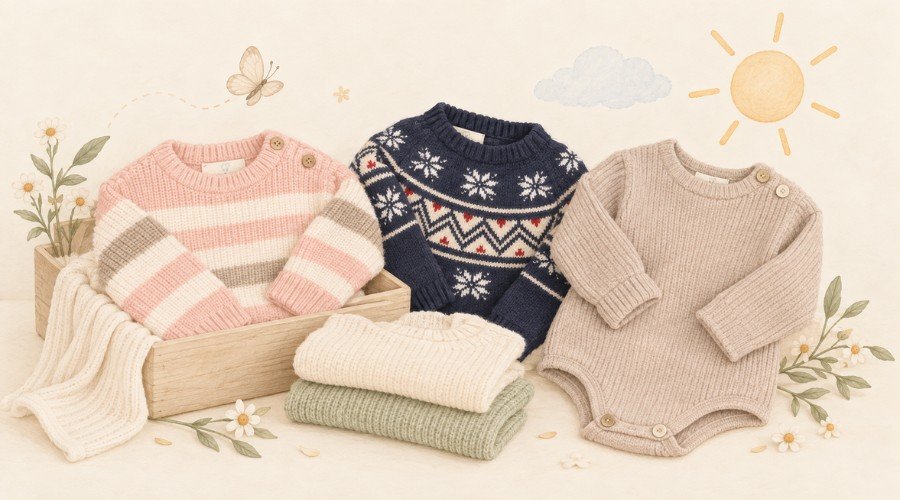
Colours can completely transform an outfit, but matching children’s clothes should not become a complicated exercise.
You do not need dozens of different shades or a new colour palette every season.
On the contrary, a wardrobe built around a few colours that work well together makes it easier to:
create outfits;
reuse the same garments;
coordinate tops and trousers;
add cardigans and jackets;
pack for a trip;
buy new clothes without ending up with pieces that are difficult to match.
Colour can be used in many different ways: tone-on-tone, through contrast, as a small accent or as the main feature of the entire look.
The most useful rule? Do not start with the number of colours, but with the garment you want to highlight.
A simple system is to distinguish between three roles:
base colour;
secondary colour;
optional accent colour.
For example:
milk-coloured trousers;
sage top;
beige cardigan.
Or:
denim trousers;
sky-blue top;
navy cardigan.
You do not always have to use three shades.
An outfit can work perfectly well with:
just one colour;
two shades from the same colour family;
one neutral and one colour;
a patterned garment combined with plain-coloured pieces.
The aim is to create a harmonious overall look, not to follow a mathematical formula.
To create a balanced look easily, two or three main colours are often an excellent starting point.
This does not mean that a fourth colour is forbidden.
Buttons, embroidery, small jacquard details, stripes and accessories can add other shades without automatically making the outfit look confused.
It is more useful to distinguish between:
predominant colours;
small details.
For example, a jacquard jumper may contain four colours and can be paired with plain trousers that pick up just one of the shades in the pattern. The result still looks balanced because not all the colours are competing at the same level.
Colours do not need to be divided rigidly into masculine and feminine categories: pink, blue, green, red, beige, periwinkle or yellow can all be worn regardless of gender.
The final result of an outfit is created by the style, fit, construction, combination and personal taste.
This also makes it easier to choose garments that can be reused between brothers and sisters.
When a garment has a pattern, there is no need to add other prints just to make the outfit more interesting.
A simple approach is to choose one of the colours already present in the pattern and repeat it elsewhere in the outfit.
For example, a jumper featuring milk, green and sky blue can be paired with milk-coloured trousers or a green cardigan.
This makes the combination look intentional without requiring perfectly coordinated garments.
Not necessarily. Milk, beige, blue, pink, green or red can all be worn throughout the year.
What changes most are:
yarn;
weight;
style;
number of layers;
knitted construction.
A beige garment in Pure Cotton may belong to a spring outfit, while the same beige shade in Merino Wool may be used during the colder season.
For this reason, it is more useful to build a personal colour palette and change the garments, rather than necessarily changing all the colours.
For practical advice on managing layers during transitional seasons, read our guide on how to dress children in spring.
An easy-to-coordinate wardrobe can be built around a limited colour palette.
For example:
milk;
beige;
blue.
sage;
powder pink.
Five coordinated shades are already enough to create many different combinations.
There is no perfect colour palette.
The best solution is the one that allows the garments already in the wardrobe to be worn frequently.
Before buying a new jumper, cardigan or pair of trousers, ask yourself: “How many garments we already own can this be worn with?”
If the answer is only one, the new purchase may be less versatile.
If, on the other hand, it can be worn with:
two pairs of trousers;
a skirt;
a cardigan;
a jacket;
it will have many more opportunities to become part of the child’s everyday wardrobe.
Colour can therefore also become a tool for making more considered purchases.
In knitwear, colour is not the only visual element: the stitch also changes the final effect.
The same colour can look different when used in:
ribbing;
cable knit;
stocking stitch;
links knit;
jacquard;
openwork knitting.
For this reason, when an outfit uses a single colour family, movement can be created through textures.
Tone-on-tone does not necessarily mean using exactly the same surface.
There is no strict limit. Two or three main colours are a simple starting point, while embroidery and patterns can introduce small secondary shades.
Milk, cream, beige, grey, denim and navy can all work as highly versatile base colours.
It can be paired with milk, brown and chocolate for a natural look, or with sky blue, denim, pink, green or red for greater contrast.
Sage and softer greens work easily with milk, beige, sky blue and dusty pink. Deeper greens can be paired with cream, blue, brown, red or burgundy.
Yes. There is no rule that prevents this combination. Different shades can be used, and a neutral can be added when you want to soften the contrast.
You can pick up one of the colours already present in the pattern through the trousers or cardigan, or use a simple neutral.
Start with one of the colours in the stripe or introduce a coordinated third colour. There is no need to reproduce the exact palette of the jumper.
No. It is enough to share a colour palette, one shade or a colour family.
No. Any colour can be worn regardless of gender.
Not necessarily. What changes most may be the yarn, weight and style of the garment.
Choose two or three base colours and add one or two character shades that work with most of the garments.
No. You can use different intensities from the same colour family and combine different knitted constructions.
Matching colours in children’s clothing does not mean creating a perfectly coordinated outfit every time.
A truly versatile wardrobe works when garments can be combined in different ways.
To begin, it is enough to:
choose a few base colours;
add a small number of character shades;
use neutrals to connect them;
pick up colours already present in patterns and jacquard;
alternate between tone-on-tone and contrast;
also consider stitch, texture and construction.
Milk, beige and blue can create the base.
Sage, powder pink, sky blue, red, green or periwinkle can add character.
But there is no universally correct colour palette.
The best combination is the one that allows the child to actually wear their clothes, creating different outfits without having to buy a complete coordinated set every time.
Colour therefore becomes not only an aesthetic choice, but also a tool for building a simpler, more versatile and more personal wardrobe.

Spedizione veloce e gratuita (>75€)
Filati naturali e pregiati
Design essenziale e senza tempo

Assistenza clienti online
Artigianalità made in Italy dal 1975
Resi facili e veloci


