

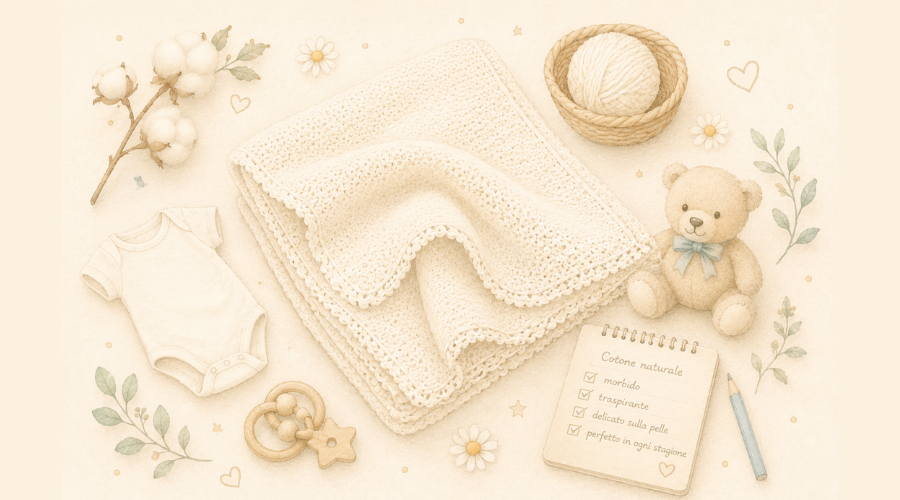
Have you already decided on a cotton newborn blanket, but are unsure which model to choose?
The fibre composition is only the first element to check.
Two blankets made entirely from pure cotton can be very different in terms of:
An openwork construction, for example, creates a very different structure from a compact cable-knit blanket or a stockinette model.
In this guide, we focus exclusively on choosing a blanket made from cotton. To compare cotton, Merino Wool, Cashmere, bamboo, eucalyptus and linen, refer to our guide on how to choose a newborn blanket according to size, material and season.
Cotton can be a particularly practical choice when looking for a blanket:
However, this does not mean that every cotton blanket is automatically lightweight or suitable for summer.
The behaviour of the finished product also depends on:
An openwork cotton blanket and a compact cable-knit blanket can therefore suit very different seasonal needs.
Cotton is a natural plant-based fibre that can be transformed into very different yarns and knitted constructions.
In knitwear, it can be used to create surfaces that are:
The final feel does not depend on the fibre alone.
An open stitch leaves more space within the knitted structure, while a very dense construction creates a more compact blanket.
Softness also depends on:
No.
The two expressions provide different information.
This means that the declared textile composition consists exclusively of cotton.
This means that the raw material comes from an organic farming system verified according to a recognised standard.
A product may therefore be:
100% conventional cotton;
100% organic cotton;
made from organic cotton certified according to a specific standard.
The word pure describes the fibre composition, while organic refers to the production method of the raw material.
GOTS stands for Global Organic Textile Standard.
The standard defines requirements designed to preserve the organic status of textiles from the harvesting of the raw material through processing, manufacturing and labelling, while also including environmental and social criteria. Certification should therefore not be interpreted simply as a generic claim that a product is natural.
For more information without repeating the entire subject here, read our guide to organic cotton and GOTS certification.
To choose a cotton blanket correctly, it is important to look at the finished product.
The dimensions should be appropriate for:
A greater weight may indicate a larger amount of yarn or a more structured construction, but it should always be considered in relation to the size.
A dense, compact knitted structure feels different from an open construction.
Stockinette, links stitch, cables and openwork patterns change the surface, volume and practicality of the blanket.
Always check the temperature, programme, spin cycle and drying instructions stated on the care label.
Many of the current Pure Organic Cotton models in the Maglificio di Verona collection measure 80×100 cm and are designed for use in the cot, pram and bedside sleeping systems. The exact dimensions should always be checked on the individual product page.
The 80×100 cm size can be chosen when you want:
It is not automatically the best size for every pram.
In a very compact space, it may create:
The knitted construction is one of the elements that most significantly affects the behaviour of a cotton blanket.
Stockinette stitch generally creates a surface that is:
It can be suitable for those looking for a versatile blanket with a clean, understated appearance.
Links stitch alternates the way the stitches appear on the right and wrong sides, creating texture, stripes or small motifs across the surface.
It can give the blanket:
An openwork construction features openings created directly within the knitted stitch pattern.
It can provide:
Even in this case, however, it is important to check:
“Openwork” does not automatically mean suitable for every hot day.
Flowers, stripes and knitted motifs make the product more decorative, but they can also affect:
The design should therefore be considered together with the construction, rather than only as an aesthetic feature.
This section refers exclusively to the characteristics of cotton blankets. The complete guide covering all materials and seasons remains available in blog article 88.
In spring, practical options may include:
The temperature can change during the same day, so practicality becomes just as important as the material.
During summer, it is useful to consider:
A lightweight blanket may be useful while travelling, on cooler evenings or in air-conditioned environments, but it should not automatically be used when temperatures are high.
Cotton does not prevent a baby from feeling hot if the blanket is too heavy or too many layers are used.
A compact cotton blanket can also be used during early autumn, particularly:
As temperatures fall, a Merino Wool blanket or a more structured construction may become more suitable.
Cotton and Merino Wool can both be used to make blankets, but they offer different feels and constructions.
| Feature | Cotton | Merino Wool |
|---|---|---|
| Origin | Plant-based fibre | Animal fibre |
| Typical feel | Dry and natural | Elastic and enveloping |
| Common seasons | Spring, summer, indoors | Autumn, winter and transitional seasons |
| Knitted constructions | Stockinette, links stitch, openwork, cables | Stockinette, cables, jacquard, woollen-spun |
| Volume | Depends on stitch and number of yarn strands | Can be greater with woollen-spun yarns |
| Elasticity | Depends mainly on the knitted construction | Naturally more pronounced |
| Care | Depends on the label | Requires specific wool care |
| Use | Mild days and indoor environments | Cooler temperatures |
For more information about the second material, read how to choose a Merino Wool newborn blanket.
Yes, a cotton blanket can change in size if the washing instructions are not followed correctly.
Its behaviour depends on:
The care label of the individual product should always be your first reference.
There is no single washing temperature suitable for every cotton blanket.
In general:
An openwork or highly detailed blanket may require greater care to prevent the weight of the water from altering the knitted structure.
After washing:
Hanging a very wet blanket may place uneven tension on the knitted structure.
It can be, although this depends on its size and construction.
A stockinette or openwork model may be:
A cable-knit or highly structured blanket will generally take up more space.
Even an 80×100 cm blanket can be versatile, although the amount of space it occupies will vary according to:
The blanket should:
It is important to:
A cotton blanket can be a good gift idea, particularly for:
Before choosing one, it is useful to check:
For more information about this specific purpose, read which blanket to choose as a birth gift.
Before purchasing, make sure the product page clearly states:
For example:
100% Pure Organic Cotton.
Check that GOTS is clearly stated in relation to the product or yarn covered by the certificate.
It should be stated in centimetres.
Check whether the blanket is:
The information should be consistent with the stitch, density and weight.
The washing temperature and method should refer specifically to the individual item.
The term Made in Italy refers to the manufacture of the garment and does not automatically mean that the fibre itself originates in Italy.
Consider size, weight, density, knitted construction, season and washing instructions. Fibre composition alone does not determine how lightweight or structured the blanket will be.
It is often chosen for spring, summer, mild days and indoor environments. Actual use depends on the weight and stitch.
It can be when the model is lightweight and the temperature requires it. A compact or cable-knit blanket may be excessive on very hot days.
Yes, particularly at the beginning of the season or indoors. At lower temperatures, a Merino Wool blanket may be preferable.
The 80×100 cm size is versatile for the cot and pram, but it should be compared with the available space and the bulk of the knitted construction.
Stockinette stitch offers a more uniform and compact surface. Openwork creates a more open and visually lighter structure.
Not necessarily. Cables increase texture, volume and the amount of yarn, making the product more structured.
“Pure” means that the composition consists entirely of cotton; “organic” refers to the origin of the raw material from verified organic farming.
It is an international standard that includes requirements relating to the organic status of fibres, textile processing, labelling and environmental and social criteria.
Not necessarily. GOTS provides different labelling categories. The certification and percentage fibre composition should always be checked together.
It is not correct to guarantee this for every individual. Tolerance also depends on dyes, finishes, detergents and individual sensitivity.
Yes, particularly when the washing temperature and drying instructions stated on the label are not followed.
It depends on the individual product. Some Maglificio di Verona blankets specify a maximum temperature of 30 °C; the care label should always remain the correct reference.
Only when permitted by the care label.
Cotton is often chosen for mild days and lightweight constructions. Merino Wool is generally preferred for cooler temperatures and more enveloping designs.
To choose a cotton newborn blanket correctly, reading the fibre composition alone is not enough.
You need to consider together:
An openwork blanket can feel lightweight and suit mild days.
A stockinette construction offers a simple and versatile surface.
A cable-knit model can be more structured and better suited to cooler temperatures.
The wording GOTS-certified Pure Organic Cotton should also be read correctly: pure describes the composition, organic refers to the raw material and GOTS identifies a standard with specific requirements.
The best blanket is therefore not simply the one described in generic terms as fresher or more natural.
It is the one that responds appropriately to:
To view models, colours and availability, explore our selection of newborn blankets in Pure Organic Cotton.
Spedizione veloce e gratuita (>75€)
Filati naturali e pregiati
Design essenziale e senza tempo

Assistenza clienti online
Artigianalità made in Italy dal 1975
Resi facili e veloci