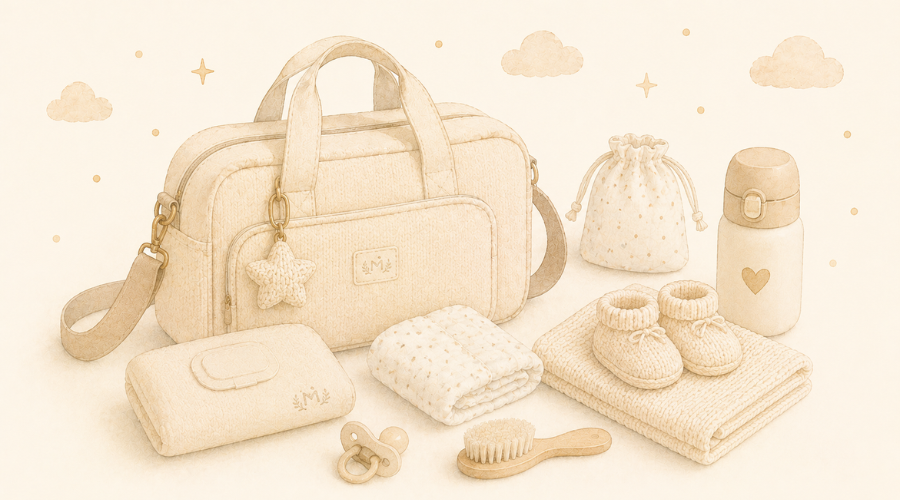
The first outings with a newborn can feel like quite an undertaking. Even a simple walk can raise plenty of questions: how many nappies will you need? Is one spare bodysuit enough? Should you take a blanket even when it is not cold?
Preparing your newborn changing bag properly helps you approach a walk, a visit to the grandparents, a day away from home or a paediatrician appointment with greater peace of mind.
However, there is no need to take an entire wardrobe with you. The contents of the bag should be chosen according to four factors:
With good organisation, you can have everything you need without turning the pushchair bag into luggage that is too heavy and difficult to manage.
Are you still preparing everything for the birth? Discover what to pack in your hospital bag too, with the complete checklist for mum and baby.
A changing bag does not necessarily need to be very large. Above all, it should be practical and easy to organise.
A good baby changing bag should be:
Compartments are particularly useful because they allow you to keep nappies, changing products, clean clothes, feeding supplies and personal belongings separate.
It is best to avoid a bag that is very deep and has no internal dividers. Even when spacious, it can quickly become disorganised and make it difficult to find what you need.
The contents may vary from one family to another, but some items provide a useful foundation for almost every outing.
Nappies are naturally the first item to place in the changing bag.
The quantity depends on the length of the outing and the baby’s habits. Two or three nappies may be enough for a short walk, while a half-day trip will require a few more.
Always adding one spare nappy helps you deal more calmly with unexpected situations or more frequent changes than usual.
Avoid taking the whole pack, as it would occupy a great deal of space without being genuinely necessary.
A foldable changing mat allows you to create a clean, protected surface when you are away from home.
It is useful in public toilets, baby-changing areas, the car or anywhere that does not provide a suitable surface for changing a newborn.
Choose one that is:
You can pack a small packet of wipes suitable for your baby’s skin or the products you normally use during nappy changes.
A small muslin cloth can also be useful for drying the skin or protecting the surface of the changing mat.
Nappy cream can be transferred into a small container or packed in a travel-size format.
One of the most important things to pack is a full change of clothes. Do not include only a bodysuit: a nappy leak, spit-up or another small accident may make it necessary to change the baby completely.
Prepare:
Place the clean clothes in a separate bag so that they remain protected and are easy to find.
Check the size regularly too. One of the most common mistakes is leaving a spare outfit in the changing bag for weeks, only to discover that it has become too small when it is finally needed.
Take a few resealable bags or a waterproof pouch.
You can use them for:
It is important to keep clean clothes separate from dirty ones, especially when the bag also contains everything required for feeding.
A washable, reusable solution also helps reduce the use of disposable bags.
A muslin cloth is one of the most versatile items to carry with you.
It can be used as:
It is useful to take one or two, choosing soft, lightweight cloths that are easy to wash.
Even during a short walk, a bib can be useful in case of spit-up or during feeding.
For a longer outing, you can prepare two and keep them together with the clean change of clothes.
A dummy is not essential for every newborn.
When the baby uses one regularly, carry it in a clean, protective case. A second spare dummy may be useful for longer outings.
When the baby does not use a dummy, there is no need to add one to the bag merely as a precaution.
What you need for feeding depends on the baby’s age and type of feeding. According to your needs, the bag may contain:
It is not correct to assume that a bottle or water is essential for every newborn. During the first six months, a baby who is exclusively breastfed does not normally need additional water unless advised otherwise by a healthcare professional.
Always follow your baby’s routine and the advice provided by your paediatrician. Avoid improvising preparation or storage methods while away from home.
You do not need to carry many documents for a short walk close to home.
For longer outings, appointments or journeys, it may be useful to have:
There is no single number that works for every baby. However, you can use the following guidelines as a practical starting point and adapt them to your baby’s habits.
For an outing lasting one or two hours, prepare:
You can add:
For a longer outing, consider:
It is better to adapt the quantity to your baby than to follow an overly rigid list. Some newborns need very frequent changes, while others follow a more regular routine.
A well-organised bag allows you to find everything without having to empty it at the least convenient moment.
You can divide it into small functional sections.
Keep the following together:
This allows you to remove a single pouch whenever you need to change the baby.
Fold the complete change of clothes together:
Keeping them in the same bag makes changing quicker and prevents clean clothes from coming into contact with other items in the changing bag.
Use a resealable bag or a washable, waterproof pouch.
When you return home, remember to empty it immediately, wash what is needed and place it back in the changing bag.
Keep everything related to feeding separate. This helps maintain order and prevents feeding supplies from coming into contact with changing products or dirty clothes.
In the easiest-to-reach pockets, you can place:
The items used most frequently should always be accessible without opening the entire bag.
During summer, the bag should contain lightweight, breathable clothes while also providing protection from the heat.
You can add:
Babies under six months should not be exposed directly to the sun. It is therefore important to favour shade, avoid the hottest hours and use appropriate physical protection, such as lightweight clothing and a hat.
Even in summer, it is important not to overdress the baby. Heavy sweating and very warm skin may be signs of overheating.
During the colder months, you can add:
Dressing the baby in layers makes it easier to add or remove a garment when moving between outdoors and a heated environment.
There is no need to cover the baby excessively. When entering a shop, car or warm indoor space, remove at least the heaviest layer and check that the baby is not sweating.
To understand whether the baby is too warm, it is more useful to check the chest or the back of the neck than to rely only on the temperature of the hands and feet.
Even a well-organised bag can become less useful when it is not checked regularly.
One spare bodysuit may not be enough.
In the event of a nappy leak or spit-up, you may also need to change the baby’s trousers, romper, socks or cardigan.
Newborn babies grow quickly.
Check regularly that the bodysuit and romper stored in the bag are still the correct size and suitable for the season.
When you return home:
This means that the bag will already be ready for the next outing.
Continuously adding items makes the bag heavy and disorganised.
After your first few outings, it will become easier to understand what you genuinely use and what always remains untouched.
A bag prepared for winter cannot remain unchanged during summer.
Regularly check hats, blankets, the weight of the spare clothes and seasonal products.
Before leaving home, quickly check that you have:
☐ Nappies
☐ Portable changing mat
☐ Wipes or cleansing products
☐ Barrier cream, when used
☐ Spare bodysuit
☐ Spare romper or two-piece outfit
☐ Bib
☐ Muslin cloth
☐ Bag for dirty clothes
☐ Feeding essentials
☐ Dummy with case, when used
☐ Additional garment suitable for the season
☐ Health card for long outings or appointments
It depends on the length of the outing and the baby’s habits. Two or three nappies may be enough for a short walk. For half a day, it is advisable to add a few more and always include at least one spare.
For a short outing, it is advisable to have at least one complete change consisting of a bodysuit and a romper or two-piece outfit. For a full day, two complete changes may be useful.
For a short walk, nappies, changing products, a portable changing mat, one complete change of clothes, a muslin cloth, a bag for dirty garments and any necessary feeding supplies are generally sufficient.
No. It depends on the type of feeding and the baby’s needs. Not every newborn uses a bottle, and a breastfed baby may not need one during the outing.
Only when the baby uses one regularly. In this case, it should be stored in a clean container, with a spare added for longer outings when useful.
In addition to the usual essentials, you can add a lightweight hat, a fresh spare outfit, a muslin cloth and age-appropriate sun protection. Babies under six months should not be exposed directly to the sun.
A hat, blanket, spare socks and a cardigan or knitted jacket are useful. Dressing the baby in layers makes it easier to adapt their clothing when moving between outdoors and heated spaces.
It is advisable to check it after every outing and carry out a more thorough review at each change of season. Replace used nappies and finished products, wash anything that has been used and check that the clothes are still the correct size.
Preparing a newborn changing bag does not mean anticipating every possible unexpected event, but carefully choosing what may genuinely be useful during the outing.
Nappies, a portable changing mat, one complete change of clothes, a muslin cloth and feeding essentials provide a reliable foundation. Everything else can be adapted to the length of the day, the season and the baby’s habits.
After the first few walks, it will become increasingly easy to find the right balance and understand which items should never be missing.
For changes of clothes, choose garments that are soft, practical and easy to put on. A comfortable bodysuit, a romper and one small additional layer take up little space in the bag and help you deal calmly with the unexpected moments that may arise during your baby’s first outings. 🤍
Spedizione veloce e gratuita (>75€)
Filati naturali e pregiati
Design essenziale e senza tempo

Assistenza clienti online
Artigianalità made in Italy dal 1975
Resi facili e veloci