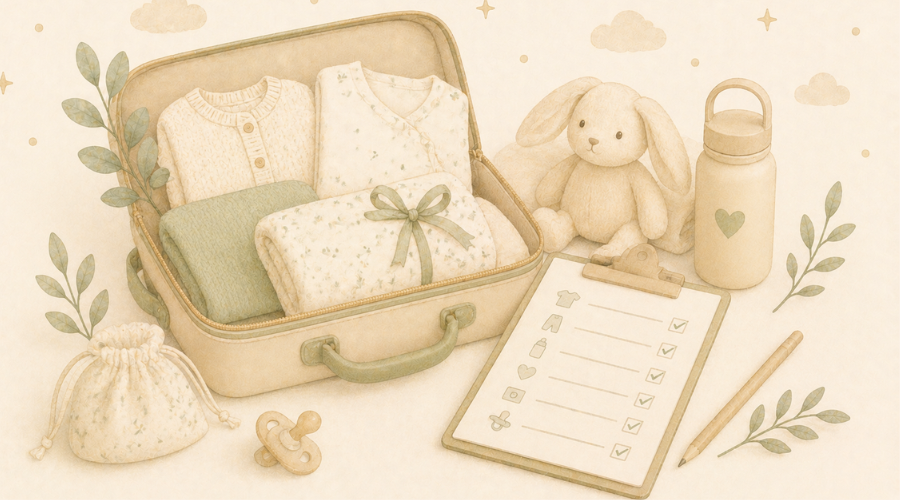
Packing your hospital bag is one of those moments that suddenly makes your baby’s arrival feel much closer.
Between tiny bodysuits, nightdresses, documents, personal-care products and changes of clothes for the newborn, however, it is easy to feel overwhelmed and wonder what to pack in your hospital bag for labour and what can safely be left at home.
The good news is that you do not need to bring an entire wardrobe. A well-organised bag containing a few carefully chosen items allows you to keep everything you need close at hand without unnecessarily filling the hospital room.
Before you begin, remember one essential rule: the checklist provided by your maternity unit should always take priority. Every hospital may request different quantities, documents and supplies, and some facilities already provide nappies, maternity pads or baby-changing products. Always check with the hospital where you have chosen to give birth.
There is no single perfect time for every expectant mother, but it is advisable not to wait until the very last few days.
You can start gathering what you need during the third trimester and gradually complete your bag with:
Packing a little at a time allows you to check calmly what is still missing, wash your baby’s first clothes and compare your own list with the one provided by the hospital.
If there are any specific considerations relating to your pregnancy, always follow the advice of your midwife, gynaecologist and chosen maternity unit.
Before buying or preparing anything, look on the hospital website for the section dedicated to maternity services or contact the ward directly.
Check in particular:
Requirements can vary considerably from one hospital to another. Some maternity units, for example, ask for two complete changes of clothes per day.
To organise your hospital bag for labour more effectively, divide everything you need into four groups:
Keep all your documents in an easily recognisable folder, placed at the top of your suitcase or in a separate bag.
In general, you may be asked to bring:
Also check which documents are needed to register the birth. Some hospitals require copies of both parents’ identification documents and additional paperwork depending on the family’s circumstances.
The bag intended for the delivery room should contain only what can help you feel comfortable and keep the essentials within easy reach.
You can prepare:
It can be helpful to place these items in a small separate bag so that you do not have to open and empty your main suitcase during labour.
During the days following the birth, you will mainly need soft, practical clothes that are easy to put on.
You can pack the following in the mother’s hospital bag:
Nightdresses with a front opening are particularly practical during medical checks and for keeping your baby close to your body.
There is no need to bring an oversized toiletry bag. Whenever possible, choose products you already use and know are suitable for your skin.
You can prepare:
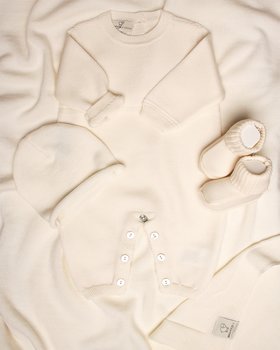
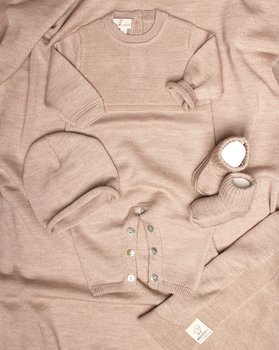
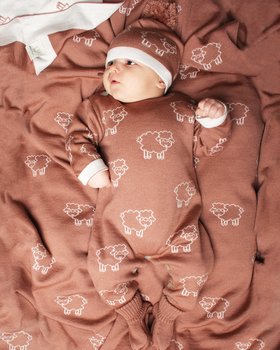
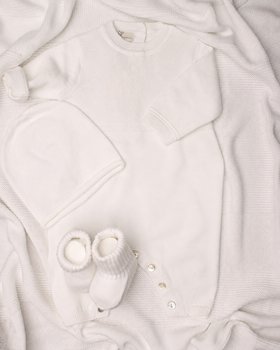
The newborn layette for hospital should be simple, soft and suitable for the season.
The exact number of changes depends on the instructions provided by your maternity unit, but in general you can prepare:
Not all hospitals require the same items. Some maternity units specify two complete changes of clothes per day, while others provide a total quantity for the entire hospital stay.
One of the most practical methods is to prepare each complete change in a separate bag.
In each bag, you can place:
You can then separate and number the bags:
Write the mother’s first name and surname on each bag and, when required, the baby’s name as well.
This allows healthcare staff or the person accompanying you to find the necessary outfit immediately without searching through all the baby clothes.
You can use washable bags, reusable transparent pouches or small fabric organisers to store the garments.
For the first few days, it is important to choose garments that are:
During the warmer months, lightweight cotton bodysuits and rompers are generally recommended. During the colder months, we at Maglificio di Verona suggest bodysuits and rompers made from natural wool.
A soft cardigan, a blanket or a warmer garment can be useful for leaving hospital and travelling home, depending on the season and outdoor temperature. Our lightweight Essential wool baby blanket is suitable throughout the year: wool is naturally thermoregulating and helps newborn babies maintain a comfortable body temperature.
The first outfit deserves particular attention because it is what your baby will wear immediately after birth.
Prepare a clearly labelled bag containing:
Choose a practical outfit that is easy to put on. The beauty of a baby’s first layette does not depend on the number of decorations, but on its quality, softness and the care with which it has been selected.
The outfit for going home can be kept separate from the others.
Prepare:
Remember to prepare the appropriate newborn car seat or transport system in advance and install it correctly before the day you leave hospital.
When preparing your hospital bag checklist, it can be tempting to add anything that might be even vaguely useful.
An overfilled suitcase, however, becomes difficult to organise and takes up unnecessary space in the room.
A compact suitcase organised with bags and pouches is better than several separate pieces of luggage.
Also check the ward’s guidance, as the cupboards in hospital rooms may offer limited space.
You do not need ten different rompers.
Prepare the number of changes requested by the hospital and, if helpful, add one spare. A trusted person can always bring additional clothes if they are needed.
Before buying large quantities of nappies for hospital, check what the ward provides.
Some hospitals already supply nappies and baby-changing products, while others ask families to bring them from home.
During the first few days, a newborn baby does not need toys.
Soft toys and decorative objects take up space, may fall on the floor and are unnecessary during the hospital stay.
There is no need to automatically pack a bottle warmer, steriliser or several feeding bottles.
If these items are needed, the healthcare staff will explain how to proceed and which equipment to use.
A breast pump does not necessarily need to be included in the hospital bag.
It can be useful in specific situations, but it is preferable to wait for guidance from the midwife or the healthcare professionals caring for mother and baby.
Nursing pillows, very bulky blankets and other large accessories can be impractical in the limited space available on the ward.
Bring them only when recommended or when you already know they will be genuinely useful.
It is best to leave jewellery, large sums of money and valuable items at home.
Hospitals also generally advise patients not to bring valuables with them during their stay.
It is advisable to begin gathering what you need during the third trimester rather than waiting until the final few days. If you have specific pregnancy-related needs, always follow the guidance of your gynaecologist, midwife and maternity unit.
The quantity depends on the hospital. Some maternity units request approximately two complete outfits per day, while others provide one overall checklist. Prepare the number requested and add one spare outfit if possible.
Each complete outfit can be placed in a separate bag labelled with the mother’s name. It is useful to number the bags and clearly identify the first outfit and the going-home outfit.
Soft, practical garments that are easy to put on are preferable. Materials, weight and quantity should be chosen according to the season and the hospital’s specific instructions.
It depends on the maternity unit. Some hospitals provide nappies and cleansing products, while others ask families to bring them from home. It is therefore important to check the hospital’s list before packing your bag.
There is no single hospital bag for labour that is identical for every mother.
Each maternity unit has its own requirements, and every family may have different needs. The best way to prepare is to check what the hospital provides, choose a small number of genuinely useful items and organise the newborn’s outfits carefully.
Packing your hospital bag in advance does not mean anticipating every possible need. It means giving yourself time to calmly choose what will accompany mother and baby during their first days together.
For the newborn layette, choose garments that are soft, practical and gentle on delicate skin: they will be the first clothes to welcome your baby and preserve the memory of a truly special moment. 🤍
Spedizione veloce e gratuita (>75€)

Filati naturali e pregiati
Design essenziale e senza tempo

Assistenza clienti online
Artigianalità made in Italy dal 1975
Resi facili e veloci