

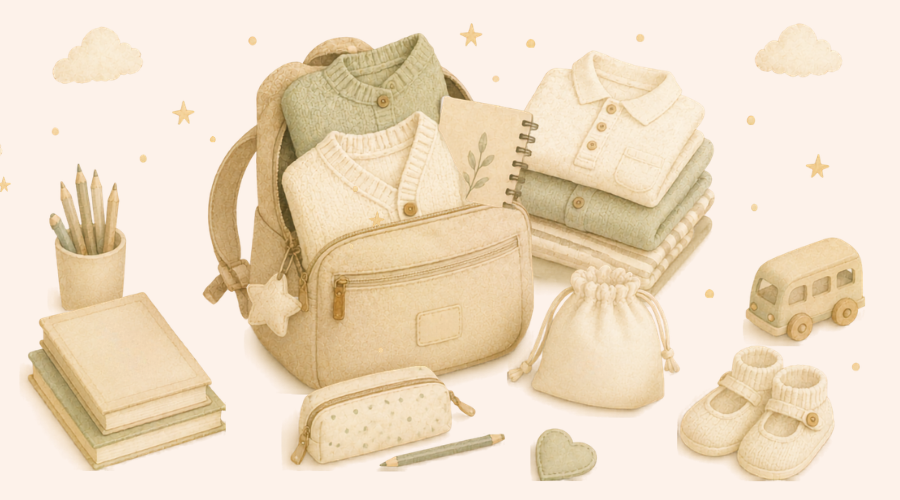
Going back to school marks the beginning of a new daily routine made up of lessons, games, outdoor activities and afternoons spent between sport and homework.
For parents, it also means organising the week’s outfits again and finding the right balance between practicality, comfort and temperature every morning.
In September and during the first months of autumn, the weather can change significantly throughout the same day: mornings may be cool, classrooms can warm up quickly and afternoons may become mild again.
To understand how to dress children for school, it is therefore not enough to choose one warm garment. It is more useful to create an outfit made up of lightweight layers that are easy to add or remove and suitable for the different activities of the day.
School clothing must accompany children for many hours and in a variety of situations.
Throughout the day, it should allow them to:
The first selection criterion should therefore be the genuine comfort of the garment.
An outfit can be neat and elegant without feeling restrictive. Simple lines, soft yarns and the correct fit make it possible to create combinations suitable both for ordinary school days and for more important school occasions.
Dressing children in layers is one of the most practical solutions during the back-to-school period.
This does not mean layering several heavy garments, but choosing a few pieces that can be managed easily throughout the day.
A simple combination may consist of:
When the classroom becomes warmer, the child can remove the cardigan. When going outside during break time, they can put it back on without having to change the entire outfit.
This approach is particularly useful between seasons, when a single heavy garment may be insufficient in the morning but excessive during the rest of the day.
The yarn affects the feeling of comfort, breathability and the way the garment accompanies the child throughout the day.
For school clothing, it is preferable to choose materials that are soft, pleasant against the skin and suitable for the temperature.
Cotton is a practical choice for the first weeks of school and for indoor spaces that are still warm.
It can be used for:
When temperatures vary, a cotton top can form the base layer over which a warmer knitted garment can be added.
Extrafine and Ultrafine Merino Wool is particularly suitable for children’s knitwear because it combines lightness, softness and the ability to help manage the microclimate between the skin and the fabric.
Wool absorbs and releases water vapour and helps maintain a more stable perceived temperature. This makes it useful on days when children move frequently between outdoor and indoor environments.
A Merino Wool cardigan or crew-neck jumper can therefore provide warmth without necessarily requiring heavy, bulky volumes.
However, it is always important to assess:
Not all wool jumpers have the same weight and they should not all be worn in the same way.
There is no need to fill the wardrobe with many similar items. A well-organised wardrobe can be created with a few versatile garments that are easy to combine and suitable for different moments of the day.
A crew-neck jumper is one of the easiest garments to wear for school.
It can be worn:
Simple styles in colours that are easy to coordinate make it possible to create several outfits without having to prepare completely different combinations every time.
A cardigan is particularly practical between seasons because it can be opened or removed easily.
It is useful when children enter a warmer classroom, while travelling and on days when the temperature changes rapidly.
A sleeveless jumper protects the torso while leaving the arms free.
It can be a useful solution on mild days or in heated environments, especially when paired with a long-sleeved top or polo shirt.
Compared with a sleeved garment, it provides greater freedom of movement and takes up little space in the school bag when removed.
A polo shirt offers a balance between practicality and a neat appearance.
It can be worn on its own at the beginning of autumn or used as a base layer under a cardigan, sleeveless jumper or knitted jacket.
It is suitable both for ordinary school days and for occasions when slightly smarter clothing is required.
School trousers and skirts should allow children to sit, run and move without difficulty.
It is important to check:
A fit that is too tight may restrict movement, while one that is excessively loose may feel uncomfortable or require constant adjustment.
A knitted jacket can complete an outfit on cooler days or for school plays, class photographs and special occasions.
For everyday use, it is preferable to choose a style that maintains a neat appearance without compromising softness or freedom of movement.
The garment must also leave enough room for the layers worn underneath.
A school wardrobe works best when the garments can be combined with one another.
You can begin with:
The quantities depend on how often clothes are washed, the child’s age and their activities. There is no single correct number for every family.
However, it is helpful to choose a coordinated colour palette made up of shades that can be combined easily.
Colours such as milk white, beige, grey, blue, light blue and soft pink can be alternated with one or two more distinctive shades. This makes preparing outfits easier, even on the busiest mornings.
When the temperature is pleasant, you can choose:
The additional layer makes it possible to manage changes in temperature without overdressing the child.
When the morning is cool but the afternoon is milder:
A cardigan is particularly useful because the child can manage it easily.
When temperatures fall:
Once inside the school, children should be able to remove their accessories and outerwear so that they do not remain excessively covered in heated rooms.
Children spend many hours at school. For this reason, fit should not be assessed only in front of the mirror.
Before choosing a garment, try to imagine whether the child will be able to:
Seams, cuffs and necklines should also feel comfortable.
The quality of a school garment becomes most apparent during everyday use: it should move with the child without immediately losing its shape or requiring constant adjustment.
Automatically buying one size larger is not always the best choice.
A garment that is excessively large may have:
When choosing the size, check:
When the child is close to the maximum limit of the size and the style has a slim fit, it may be appropriate to consider the next size.
With an oversized garment, however, there is no need to increase the size automatically.
For more information, read our dedicated guide on how to choose the right size for a child.
As children grow, they should be able to manage their own clothing with increasing independence.
Particularly practical options for school include:
For younger children, overly complicated fastenings and several layers that are difficult to remove may become an obstacle during the day.
A name label can also be useful for finding jumpers, cardigans and accessories left in the classroom or changing rooms.
On days dedicated to physical activity, it is preferable to choose garments that are particularly easy to manage.
The outfit should allow children to change independently and move without restriction.
Useful choices include:
Whenever possible, it is better to avoid clothing that requires constant adult assistance to put on or remove.
Practical clothing does not necessarily need to be visually plain. However, it is useful to avoid several recurring mistakes.
Layering several warm garments may make movement difficult and cause discomfort in heated environments.
A few carefully selected layers are better.
Buying a garment “so that it lasts longer” may completely alter its fit.
A small amount of growing room is useful, but the garment should fit correctly from the beginning.
An overly tight neckline, numerous buttons and complicated fastenings may make independent dressing more difficult.
The same outfit cannot be worn in exactly the same way in September and during the colder months.
The yarn, construction and number of layers should be adapted to the temperature.
School is a place where children write, paint, eat and play.
Garments should also be selected by considering the type of day and the likelihood that they will need to be washed frequently.
A functional wardrobe does not necessarily depend on the number of garments available.
A few coordinated items chosen according to the child’s genuine needs can provide many different combinations.
Before purchasing a new garment, it can be useful to ask:
These questions help avoid underused purchases and create a more balanced wardrobe.
Before preparing the outfit, check:
☐ The expected temperature throughout the day
☐ The temperature inside the school
☐ The planned activities
☐ The presence of a layer that is easy to remove
☐ Freedom of movement
☐ The correct fit
☐ The simplicity of the fastenings
☐ Whether the child can manage the garment independently
☐ Whether easily misplaced items are labelled with the child’s name
In September, it is helpful to dress children in layers. A lightweight top can be paired with a cardigan or crew-neck jumper that can be removed when the temperature rises. The outdoor jacket should be selected according to the weather that day.
Crew-neck jumpers, cardigans, sleeveless jumpers, polo shirts and comfortable trousers are easy to combine and suitable for different activities. It is important that children can manage them independently.
It is preferable to add a removable layer, such as a cardigan, rather than relying on a single very heavy garment. Once in the classroom, children can adapt their clothing to the indoor temperature.
It depends on the child’s age and habits. A cardigan is easier to open and remove, while a crew-neck jumper offers a simple and neat fit. Both can be useful in a school wardrobe.
An Extrafine or Ultrafine Merino Wool jumper can be suitable for cooler days because it provides warmth without excessive bulk and helps manage moisture and temperature changes. However, the weight and knitted construction should always be chosen according to the season.
Not necessarily. The next size may be useful when the child is close to the maximum limit or when the garment will be worn later. However, an excessive size may make the sleeves, shoulders and neckline look disproportionate.
There is no single number that applies to everyone. It depends on washing frequency, the season and family habits. It is more useful to choose several coordinated styles that will genuinely be worn than to buy many garments that are difficult to combine.
Choose lightweight, removable layers. Cardigans, sleeveless jumpers and jackets that are easy to open allow children to adapt their clothing without having to change their entire outfit.
Understanding how to dress children for school means considering the entire day, not only the morning temperature.
The ideal outfit should allow children to move, play, sit comfortably and manage the different layers independently. Versatile jumpers, cardigans, sleeveless jumpers and trousers help create a practical wardrobe in which garments are easy to coordinate.
During the back-to-school period, it is therefore preferable to choose a few well-designed garments that are suited to the season and able to support everyday life without compromising softness or attention to detail.
The quality of knitwear becomes most apparent in everyday use: in the movements it follows, the comfort it maintains and its ability to be worn at school, during leisure time and on special occasions. 🧶📚
Spedizione veloce e gratuita (>75€)
Filati naturali e pregiati
Design essenziale e senza tempo

Assistenza clienti online
Artigianalità made in Italy dal 1975
Resi facili e veloci