

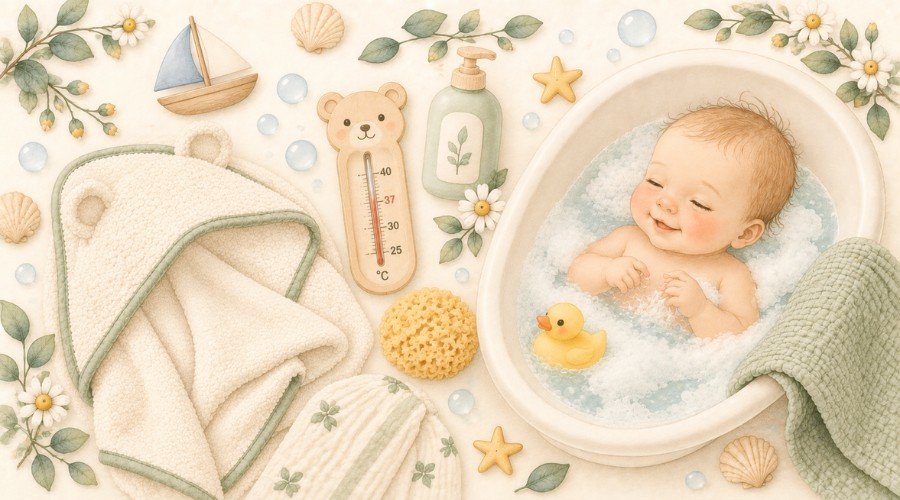
When temperatures rise, it is natural to wonder whether the temperature of a newborn’s bath in summer should also be adjusted.
Should the water be cooler?
Can a cold bath help when it is very hot outside?
Should babies be bathed more often?
The most important answer is simple: summer does not mean cold water.
As a practical reference, bath water can be kept at around 37–38 °C, close to body temperature. The Australian health service Pregnancy, Birth and Baby recommends precisely 37–38 °C for a newborn’s bath; the NHS also recommends warm, but not hot, water that feels close to body temperature.
On very hot days, the Italian Ministry of Health recommends baths or showers with lukewarm water, avoiding sudden changes in temperature.
So the key principle to remember is:
lukewarm, comfortable water: neither cold nor too hot.
Not necessarily.
When it is very hot, it is understandable to think: the cooler the water, the more relief the baby will feel.
But this is not a good general rule.
In its updated guidance on heatwaves, the Italian Ministry of Health recommends cooling babies and young children with lukewarm showers, avoiding sudden transitions between hot and cold.
So, on very hot days:
there is no need to use cold water;
avoid sudden changes in temperature;
choose lukewarm water;
adjust the room temperature as well;
avoid directing a fan or air conditioning directly at a wet baby.
Bath time can be pleasant and refreshing without becoming a cold bath.
The most accurate method is to use a bath thermometer.
Before placing the baby in the water, check that the temperature is within the desired range and mix the water thoroughly.
This is important because different areas of the bath may be:
warmer;
cooler;
unevenly mixed.
The NHS recommends filling the bath with cold water first and then adding hot water, mixing thoroughly to avoid areas that are particularly hot.
You can check the water with:
the inside of your wrist;
your elbow.
The water should feel pleasantly lukewarm, not hot.
Testing the water with your hand is less reliable because hands are accustomed to tolerating a wide range of temperatures.
A thermometer therefore remains the simplest solution when you want to check the temperature more precisely.
Before undressing the baby, prepare everything you will need.
For example:
baby bath;
water;
towel;
nappy;
clean clothes;
cleanser, when necessary;
gauze or a soft cloth, if needed.
This way, you will not need to move away while the baby is in the water.
The NHS and the American Academy of Pediatrics recommend having everything within reach precisely because a newborn should never be left alone in the bath, even for a moment.
Even a small amount of water can pose a risk.
During bath time, continuous and close supervision is essential.
If:
the phone rings;
someone knocks at the door;
you have forgotten a towel;
you need to retrieve an item;
the baby must be taken with you.
Do not rely on:
the baby bath itself;
a bath seat;
an older sibling;
an anti-slip support.
According to CDC data, for children under one year of age, the bathtub is one of the main places where drowning incidents occur in the home.
There is no need to fill it completely.
For a newborn’s first baths, the NHS recommends using a limited amount of water, sufficient to wash the baby while keeping the head and face out of the water at all times.
The amount should allow the adult to:
support the newborn securely;
control their position;
wash them easily;
keep the nose and mouth away from the water.
More water does not automatically make bath time more comfortable.
There is no compulsory duration.
Especially during the first few months, a short bath may be sufficient.
The American Academy of Pediatrics notes that very long baths may contribute to dry skin and recommends keeping them brief, particularly for dry skin.
There is therefore no need to prolong bath time with the aim of “cooling the baby down more”.
The bath can end when:
the baby seems uncomfortable;
the water begins to cool;
cleansing is complete;
the experience is no longer pleasant.
No, not necessarily.
Hot weather does not mean a newborn must automatically have a full bath every day.
According to the American Academy of Pediatrics, during the first year around three baths per week may be sufficient for many babies; bathing more frequently may contribute to dry skin.
Naturally, there may be situations when washing the baby more often is useful, for example after:
sweating;
regurgitation;
nappy changes;
being at the seaside;
other situations that leave the skin dirty.
The Italian Ministry of Health recommends refreshing babies and young children with lukewarm water, avoiding sudden temperature changes.
It is also important to:
keep the environment cool;
reduce clothing layers;
follow age-appropriate feeding and hydration guidance;
avoid exposure to intense heat.
If the baby has a fever, marked drowsiness, difficulty waking, changes in behaviour or other concerning symptoms, do not rely on bath time: contact your paediatrician or healthcare service.
No, during the very first weeks, water alone may be sufficient.
The NHS states that during the first month plain water is generally sufficient and liquid cleansers do not need to be used at every bath.
When a cleansing product is used, it is preferable to choose one that is:
specifically formulated for babies;
gentle;
used in a small amount.
There is no need to use more soap simply because the baby has been sweating. Very frequent washing and aggressive products may contribute to dryness and irritation. If the baby has eczema, dermatitis or another skin condition, follow the advice of your paediatrician or dermatologist.
At the end of the bath, have an open towel ready beside the baby bath.
Lift the newborn while supporting the head, neck and body.
Wrap the baby immediately and dry them by gently patting, without rubbing.
Pay particular attention to skin folds:
neck;
armpits;
groin;
behind the ears;
folds of the legs.
The NHS specifically recommends drying skin folds carefully after bathing.
There is no single compulsory garment.
The choice depends on:
room temperature;
humidity;
time of day;
air conditioning;
age;
whether the baby will sleep afterwards.
On a very hot day, one lightweight garment may be sufficient.
In milder conditions, a different layer may be needed.
The important point is to avoid thinking: “the baby has just come out of the water, so I need to cover them heavily”.
Once dry, the newborn should be dressed according to the actual temperature, not simply because they have just had a bath.
To choose the first layer during warmer months, read our guide to summer bodysuits for newborns.
In summer, the problem may not be the heat itself, but the sudden transition between very different environments.
For example:
a warm bathroom;
a heavily air-conditioned room;
direct airflow from the air conditioner;
a fan pointing towards the changing table.
The Italian Ministry of Health recommends avoiding major temperature differences and not setting indoor environments excessively cold compared with outdoors.
During and immediately after bath time:
do not direct cold air straight at the baby;
dry the baby before moving them;
avoid sudden temperature changes;
adapt clothing to the environment where the baby will remain.
There is no need, however, to make the room very warm; it simply needs to be comfortable.
There is no universally correct time. It may be useful to choose a moment when the baby is:
calm;
awake;
not hungry;
not immediately after a feed;
not particularly tired.
The NHS recommends avoiding bath time immediately after a feed or when the baby is hungry or tired.
In summer, it may also be more pleasant to choose a time when the room is not particularly hot.
Hot weather outside does not mean bath water should be cold.
It increases the risk of burns and may irritate the skin.
It is better to use a thermometer or your wrist/elbow.
Warmer areas may remain in the bath.
This is the behaviour that should be avoided most carefully.
Everything should already be within reach.
It is not necessary.
The amount of cleanser does not automatically need to increase during summer.
Once dry, the baby should be dressed according to the room temperature.
These are situations with different conditions and risks.
As a practical reference, water can be kept at around 37–38 °C, close to body temperature.
Not necessarily. During hot weather, lukewarm water is preferable, avoiding sudden temperature changes.
There is no need to use cold water. To refresh babies and young children during heatwaves, the Italian Ministry of Health recommends lukewarm water.
You can use the inside of your wrist or your elbow: the water should feel lukewarm and comfortable, not hot.
Not necessarily. The AAP indicates that for many babies, around three baths per week may be sufficient during the first year. Frequency can be adapted to individual needs.
There is no compulsory duration. During the first few months it can be brief; excessively long baths may contribute to dry skin.
No. During the first weeks, water alone may be sufficient; the NHS states that during the first month routine use of liquid cleansers is not necessary.
No. A baby should never be left alone, even for a few seconds. Prepare everything before you begin.
Pat gently and carefully dry the skin folds, avoiding vigorous rubbing.
No. Once dry, the baby should be dressed according to the actual room temperature.
It is preferable to avoid the period immediately after feeding and choose a time when the baby is calm, not hungry and not overly tired.
The temperature of a newborn’s bath in summer does not need to change drastically simply because it is hot outside.
As a practical reference: around 37–38 °C, with lukewarm and comfortable water.
During very hot days, there is no need to use cold water: the Italian Ministry of Health also recommends refreshing babies and young children with lukewarm water while avoiding sudden changes in temperature.
Simple and important rules:
check the water before placing the baby in it;
prepare everything in advance;
maintain continuous supervision;
avoid excessively hot or cold baths;
dry the baby gently;
adapt clothing afterwards to the actual temperature.
Bath time should remain a simple and pleasant moment, not a procedure for rapidly cooling the baby during hot weather.
After bath time, choose the layers according to the room temperature. Discover our selection of newborn clothing in natural fibres.
Spedizione veloce e gratuita (>75€)
Filati naturali e pregiati
Design essenziale e senza tempo
Assistenza clienti online
Artigianalità made in Italy dal 1975
Resi facili e veloci


