

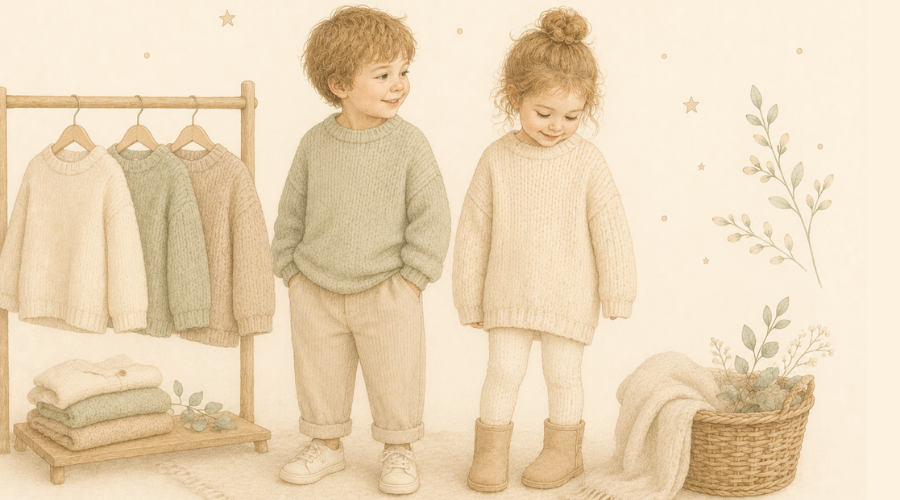
Soft, comfortable and characterised by relaxed proportions, an oversized jumper for children can be worn for school, leisure time and more informal occasions.
Its defining feature is not simply that it is wider. A true oversized design is created from the outset with precise proportions:
softer or slightly dropped shoulders;
a wider body;
relaxed sleeves;
a length designed according to the style;
hem and cuffs proportioned to the overall volume;
greater freedom of movement.
To wear it correctly, it is therefore not necessary to automatically buy a larger size.
The key distinction is this:
An oversized garment is designed with generous proportions. A garment that is too large is simply the wrong size.
Choosing the correct size allows the jumper to maintain the line it was designed with, without creating excessively long sleeves, an overly wide neckline or impractical proportions.
The term oversized describes an intentionally wide and relaxed fit.
The garment does not closely follow the body but creates softer volume than a regular or slim-fit style.
This does not mean that every part of the garment should be oversized. Even an oversized jumper should maintain balance between:
body width;
shoulder position;
sleeve length;
neckline depth;
hem stability;
freedom of movement.
A well-proportioned style may have dropped shoulders and a wide body, but it should still allow the child to use their hands, wear a jacket and move without constantly having to adjust the sleeves.
Buying one size larger does not automatically turn a regular jumper into an oversized garment.
A jumper that is simply too large may have:
an excessively wide neckline;
shoulders sitting in the wrong position;
sleeves that are too long;
a hem that falls below the intended proportion;
uneven bulk under the arms;
difficulty fitting a jacket over it;
fabric bunching during movement.
An oversized design, on the other hand, is constructed so that the extra volume looks intentional and balanced.
Shoulders, armholes, length and cuffs are designed to work together. For this reason, it is generally preferable to choose the size that corresponds to the child’s measurements, always checking the information provided on the product page.
An oversized fit can be particularly practical for everyday wear.
An oversized jumper:
allows freedom of movement;
makes it possible to wear a lightweight layer underneath;
creates an informal but polished outfit;
can be paired with trousers, skirts and leggings;
works for both school and leisure time;
offers comfort without clinging to the body;
can suit different body shapes.
Comfort, however, depends on the garment being correctly proportioned. Excessive volume can become just as uncomfortable as a jumper that is too tight.
Once worn, check that the jumper maintains a generous line without restricting movement.
In oversized styles, the shoulder seam may sit beyond the natural shoulder line.
However, it should remain proportionate to the design and should not create excessive fabric build-up under the arm.
The sleeves can be soft and slightly generous, but the cuffs should allow the child to use their hands freely.
If the sleeves completely cover the fingers or constantly need to be rolled up, the size may be too large.
The neckline should remain stable.
It should not:
slip off one shoulder;
leave the chest excessively exposed;
create overly wide openings;
make it difficult to wear a layer underneath.
The body should look evenly wide, without pulling and without bunching excessively when the child sits down.
The length depends on the design.
Some oversized jumpers finish just below the waist, while others have a longer silhouette. In both cases, the garment should allow the child to walk, sit and play comfortably.
When a style is described as oversized or over, it is generally not necessary to buy one size larger to achieve the intended effect.
Before purchasing, check:
the child’s height;
chest circumference;
the stated garment length;
the fit described on the product page;
the season in which it will be worn;
what will be worn underneath;
sleeve proportions;
when the jumper will actually be used.
If the child is close to the upper limit of a size, you can consider the next size depending on when the garment will be worn.
I would not, however, size up simply to create more volume: the garment is already designed with a generous fit.
For more information, read our guide on how to choose the right size for babies and children.
The layer underneath should be chosen according to the temperature, yarn and knitted construction of the jumper.
You can pair it with:
a lightweight long-sleeved top;
a cotton T-shirt;
a lightweight polo shirt;
a shirt;
a lightweight mock-neck top;
a suitable thermal base layer;
a bodysuit for sizes intended for younger children.
It is preferable to avoid another very bulky knitted layer underneath, especially when the oversized jumper already has a wide armhole.
Too many layers can create:
bulk around the shoulders;
folds under the arms;
excessive warmth;
difficulty putting on a coat;
less freedom of movement.
A lightweight layer instead allows the jumper to maintain its intended shape.
Outfit proportions are important.
Because the upper part already has generous volume, trousers, skirts and accessories should create a balanced overall look.
Regular-fit trousers are one of the simplest combinations.
They can be:
knitted;
cotton;
with an elasticated waist;
straight-leg;
slightly tapered;
in a coordinating colour.
The cleaner trouser line balances the jumper’s volume without making the outfit overly fitted.
For girls, leggings can create a stronger contrast with the wider upper half.
It is a practical combination for:
school;
leisure time;
days spent at home;
activities that require freedom of movement.
The jumper should, however, have an appropriate length, and the leggings should be made from a comfortable fabric that is not excessively thin.
An oversized jumper and wide-leg trousers can be paired together, but greater attention should be paid to proportions.
To avoid an excessively bulky effect, you can choose:
a jumper that is not too long;
wide-leg trousers with a clearly defined waist;
coordinating colours;
constructions that are not too heavy;
only one particularly structured element.
The aim is not to remove volume, but to distribute it in a balanced way.
An oversized jumper can be paired with:
a straight skirt;
an A-line skirt;
a knitted skirt;
a pleated skirt;
a short skirt with tights.
It can be left loose or lightly tucked into the front of the skirt when the style and the child’s age make this practical.
For everyday wear, choose skirts that allow the child to sit, run and move freely.
A shirt worn under the jumper adds a more polished detail.
You can leave visible:
the collar;
the hem of the shirt;
the cuffs, provided they do not create too much bulk.
This combination works well for school, parties and occasions when you want a more polished outfit without giving up the softness of knitwear.
The outer layer should have enough room to accommodate the volume of the jumper.
A jacket that is too fitted may:
compress the sleeves;
create folds;
restrict movement;
feel uncomfortable around the shoulders.
When the oversized jumper is worn under a coat, check that the armholes and overall width of the outer layer are suitable.
An oversized jumper can work well for school when it maintains practical proportions and does not limit independence.
For a school outfit, you can pair it with:
elasticated-waist trousers;
leggings;
a soft skirt;
a T-shirt or lightweight polo;
comfortable shoes;
a sufficiently roomy jacket.
Before choosing it, check that the child can:
write without the cuffs covering the hands;
wear a backpack;
take the jumper off independently;
sit comfortably;
take part in break-time activities;
use the bathroom without difficulty;
put the garment into a backpack when needed.
For school, I would avoid styles with excessively long sleeves, bulky decorations or constructions that could catch easily.
You can explore this topic further in our guide to how to dress children for school.
During leisure time, an oversized fit makes it easy to create simple and comfortable outfits.
It can be paired with:
soft trousers;
leggings;
a knitted skirt;
denim;
straight-leg trousers;
trainers;
ankle boots in winter.
For outdoor play, it is important that the hem is not excessively long and that the sleeves remain correctly positioned.
The child should be able to run, climb and move their arms freely.
A generous fit is not necessarily only informal.
Yarn, colour and construction can also make an oversized jumper suitable for a party or a more polished occasion.
You can pair it with:
a collared shirt;
more structured trousers;
an A-line skirt;
tights;
a knitted coat;
coordinating accessories.
A plain-coloured style made from a fine yarn with a clean construction can create an elegant result while maintaining a soft silhouette.
An oversized fit can be interpreted with different yarns. The choice should depend on the season and intended use.
Extrafine Merino Wool is suitable for cooler months and can be used to create soft, comfortable knitwear that provides warmth without necessarily requiring excessive thickness.
It is suitable for:
autumn;
winter;
early spring;
school;
leisure time;
layered outfits.
Weight still depends on construction. Stockinette stitch will behave differently from cables, ribbing or more structured patterns.
Ultrafine Merino Wool can be used to create finer, more refined garments.
It can be useful when you want:
a wide but lightweight fit;
less bulk under a coat;
a garment suitable for heated indoor environments;
a jumper to layer over a shirt;
a soft, fluid silhouette.
Even an Ultrafine style should be chosen according to the temperature and the layers worn underneath.
Cotton is particularly suitable for:
transitional seasons;
mild days;
indoor environments;
spring;
lightweight outfits.
An oversized cotton jumper can be paired with a T-shirt or lightweight shirt, avoiding an overall look that feels too heavy.
Cashmere can be used to create lightweight, soft and warm knitwear.
With an oversized fit, it can create a particularly comfortable garment, provided the correct size is chosen so that the silhouette is not distorted and unnecessary volume is not added.
Yarn quality does not remove the need to check fit, temperature and intended use.
Colour changes the way volume is perceived.
Dark, uniform shades can make the silhouette appear more compact, while light colours and three-dimensional textures emphasise the width of the garment more strongly.
For an easy-to-style outfit, you can choose:
milk white;
beige;
rope;
grey;
blue;
light blue;
powder pink;
sage;
pearl.
A stronger colour can become the focal point of the outfit, while trousers, skirt and accessories remain neutral.
Combining similar shades creates a harmonious look:
milk white and beige;
blue and light blue;
powder pink and pearl;
sage and rope;
light grey and anthracite.
An oversized style should be wide, but it should not look as though it was bought several sizes too large.
It may be excessive when:
the hands completely disappear inside the sleeves;
the neckline slips;
the shoulders drop too far;
the hem restricts movement;
the child cannot comfortably wear a jacket over it;
the jumper constantly twists around the body;
fabric bunches under the arms;
the weight of the garment pulls the silhouette downwards.
In these cases, it may be better to consider the previous size or a style with less pronounced volume.
Even an oversized garment can become too small.
Check whether:
the sleeves look short;
the hem rides up during movement;
the body loses its generous shape;
the armhole pulls;
the neckline feels tight;
the shoulders no longer sit in the intended position;
the child finds it difficult to raise their arms.
When the oversized line disappears and the garment begins to cling to the body, it may be time to move up to the next size.
The style is already designed with generous proportions.
A larger size can make the sleeves, neckline and length disproportionate.
A relaxed fit does not mean that proportions can be random.
The garment should maintain precise construction and a balanced silhouette.
A thick jumper underneath an already voluminous design can create excessive bulk.
It is better to choose a lightweight layer suited to the temperature.
The jumper may become compressed at the shoulders and under the arms.
The outer garment should comfortably accommodate the volume of the knitwear.
Sleeves that cover the hands can interfere with writing, playing and everyday activities.
A stockinette oversized jumper and one with large cables will not create the same amount of volume.
Yarn and structure should be considered together with size.
An oversized jumper, very wide trousers, a bulky scarf and a structured coat can create an impractical outfit.
It is preferable to choose one or two statement elements and keep the rest more essential.
The generous fit requires particular care during washing and drying because the weight of water can distort the garment.
Always check the specific care label.
In general:
use a detergent suitable for the yarn;
choose a delicate programme when permitted;
avoid high temperatures;
do not wring the garment;
do not leave it wet inside the washing machine;
support it correctly when moving it;
dry it flat when indicated;
gently reshape shoulders, sleeves and hem;
do not hang it while still damp;
store it only when completely dry.
While drying, it is important to return the jumper to its original proportions without stretching the knitted fabric excessively.
Before purchasing, check:
☐ Is the style actually described as oversized or over?
☐ Have I checked the child’s height and measurements?
☐ Have I read the fit information on the product page?
☐ Will the sleeves leave the hands free?
☐ Will the garment be worn immediately or in a few months?
☐ What will be worn underneath?
☐ Can the jacket accommodate the volume of the jumper?
☐ Is the yarn suitable for the season?
☐ Does the knitted construction add even more volume?
☐ Does the colour work with the garments already in the wardrobe?
It means that the garment has been designed with wider proportions than a regular fit. It may feature dropped shoulders, a soft body and relaxed sleeves while still maintaining precise proportions.
Generally no. The garment is already designed with a generous fit. It is preferable to follow the child’s measurements and the information provided on the product page.
An oversized style is designed with generous but balanced proportions. A garment that is too large instead has a neckline, sleeves, shoulders and length that do not fit the child correctly.
You can choose a T-shirt, long-sleeved top, polo shirt, shirt or lightweight mock-neck. It is preferable to avoid overly bulky layers.
It can be paired with leggings, regular-fit trousers, skirts, tights or denim. The lower half should balance the volume of the jumper while still allowing freedom of movement.
It can be worn with straight-leg, soft or slightly tapered trousers. Underneath, you can add a T-shirt, polo shirt or shirt.
Yes, when the sleeves and length do not interfere with writing, play or independence. It should also fit comfortably under a jacket.
It can be, provided the size is correct and the volume does not interfere with movement. For younger children, it is particularly important to check sleeve length, neckline and overall length.
Extrafine Merino Wool, Ultrafine Merino Wool and Cashmere can all be suitable for the colder season. The choice also depends on construction, garment weight and the layers worn underneath.
The sleeves should not completely cover the hands, the neckline should not slip and the volume should not prevent the child from moving or wearing a jacket.
Choosing an oversized jumper for children does not mean buying a larger size.
An oversized fit comes from carefully designed proportions: a wide body, relaxed shoulders, soft sleeves and a silhouette that allows freedom of movement without becoming excessive.
The correct size allows the garment to maintain its balance and accompany the child at school, during leisure time and on more polished occasions.
To create a harmonious outfit, it is also important to consider what is worn underneath, the volume of the lower half, the yarn and the construction. A jumper with large cables will require different styling from a lightweight stockinette design.
True comfort does not come from choosing a generously sized garment, but from selecting a piece designed to be wide while still respecting the child’s measurements.
When volume, yarn and proportions work together, an oversized jumper becomes a versatile, practical garment that naturally accommodates movement. 🤍🧶
Spedizione veloce e gratuita (>75€)
Filati naturali e pregiati
Design essenziale e senza tempo

Assistenza clienti online
Artigianalità made in Italy dal 1975
Resi facili e veloci