

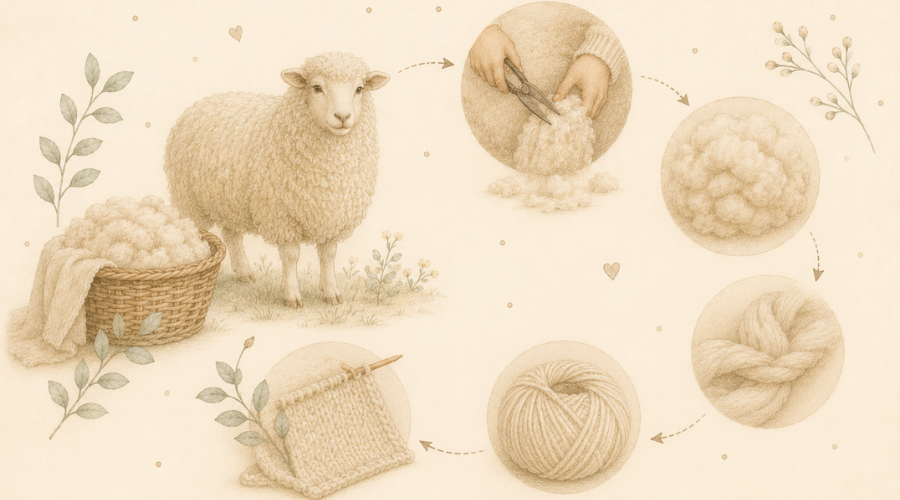
When we touch a soft jumper or wrap a newborn in a Merino Wool blanket, we are only seeing the final result of a much longer journey.
Before becoming a garment, wool is a raw fibre that covers the sheep’s body. It must be collected, sorted, washed and processed through several stages, each of which helps determine the characteristics of the final yarn.
But how is wool made? Where exactly does it come from, and what transformations does it undergo before reaching a knitwear factory?
The process can be summarised in the following stages:
Each stage requires different expertise. Final quality depends not only on the animal from which the fibre comes, but also on its fineness, length, strength and all the processes that follow.
Wool is a natural textile fibre of animal origin, obtained mainly from the fleece of sheep and lambs.
Structurally, it is composed mainly of keratin, a fibrous protein also found in hair and nails. The surface of the fibre is made up of small overlapping scales, while the inner part consists mainly of the cortex.
Wool also has a natural waviness known as crimp, which helps create air spaces between the fibres and influences the material’s volume, elasticity and insulating properties.
It is important to distinguish the fibre from the yarn:
Wool in the strict sense comes from the fleece of sheep belonging to the species Ovis aries.
There are many sheep breeds, and each can produce fibres with different characteristics in terms of:
Geographical origin, climate, diet, age of the animal and farming practices can also influence the characteristics of the fleece. For this reason, there is no single type of wool: some fibres are very fine and suitable for garments worn close to the skin, while stronger fibres may be used for blankets, upholstery and home textiles.
Among the best-known breeds is the Merino sheep, valued for its ability to produce particularly fine fibres.
The word “Merino”, however, does not by itself describe the full quality of the yarn. To assess it, the average fibre diameter, length, uniformity and type of processing should also be considered.
The fleece is the layer of fibres covering the sheep’s body.
It is not completely uniform. Even within the same animal, there may be differences in fineness, length, cleanliness and fibre strength.
Fibres from different areas of the body can therefore be separated and intended for different uses.
It is not correct, however, to establish a universal map according to which one part of the body is always “better” and another necessarily lower quality. Assessment varies according to the breed, the individual animal and the characteristics of each batch.
For this reason, after shearing, the wool is carefully sorted and graded.
The first stage of collection is shearing, meaning the removal of the fleece from the sheep’s body.
It is carried out by trained shearers using specific tools and techniques designed to work with respect for the animal while preserving the integrity of the fibres as much as possible.
When the technique allows, the main fleece is removed in one large piece. It is then spread out and passed to the people responsible for sorting.
In some respects, shearing can be compared with cutting hair: the fibre grows back and can be collected again. It is precisely the fleece’s ability to regenerate that makes wool a naturally renewable fibre.
The frequency and timing of shearing may vary according to:
Not all sheep are therefore shorn at the same time or using identical methods.
Fibre quality cannot be separated from the conditions in which the animals live.
Responsible management should consider:
International sheep-welfare guidelines recognise that practices should be adapted to breeds, production systems and the climatic conditions of different countries.
For a company purchasing yarns, supplier traceability and documentation are therefore important not only for understanding the technical characteristics of the fibre, but also its origin and the path it has followed through the supply chain.
After shearing, the fleece is opened out and inspected.
At this stage, parts with different characteristics or containing a greater amount of impurities are separated.
Grading may consider:
Wool is a natural material, so every batch can vary. For this reason, lots are analysed through specific tests that measure parameters such as micron count, length, staple strength, colour and the amount of vegetable matter.
Fibres with similar characteristics are grouped together to create batches that are as homogeneous as possible and suited to the intended processing.
Micron count indicates the average diameter of the fibres.
One micron, or micrometre, equals one millionth of a metre.
Diameter has an important influence on how the material feels against the skin and on its intended use. Fine wools are often used for soft garments that can be worn directly against the body; coarser fibres may be preferred where more structure and strength are required.
Micron count, however, is not the only parameter to consider.
Freshly shorn wool is not yet ready to be spun.
Raw fleece may contain:
For this reason, it undergoes industrial washing, also known as scouring.
The wool passes through tanks containing water and detergents under controlled conditions to remove grease and dirt without damaging the fibres. After washing, it is rinsed, dried and prepared for the following stages.
The process must be carefully controlled. Incorrect temperatures, movement or treatments could encourage:
Part of the fatty substances removed during washing can be recovered and refined to obtain lanolin, which is used in various industrial and cosmetic applications.
The washed wool, meanwhile, continues its journey as a mass of loose, clean but still disorganised fibres.
After washing, the fibres may remain gathered in small tufts and tangled together.
Carding serves to:
During the process, the wool passes through cylinders covered with fine metal teeth that progressively comb and distribute the fibres.
The result is a more homogeneous web, which is then condensed into slivers or rovings for the following stages.
Carding is a fundamental stage in both woollen and worsted systems, but the process that follows is different.
After carding, wool can mainly follow two processing systems:
These are not two absolute levels of quality, but two methods that produce yarns with different appearances and behaviour.
In the woollen system, the fibres remain less parallel and may also include shorter lengths.
The resulting yarn generally tends to be:
It is often used for knitwear with a warm, enveloping and full appearance.
Discover more about Woollen-Spun Wool.
In the worsted system, after carding, the fibres are aligned further.
Combing helps to:
Worsted yarn therefore tends to be:
The worsted system generally uses longer fibres, while the woollen system can also make effective use of shorter fibres.
Discover more about Worsted Wool.
The choice between woollen and worsted depends on the desired result.
A soft and voluminous yarn is not necessarily better than a smooth and fine one, and vice versa. They are materials designed for different garments, constructions and sensations.
Once cleaned and prepared, the fibres are transformed into a continuous thread through spinning.
During this stage, they are:
Twist holds the fibres together and gives the yarn characteristics such as:
The amount and direction of twist can significantly change how the yarn behaves.
A higher level of twist may produce a more compact and defined yarn; a different twist, together with the fibre type and spinning system, can create a softer and more voluminous result.
Spinning must therefore be designed according to the final use: a blanket, a lightweight romper and a knitted coat do not necessarily require the same type of yarn.
The first yarn produced can be used on its own or combined with other yarns.
When two or more strands are twisted together, a plied yarn is created.
This can influence:
For this reason, even with the same fibre composition, two yarns can create very different knitted fabrics.
Wool can be dyed at different stages of the production process.
Colouring can take place:
The choice depends on the desired result, the quantity to be produced and the type of processing.
Dyeing the fibres before spinning, for example, makes it possible to blend different shades and create mélange effects. Yarn dyeing allows uniform colours to be prepared for direct use on knitting machines. Garment dyeing offers other aesthetic and production possibilities.
This stage also requires precise controls to achieve:
Only after all these stages is the yarn ready to enter the knitwear factory. This is where our real work begins.
It is here that the fibre, now transformed into yarn, begins to take the form of:
The yarn is worked on knitting machines set according to:
Gauge indicates the number of needles within a given measurement of the machine and influences the thickness of the knitted fabric.
In simplified terms:
The same fibre can therefore produce a very lightweight garment or a fuller, more structured knitted fabric depending on the yarn and machine used.
Depending on the production system, knitwear can be made from shaped pieces that are subsequently assembled, or using technologies that construct the garment with fewer seams.
This is followed by processes such as:
It is during these stages that the yarn is definitively transformed into a garment designed to be worn.
Talking generically about “high-quality wool” is not enough.
Quality should be assessed in relation to the intended use.
Among the most important factors are:
It influences the feel against the skin and whether the garment can be worn directly against the body.
Long, regular fibres can be particularly suitable for worsted spinning. Shorter fibres may instead be used very effectively in the woollen system.
A fibre must withstand processing without breaking excessively.
Consistency of diameter and length contributes to producing more regular yarns.
A light and uniform base generally allows greater freedom during dyeing.
The amount of fibre that can actually be used after removing grease, dust and vegetable matter influences the value and intended use of the batch.
Woollen and worsted systems produce different results and should be chosen according to the garment being made.
They determine thickness, strength, compactness and definition.
Even the best yarn must be worked correctly. Tension, stitch, shaping, washing and finishing all influence the final result.
There is therefore no universally “best” wool: there is the fibre best suited to a specific use.
In everyday language, many animal fibres tend to be grouped under the term “wool”.
Their origins, however, are different:
| Fibre | Animal of Origin |
|---|---|
| Wool | Fleece of sheep or lamb |
| Cashmere | Undercoat of the Cashmere goat |
| Mohair | Hair of the Angora goat |
| Angora | Hair of the Angora rabbit |
| Alpaca | Alpaca fibre |
| Llama | Llama fibre |
| Vicuña | Vicuña fibre |
European regulations distinguish these names and associate each fibre with its animal of origin.
It is therefore more accurate to speak of animal fibres when grouping them together in one category.
Cashmere, alpaca and mohair are not types of sheep wool, even though commercial language may include expressions such as “Cashmere wool” or “alpaca wool”.
Here we explore the difference between Wool and Cashmere. Read the Blog.
Merino Wool comes from sheep belonging to the Merino breed.
It is known above all for the fineness of its fibres, which makes it suitable for yarns intended even for garments worn close to the skin.
This does not mean that all Merino Wool is identical.
There may be differences in:
micron count;
length;
uniformity;
origin;
spinning system;
number of plies;
twist;
treatment;
construction.
The terms Extrafine, Ultrafine or other classifications should be interpreted together with the technical data of the yarn, rather than simply as marketing expressions.
To learn more about this fibre, read our guide to Merino Wool: characteristics and properties.
The term Pure Virgin Wool does not mean that the fibre has not been washed, dyed or processed.
The word “virgin” indicates that the wool has not previously been incorporated into a finished product and then recovered for reuse.
The words “100%”, “pure” or “all”, on the other hand, are reserved under European regulations for products composed of a single textile fibre, subject to the permitted technical tolerances.
In short:
This topic deserves a separate explanation, because reading the label correctly helps you truly understand what you are buying.
Two garments both labelled “100% wool” can have a very different hand feel, weight and appearance.
There can be many reasons:
sheep breed;
fibre diameter;
length;
carding or combing;
yarn count;
number of plied strands;
twist;
treatment;
machine gauge;
stitch used;
density;
washing;
finishing.
A lightweight, compact crew-neck jumper in worsted Merino Wool will not have the same surface as a voluminous jumper made from woollen-spun yarn, even when both are labelled as entirely wool.
The percentage shown on the label is therefore essential, but it does not tell the entire story of the material.
The transformation of wool involves many different professionals:
Each stage adds knowledge and helps transform a natural fibre into a precise, regular material suitable for production.
When we look at a finished garment, we are seeing the result of this collective work: from raising the sheep to selecting the yarn and carrying out the final product inspection.
Wool begins as a fibre. It becomes yarn only after it has been cleaned, prepared and spun.
Cashmere, alpaca, mohair and angora come from different animals and have their own specific fibre names.
Fineness, length and strength can vary even within the same fleece.
Diameter is important, but it should be considered together with length, strength, uniformity, spinning and construction.
Woollen and worsted are two different systems. The first can create voluminous and soft yarns; the second smoother and more regular yarns.
Virgin wool can be washed, dyed, spun and finished. The term refers to the previous use of the fibre, not to the absence of processing.
The phrase “100% wool” indicates composition, but on its own does not describe fineness, spinning, construction or garment fit.
Wool in the strict sense comes from the fleece of sheep and lambs. Cashmere, mohair, angora and alpaca are different animal fibres, obtained respectively from goats, rabbits and camelids.
When carried out by trained professionals using correct techniques, shearing removes the fleece in a way comparable in some respects to cutting hair. Management should respect the animal’s health, behaviour and welfare.
Freshly shorn fleece contains natural grease, dust, soil, perspiration and vegetable matter. Washing removes much of these impurities and prepares the fibre for subsequent processing.
In woollen-spun yarn, the fibres remain less aligned and the yarn is generally more voluminous and soft. In the worsted system, the fibres are made more parallel and shorter fibres are removed, producing a smoother and more regular yarn.
A micron is the unit used to measure fibre diameter. It equals one millionth of a metre. A lower value indicates a finer fibre.
Both are possible. Dyeing can take place on the fibre, combed top, yarn, knitted fabric or finished garment depending on the desired result.
In everyday language it is often referred to as wool, but technically Cashmere is the undercoat of the Cashmere goat. Wool in the strict sense comes from sheep.
It indicates wool that has not previously been used in a finished product and then recovered. “Pure” or “100%” instead means that the product is composed of a single textile fibre.
It depends mainly on fibre diameter and uniformity, but also on length, spinning, twist, stitch and garment finishing.
No. It can vary in micron count, length, origin, spinning system, twist, construction and treatment.
Understanding how wool is made means looking beyond the finished garment.
Everything begins with the sheep’s fleece, a natural material whose fibres can vary in fineness, length, colour and strength. After shearing, the wool is sorted, analysed, washed and prepared through carding and, where required, combing.
Only through spinning do the individual fibres become a continuous yarn, ready to be dyed and worked into knitwear.
At that point, shaping, stitches, assembly, washing, finishing and quality control come into play: the stages that transform the yarn into a romper, blanket, cardigan or jumper.
Every wool garment therefore contains a long chain of expertise. Understanding it helps explain why composition, origin and micron count are important, but also why they cannot be assessed separately from the way the yarn is processed.
From fleece to finished garment, wool changes form many times. What remains is its natural origin and the expertise required to transform it into knitwear designed to accompany us over time. 🧶🤍
Spedizione veloce e gratuita (>75€)
Filati naturali e pregiati
Design essenziale e senza tempo

Assistenza clienti online
Artigianalità made in Italy dal 1975
Resi facili e veloci