

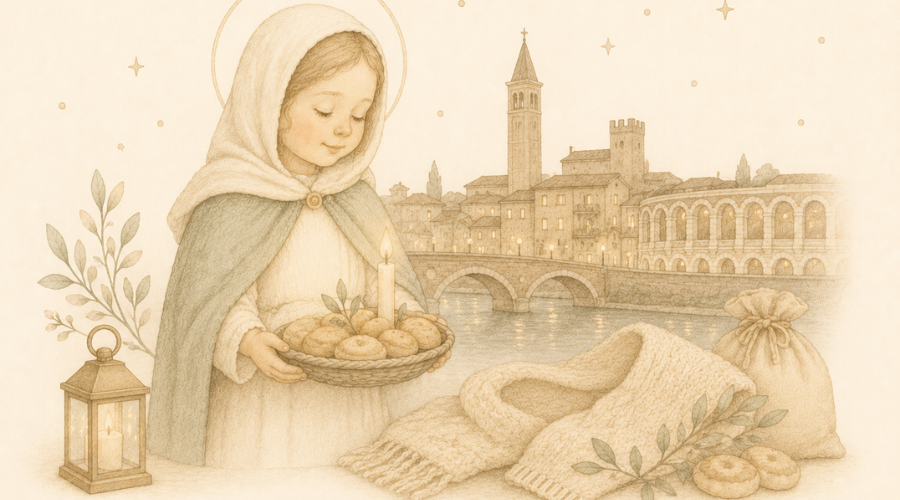
There are nights that, when you are a child, seem as though they will never arrive.
In Verona, one of these is certainly the night between 12 and 13 December, when homes prepare to welcome Saint Lucy, her helper Gastaldo and, of course, her little donkey.
For many families in Verona, Saint Lucy is one of the most exciting moments of the festive season. In the days leading up to it, children write their letters, look at shop windows and stroll among the traditional stalls in Piazza Bra. On the evening of 12 December, they prepare something to eat and drink for their long-awaited visitors before going to bed, hoping to wake up to sweets and presents.
The tradition of Saint Lucy in Verona is made up of anticipation, small family rituals and memories passed down from one generation to the next. To truly understand its meaning, however, we need to go back many centuries.
Saint Lucy was a young Christian woman born in Syracuse at the end of the 3rd century. According to religious tradition, she was martyred during the persecutions under Emperor Diocletian and died on 13 December 304.
Over the centuries, she became a symbol of light and the patron saint of eyesight. Her name is traditionally associated with the Latin word lux, meaning “light”, and she has long been invoked for the protection of the eyes.
Devotion to Saint Lucy spread across many parts of Italy and Europe, giving rise to different customs. In Verona, however, her feast day took on a particular significance, deeply connected with children and family life.
According to popular legend, the origins of the Veronese tradition date back to the 13th century.
It is said that a serious epidemic affecting the eyes spread through the city at that time, particularly among children. The population is said to have asked for Saint Lucy’s intercession by organising a pilgrimage to the Church of Sant’Agnese, which once stood in Piazza Bra and was later demolished in 1837.
Because of the cold weather, the children were apparently reluctant to take part. To persuade them, their parents promised that Saint Lucy would leave sweets and gifts for them upon their return from the pilgrimage.
This story is said to have given rise to the custom of waiting for presents during the night between 12 and 13 December. It is important to remember that this is a legend passed down through popular tradition, rather than an event documented historically in every detail.
On the evening of 12 December, the real ritual of anticipation begins in homes across Verona.
Every family has its own customs, but traditionally children prepare something to refresh Saint Lucy and her companions during their long night-time journey.
On the table, there may be:
Tradition says that children should go to bed early without trying to catch Saint Lucy arriving.
In the morning, the food has disappeared and sweets, treats and gifts have appeared in its place. In some homes, small traces of the donkey’s visit are also left behind, making the story feel even more real to children.
Customs may vary from one family to another, but the meaning remains the same: preserving the mystery and making the anticipation special. The tradition as described by the Municipality of Verona also recalls the presence of Saint Lucy, Gastaldo and the little donkey, for whom food and water are prepared.
In Verona, Saint Lucy does not travel alone.
She is accompanied by the little donkey, which carries the gifts for children, and Gastaldo, her faithful helper.
The term “Gastaldo” once referred to a person entrusted with administering property and carrying out positions of responsibility. In Veronese tradition, he became the helper who accompanies Saint Lucy on her journey from house to house.
The little donkey, however, is probably the character most loved by children. Hay, carrots or flour are left for it, often together with a bowl of water.
These small gestures turn the anticipation into an experience shared by the whole family: someone prepares the plate, someone arranges the food for the donkey and someone else checks that every detail is ready before bedtime.
The tradition of Saint Lucy does not live only inside people’s homes.
In the days leading up to 13 December, Piazza Bra hosts the famous bancheti de Santa Lùssia, one of the city’s oldest and most beloved events.
According to the story passed down by the Municipality of Verona, the presence of sweet and toy sellers arose around the pilgrimage to the Church of Sant’Agnese. Families bringing their children to Piazza Bra would find stalls selling sweets and toys, gradually giving rise to the traditional fair.
Even today, the stalls fill the square with colours, scents and lights, offering:
Walking among the stalls has become a ritual in itself. For many children in Verona, it is the moment when they choose, or at least point out, what they would like to find on the morning of 13 December.
Among the specialities most closely associated with the feast are the frolle di Santa Lucia, small crumbly biscuits prepared in different shapes.
Stars, hearts, animals and Christmas figures fill the windows of bakeries and pastry shops throughout Verona and its province during the first days of December.
They can be bought at the stalls, prepared at home with children or left on the table as a small treat for Saint Lucy.
Their simplicity is part of their charm: fragrant dough, cheerful shapes and a light dusting of sugar turn these biscuits into one of the most recognisable flavours of the Veronese festive season. The city’s official tourism website also lists them among the most characteristic specialities associated with the celebration.
In the days before the feast, many children prepare a letter.
It does not contain only a list of desired gifts. It can become an opportunity to talk about:
Some families keep the letters over the years, turning them into a small archive of childhood.
Reading them again after several years means rediscovering wishes, words and drawings that tell the story of a phase of life that changes very quickly.
Part of the magic of Saint Lucy comes precisely from waiting.
Unlike many immediate experiences of everyday life, this tradition invites children to imagine, wait and prepare.
The letter is written several days beforehand. The stalls are visited slowly. The food is prepared in the evening, and the gifts arrive only during the night.
It is therefore not only the gift that makes 13 December special, but everything that comes before it:
These are simple gestures that, repeated over the years, become part of family memory.
Many parents in Verona today tell their children the same story they heard when they were young.
The toys change, wishes change and homes change, but some rituals remain surprisingly similar.
Something is still prepared for the donkey. Families still walk among the stalls. Children still listen for the distant sound announcing Saint Lucy’s arrival. And they still go to bed with a curiosity that is difficult to contain.
Some traditions belong not only to a date on the calendar, but to the history of families.
Saint Lucy means remembering the excitement felt as a child and finding it again, many years later, in the eyes of the youngest members of the family.
Maglificio di Verona was founded and has worked in this city since 1975.
Telling the story of the Saint Lucy tradition therefore means sharing something that also belongs to our own history: the memories of those who work every day in our knitwear factory, the families of Verona who have accompanied us and the children for whom we create our garments.
Our idea of craftsmanship comes from the same value we recognise in traditions: the care with which a gesture is repeated, passed down and preserved over time.
Just as a blanket, a romper or a small cardigan can be passed from one child to another, family stories also travel through generations while keeping their meaning intact.
Saint Lucy reminds us that wonder can come from the simplest things: a little letter, a few biscuits on a plate, a walk beneath the lights of Verona and the anticipation of a special night.
According to tradition, Saint Lucy arrives during the night between 12 and 13 December. Children find sweets and presents when they wake up on the morning of 13 December.
In Veronese tradition, Saint Lucy is accompanied by the little donkey, which carries the gifts, and Gastaldo, her faithful helper.
Customs vary from one family to another. Generally, biscuits, bread or drinks are prepared for Saint Lucy and Gastaldo, together with hay, flour, carrots or water for the little donkey.
The traditional stalls are set up in Piazza Bra, in the centre of Verona, in the days leading up to 13 December. Dates and organisation may change each year, so it is advisable to check the Municipality’s official calendar.
The stalls traditionally offer sweets, toys, gifts, food products and small artisan items.
Among the most characteristic are the frolle di Santa Lucia, crumbly biscuits prepared in different shapes and sold in bakeries, pastry shops and at the stalls.
According to legend, an epidemic affecting the eyes is said to have struck mainly children in the 13th century. Their parents are said to have promised them gifts to persuade them to join a pilgrimage to the Church of Sant’Agnese. According to the story, this gave rise to the custom of gifts during the night between 12 and 13 December.
The feast of Saint Lucy in Verona is much more than simply an occasion to receive a present.
It is a tradition made up of small gestures, stories and rituals that connect the city with its families. It lives on in the stalls of Piazza Bra, in the scent of the biscuits, in the letters written by children and in the plates prepared for Saint Lucy, Gastaldo and the little donkey.
Every family interprets the tradition in its own way, adding details, habits and personal memories. It is precisely this ability to evolve without losing its roots that makes it so deeply loved even today.
On the morning of 13 December, when children wake up and run to look for their gifts, they receive more than something to unwrap. They become part of a story that Verona has been telling for generations and that, year after year, continues to light up the anticipation of Christmas. 🤍✨

Spedizione veloce e gratuita (>75€)

Filati naturali e pregiati

Design essenziale e senza tempo

Assistenza clienti online

Artigianalità made in Italy dal 1975

Resi facili e veloci