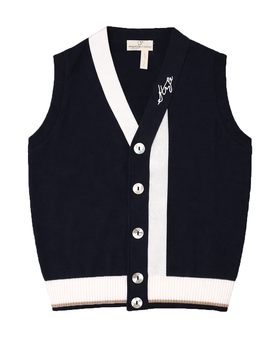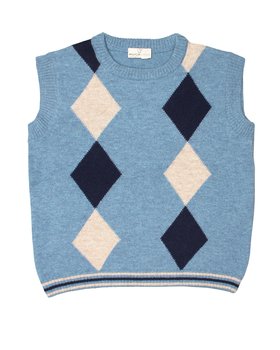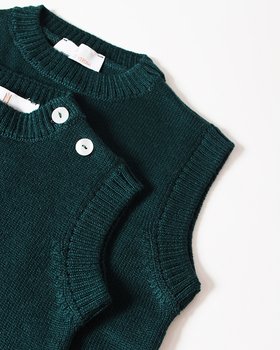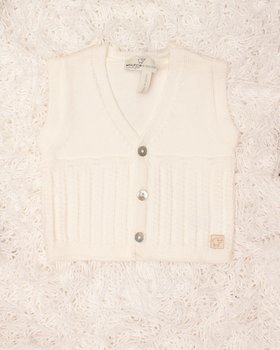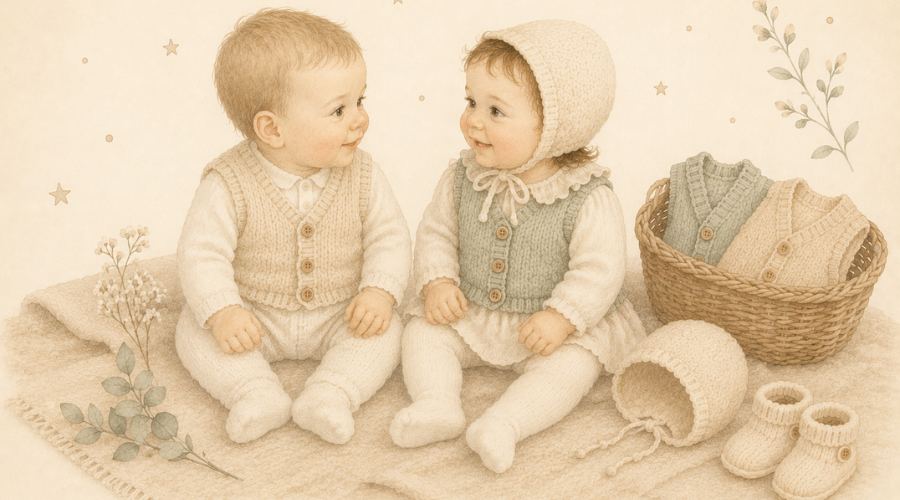
A gilet is one of the most versatile garments in a baby’s or child’s wardrobe.
It adds a layer over the body, leaves the arms free and can be worn over bodysuits, tops, polo shirts and shirts. Depending on the yarn and construction, it can be worn on cooler days, during transitional seasons, at school and for more elegant occasions.
Understanding how to style a gilet for a child, however, means considering more than simply matching colours.
It is important to take into account:
A gilet does not automatically replace a cardigan or jacket because it leaves the arms uncovered. Its strength lies elsewhere: it adds coverage to the body without creating too much bulk or restricting movement.
A gilet can become one of the most frequently worn pieces in a child’s wardrobe because it adapts easily to different situations.
Compared with a long-sleeved jumper:
It is particularly practical during transitional seasons, when the weather changes throughout the day and a full jumper is not always necessary.
It can also be used in winter as a mid-layer, provided it is combined with garments suited to the temperature.
To understand when to put a gilet on a baby, it is important to consider the complete outfit rather than the single garment.
It can be useful:
A gilet can add a layer over the body without creating excessive bulk around the arms. It should, however, be appropriate for the temperature and the other garments already being worn.
On a cold day outdoors, a gilet on its own does not provide the same coverage as a cardigan, jacket or coat. It can therefore be used as part of a layered outfit rather than as the only form of protection.
Discover all our Gilets for Babies.
The garment underneath should be soft, not too bulky and suited to the season.
You can pair the gilet with:
It is preferable to avoid garments with very wide sleeves, bulky ruffles or particularly thick constructions around the shoulders.
The armhole of the gilet should sit correctly without compressing the layer underneath or restricting movement.
For older children, a gilet can be paired with:
The choice depends on the desired result.
Again, it is important to avoid too many layers: a thick jumper under a compact gilet could create bulk around the shoulders and make the garment less comfortable.
The same style can be used very differently depending on the fibre, yarn fineness and knitted construction.
Extrafine Merino Wool can be used to create soft, comfortable garments suitable for cooler months.
An Extrafine Merino gilet can be worn:
The actual weight depends on the construction. A lightweight stockinette style will be used differently from a gilet with cables or more structured stitches.
Ultrafine Merino Wool makes it possible to create particularly fine, soft and refined knitwear.
It is suitable when you want:
The fineness of the yarn does not mean that the garment is suitable for every temperature. Construction, style and the complete outfit should always be considered.
Organic cotton is particularly suitable for:
A cotton gilet can be a practical solution when temperatures do not require a wool jumper but you still want to add a layer over the body.
Bamboo and cotton styles are particularly suitable for milder periods.
The blend can be used to create lightweight, pleasant-to-wear garments, ideal over a fine top or shirt.
Here too, the actual weight of the garment should be considered: composition and season provide an initial guide, but construction remains fundamental.
The choice between an open and closed gilet depends on the child’s age, intended use and type of outfit.
A closed gilet has a simple, continuous line across the body.
It is particularly suitable:
The neckline should be comfortable enough for the garment to be pulled on without difficulty.
An open gilet is similar to a small sleeveless cardigan.
It can be practical because:
Buttons should be firmly attached and proportioned to the style. For older children, it is useful to check that they are easy to open and close independently.
Gilets and cardigans do not perform exactly the same function.
A gilet is suitable when:
A cardigan is preferable when:
There is no universally better choice. A gilet offers greater freedom and lightness; a cardigan provides more complete coverage.
Both can have a place in a child’s wardrobe and be used at different times.
During spring, you can pair a lightweight gilet with:
On changeable days, it is useful to carry a cardigan or lightweight jacket as well.
A gilet is not necessary on the hottest days.
It can, however, be used:
For this period, fresher yarns and lightweight constructions are preferable.
Autumn is one of the seasons in which a gilet is most versatile.
You can pair it with:
It is especially useful on days when the morning is cool and the afternoon milder.
During winter, a gilet can be used as a mid-layer.
You can wear it:
On very cold days, it should not automatically be considered a substitute for a jumper or cardigan because the arms remain uncovered.
A practical combination can include:
It is a simple, comfortable combination that is easy to adapt to the temperature.
For a newborn layette, you can choose:
The result is polished without resorting to excessive decorations or garments that are difficult to put on.
For a more elegant occasion, you can combine:
Neutral shades such as milk white, beige, pearl and blue make it possible to create refined outfits that are easy to wear again.
A gilet can be a practical garment for back to school.
You can pair it with:
It leaves the arms free and can be removed easily when the classroom becomes warmer.
For an everyday outfit:
The aim is to allow freedom of movement without creating too many layers.
A knitted gilet can replace more rigid and structured garments.
It can be paired with:
The construction and colour can make the garment either more understated or more refined.
A gilet that is easy to coordinate is likely to be worn more often.
Neutral shades can be combined with many garments:
A more distinctive colour can instead become the focal point of the outfit.
To create a coordinated wardrobe, choose gilets that can be paired with at least two or three garments already in the wardrobe.
You can use:
The correct size should allow the child to move their arms freely without creating excess fabric.
Check in particular:
The armhole should not feel tight, but it should not be so wide that it leaves the body exposed or alters the line of the style.
A size that is too large can create:
When the child is close to the upper limit of a size and the style has a slim fit, it may be appropriate to consider the next size.
With an oversized fit, however, it is not necessary to automatically choose a larger size.
For more information, read our guide on how to choose the right size for babies and children.
When the garment is worn, check that:
For babies, also check that the garment does not ride up or create excessive folds across the back when lying down.
A gilet covers the body but leaves the arms free.
On cold days, it should be part of a layered outfit and combined with suitable outerwear.
Buying a larger size “so it lasts longer” can completely alter the fit.
Room for growth should be balanced and should not compromise the shoulders, neckline or armholes.
A bulky construction can bunch up under the gilet and restrict movement.
It is preferable to pair it with lightweight or mid-weight garments.
A wool gilet and a cotton style are not used in the same way.
Yarn, weight and construction should be chosen according to the actual period in which the garment will be worn.
Colour and construction are important, but they should be accompanied by:
The gilet already adds one layer.
Layering it over several heavy garments can make the outfit bulky and uncomfortable.
Before washing, always check the care label of the individual product.
To preserve its shape and softness, it is important to:
Wool and cotton gilets may require different care. Do not therefore apply the same washing method to every material.
Discover how to wash our Merino Wool.
Before purchasing, check:
☐ In which season will it be worn?
☐ What garment will be worn underneath?
☐ Is the yarn suitable for the temperature?
☐ Is the style open or closed?
☐ Is the fit slim, regular or oversized?
☐ Do the armholes allow freedom of movement?
☐ Is the child close to the upper limit of the size?
☐ Does the colour coordinate with the wardrobe?
☐ Will the garment be used every day or for a special occasion?
☐ Can it be worn under a jacket without creating too much bulk?
It can be used on mild days, during transitional seasons, indoors or as a mid-layer under a jacket. The choice depends on the temperature, yarn and other garments being worn.
Long-sleeved bodysuits, lightweight tops, knitted shirts and collared bodysuits are all suitable. The garment underneath should not create too much bulk around the shoulders and armholes.
You can pair it with a polo shirt, shirt, long-sleeved top, lightweight crew-neck jumper or fine mock-neck.
A gilet leaves the arms free and creates less bulk. A cardigan provides more complete coverage. The choice depends on temperature, activity and the other layers being worn.
Yes, but generally as a mid-layer or for indoor environments. On cold days, it should be combined with a suitable jumper and outer garment.
For mild days, lightweight styles in organic cotton or bamboo and cotton are suitable. On cooler days, a lightweight Merino Wool style can also be appropriate.
Check measurements, fit and the garment that will be worn underneath. The armholes should allow freedom of movement without being excessively wide.
Yes. It leaves the arms free, takes up little space and is easy to pair with polo shirts, shirts and long-sleeved tops. It should, however, be appropriate for the classroom temperature and planned activities.
It can be worn over a shirt or polo and paired with more structured trousers. For girls, it can also complete a dress or skirt outfit, choosing coordinating colours and constructions.
It should follow the body correctly without feeling tight. A fit that is too close restricts movement, while an excessively wide style loses stability around the neckline and armholes.
Understanding how to style a gilet for babies and children means considering much more than colour or occasion.
Yarn, season, fit and the layer underneath determine the garment’s real comfort.
A gilet can accompany a baby through the first months, complete a school outfit or add a more polished touch to an outfit for a ceremony. It is practical because it covers the body, leaves the arms free and can be layered without necessarily creating too much bulk.
During transitional seasons, it can be worn over a bodysuit, polo shirt or lightweight top. In winter, it can become a mid-layer under a cardigan or coat. On warmer days, it is preferable to choose lightweight constructions and suitable yarns.
The right gilet should be neither too tight nor bought excessively large in the hope that it will last longer. It should accommodate movement, maintain its shape correctly and fit naturally into the child’s wardrobe. 🤍🧶
Spedizione veloce e gratuita (>75€)

Filati naturali e pregiati
Design essenziale e senza tempo

Assistenza clienti online
Artigianalità made in Italy dal 1975
Resi facili e veloci