

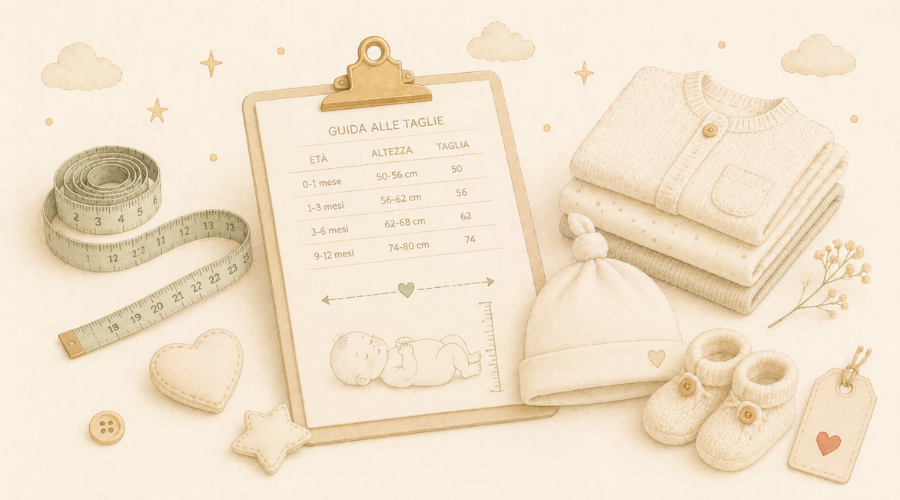
Choosing the right size for a newborn baby may seem simple, but the information shown on clothing labels is not always enough.
Size 0 months, 1 month or 3 months: age is a useful reference, but it does not fully describe a baby’s build. Two babies of the same age may have very different heights, weights and proportions.
To choose correctly, it is therefore important to consider:
the baby’s height in centimetres;
their build;
the period in which the garment will be worn;
the style;
the fit;
the knitted construction.
A size that is too small may only be worn for a very short time. A size that is excessively large, however, may alter the intended fit of the garment and make it impractical.
The solution is not to always buy one size larger, but to learn how to read the measurements and characteristics of each individual style correctly.
Labels such as 0 months, 1 month or 3 months help to identify a general period of use, but they should not be treated as absolute measurements.
The age shown on the size label does not mean that every baby will be able to wear the garment for exactly the same length of time.
The choice may vary according to:
height at birth;
physical build;
growth rate;
the space required for a nappy;
the number of layers worn underneath the garment;
the specific fit of the style.
For this reason, alongside age, it is always advisable to check the height in centimetres associated with the size.
On the Maglificio di Verona website, every size is matched with an approximate baby height to make the choice more accurate than relying on age alone.
As a general reference for the first Maglificio di Verona sizes:
| Size | Approximate baby height |
|---|---|
| 0 months | up to approximately 50 cm |
| 1 month | up to approximately 56 cm |
| 3 months | up to approximately 62 cm |
These measurements are indicative and should be considered together with the fit information shown on the individual product page.
Height is often the most useful measurement because it helps you understand whether the baby is at the beginning, in the middle or close to the maximum limit of the size.
This is one of the most common questions when preparing a newborn layette.
Size 0 months is designed for smaller newborn babies and the very first days. It can be particularly useful for the baby’s first change of clothes in hospital or when you want an outfit that fits neatly from birth.
Size 1 month offers a few extra centimetres and may be worn for longer, especially when the baby is born close to the maximum height for size 0 months.
As a general rule:
choose 0 months when you want a garment suitable for the first days and the expected measurements are compatible;
consider 1 month when the baby may be born taller or with a sturdier build;
choose the next size when the baby’s measurement is very close to the maximum limit;
always check whether the style has a slim, regular or oversized fit.
Before the birth, it is advisable not to buy the entire layette in the smallest size. It is better to prepare only a few size 0 months garments and complete the wardrobe with several size 1 month pieces.
There is no single answer that applies to every baby.
Some newborn babies may wear size 0 months during the first few weeks, while for others it may already fit closely or have very limited use from birth.
How long it lasts depends mainly on:
the baby’s initial height;
their build;
their growth rate;
the type of garment;
the elasticity of the knitted construction;
the fit of the style.
To avoid buying too much, only a few garments in the smallest size may be sufficient for the layette, combined with size 1 month pieces. The Maglificio di Verona newborn layette guides also recommend not concentrating all purchases on size 0 months, as it is often worn for only a limited period.
When the baby is expected to be taller or have a sturdier build at birth, it may be useful to limit the number of garments purchased in size 0 months.
In these cases, you can:
prepare one or two changes of clothing in the smallest size;
choose size 1 month for most of the layette;
avoid buying many identical garments in advance;
check the centimetres shown on the product page;
consider the fit of the individual style.
It is not necessary to move automatically to a much larger size. An excessively large garment may have sleeves that are too long, a wide neckline and impractical proportions.
The aim is to leave a small amount of growing room without losing the correct fit.
When buying a garment for a newborn baby, do not stop at the number of months. Always check the value shown in centimetres.
Height helps you understand which size is closest to the baby’s proportions.
When the baby is:
well below the maximum limit, the size should still provide a good amount of growing room;
close to the maximum limit, it may be advisable to consider the next size;
between two sizes, the fit and style should also be considered.
Two garments in the same size may fit differently.
A slim-fit crew-neck jumper, a regular-fit cardigan and an oversized coat will not have the same volume, even when they show the same age indication.
Always check:
the recommended centimetres;
the type of fit;
the construction of the style;
any specific information included in the description.
A cardigan or coat must leave enough room for a bodysuit, romper or other layers.
A garment worn directly over a bodysuit, on the other hand, may follow the baby’s proportions more closely.
The correct amount of room therefore also changes according to the purpose of the product.
To choose the right size, it is particularly useful to know the baby’s height.
Whenever possible, measure the baby during a calm moment and without forcing their position.
You can consider:
total length, from the top of the head to the heel;
chest circumference, when required;
foot length, for socks and booties;
head circumference, for hats and beanies.
The measurements should be compared with those shown in the brand’s size guide or on the product page.
It is not advisable to compare sizes from different brands directly: each company may use different proportions and fit criteria.
The size indicates the dimensional range of the garment. The fit explains how that garment has been designed to sit on the body.
Maglificio di Verona also distinguishes its styles using slim, regular and oversized fit descriptions. This makes it possible to choose more accurately without relying only on age.
A slim-fit garment has a line that sits closer to the body and more contained proportions.
This does not mean that it should feel tight, but that the style has been designed to follow the baby’s proportions more closely.
When the baby is close to the maximum limit of the size, it may be advisable to consider the next one, especially when several layers will be worn underneath.
A regular fit has balanced proportions and offers a combination of comfort and a defined silhouette.
In this case, you can base your choice mainly on:
the centimetres shown;
the baby’s build;
the expected period of use;
the space required for layers underneath.
This is the easiest fit to interpret, but it is still important not to ignore the specific characteristics of the style.
An oversized garment is intentionally designed with more generous proportions and a relaxed line.
It is therefore not necessary to choose a larger size automatically to obtain more comfort. Doing so may make the garment excessively large across the shoulders, sleeves or overall length.
With an oversized fit, it is generally preferable to follow the size corresponding to the baby’s height in centimetres.
Knitwear does not behave like a rigid woven fabric.
The stitch structure, yarn and construction may alter the perception of volume and the way the garment follows the body.
The following factors influence size selection:
the natural elasticity of the knitted construction;
the compactness of the stitch;
the presence of ribbing;
cables or three-dimensional textures;
the fineness of the yarn;
the shape of the cuffs, hem and neckline;
the sleeve construction;
the overall weight of the garment.
A ribbed construction, for example, may follow the body more closely. A structured cable knit or a particularly compact stitch may instead maintain a more defined shape.
For this reason, it is incorrect to assume that all knitwear fits in the same way or that choosing a larger size is always necessary.
No. The purpose and construction of the garment influence the choice.
They should be comfortable and allow freedom of movement without creating too much excess fabric.
For a full-length romper, checking the overall length is particularly important because the garment covers the torso, legs and feet at the same time.
They may offer a longer period of use, especially when the knitted construction follows the body and the cuffs and hem retain their shape correctly.
However, you should consider the layers that will be worn underneath.
They must provide enough room for the other garments in the layette.
In this case, a slightly more generous fit can be useful, but without choosing an excessively large size.
It is important to consider the waist, length and the space required for a nappy.
A size that is too large may slip down at the waist or create too much fabric around the legs.
For accessories, it is preferable to refer to the baby’s head circumference and the information shown on the product page.
A size that is too large may not remain correctly in position, while one that is too small may feel uncomfortable.
When the measurement falls exactly between two sizes, consider the style first.
You can choose the larger size when:
the baby is close to the maximum limit;
the garment will be worn in a few weeks;
several layers will be worn underneath;
the style has a slim fit;
you want a small amount of growing room.
You can keep the corresponding size when:
the style has a regular or oversized fit;
the baby is still well below the maximum limit;
the garment needs to be worn immediately;
choosing the larger size would alter the proportions;
the style has already been designed with generous proportions.
When in doubt, it is helpful to provide customer service with:
the baby’s height;
their approximate weight;
their age;
the chosen style;
the period in which it will be worn.
This information makes it possible to receive more accurate advice than age alone can provide.
Before the birth, it is not always possible to know the baby’s measurements precisely.
The most balanced solution is to create a layette divided between several sizes.
You can prepare:
a few size 0 months garments for the first changes;
a larger quantity in size 1 month;
some size 3 months garments for later use;
styles that are easy to layer;
garments suitable for the season in which they will actually be worn.
Avoid buying large quantities of the same item in the smallest size.
The baby may only be able to wear it for a very short time or may need the next size immediately.
When buying in advance, do not consider only the baby’s current age or expected date of birth.
It is important to ask:
In which month and season will the baby actually wear this garment?
A jumper purchased in summer to be worn in autumn should be chosen by considering the baby’s expected growth over the following months.
Similarly, a coat intended for winter must leave enough room for the layers worn underneath.
Before purchasing, therefore, check:
the expected period of use;
the likely temperature;
the growth expected between purchase and use;
how it will be combined with bodysuits, rompers or outfits;
the fit of the style.
This helps you avoid garments that fit perfectly at the time of purchase but are already too small when the appropriate season arrives.
Age is only indicative. Centimetres and fit provide more accurate information.
The newborn size may only last for a short period. It is preferable to prepare a balanced layette divided between 0 and 1 month, adding several garments for the following months.
A larger size does not automatically guarantee greater comfort.
The garment may have sleeves that are too long, a wide neckline or disproportionate volumes.
Slim, regular and oversized fits change the way the same size appears on the baby.
The fit must be considered together with the centimetres.
A size 1 month garment will not necessarily fit in the same way across all brands.
Always use the size guide provided by the company from which you are purchasing.
A garment purchased well in advance should be selected according to the measurements the baby will have when it can actually be worn.
Check the layette regularly.
Newborn babies grow quickly, and a garment saved “for a special occasion” may become too small before it is ever worn.
Before adding a garment to your basket, check the following points:
☐ Have I checked the centimetres associated with the size?
☐ Is the baby close to the maximum limit?
☐ Does the style have a slim, regular or oversized fit?
☐ Will it be worn immediately or in a few weeks?
☐ Which garments will be worn underneath?
☐ Will the size be suitable for the season in which it will be worn?
☐ Is the style designed to fit closer to the body or more loosely?
☐ Have I compared the measurements with the brand’s size guide?
It mainly depends on the baby’s height and the fit of the garment. Size 0 months is suitable up to approximately 50 cm, while size 1 month generally fits up to approximately 56 cm. Before the birth, it is advisable to prepare only a few size 0 months garments and a larger quantity in size 1 month.
There is no single answer that applies to every baby. Some newborn babies wear it during the first few weeks, while for others it may already fit closely at birth. How long it lasts depends on height, build, growth and the fit of the style.
It may be useful to limit purchases in size 0 months and choose more garments in size 1 month. However, it is not necessary to select excessively large sizes: always check the centimetres and the fit.
It is best to divide the layette between sizes 0 and 1 month, adding several size 3 months items. This avoids buying too many garments in the smallest size and ensures that you already have clothing available for the following weeks.
When the baby is close to the maximum limit, you can consider the next size, especially for slim-fit styles or garments intended to be worn later. With an oversized garment, however, it may be preferable to keep the corresponding size.
No. A larger size may be useful in certain situations, but it should not be an automatic choice. A garment that is too large may have impractical proportions and may not fit as intended.
It depends on the construction and style. Some stitches follow the body more closely, while others maintain a more compact structure. This is why it is important to check the fit information shown on the product page.
A romper may have become too small when it is short in the overall length, pulls around the nappy or restricts movement. In these cases, it is advisable to move to the next size.
No. Every brand may use different measurements and proportions. It is therefore preferable to always consult the manufacturer’s specific size guide.
Choosing the right size for a newborn baby means looking beyond the simple number of months.
The baby’s height in centimetres, the fit of the style, the structure of the knitted construction and the expected period of use make it possible to choose more accurately and consciously.
Size 0 months may be useful for the first changes of clothing, but it is preferable not to buy the entire layette in the smallest size. Adding size 1 month and 3 months garments allows you to accommodate the baby’s growth without filling the wardrobe with items that can only be worn for a very short time.
When you are undecided between two sizes, always check the centimetres and consider how the style has been designed: slim, regular or oversized.
The correct size should be neither tight nor excessively large. It should allow the baby freedom of movement and enable the garment to retain the fit for which it was designed. 🧶🤍
Spedizione veloce e gratuita (>75€)
Filati naturali e pregiati
Design essenziale e senza tempo

Assistenza clienti online
Artigianalità made in Italy dal 1975
Resi facili e veloci