

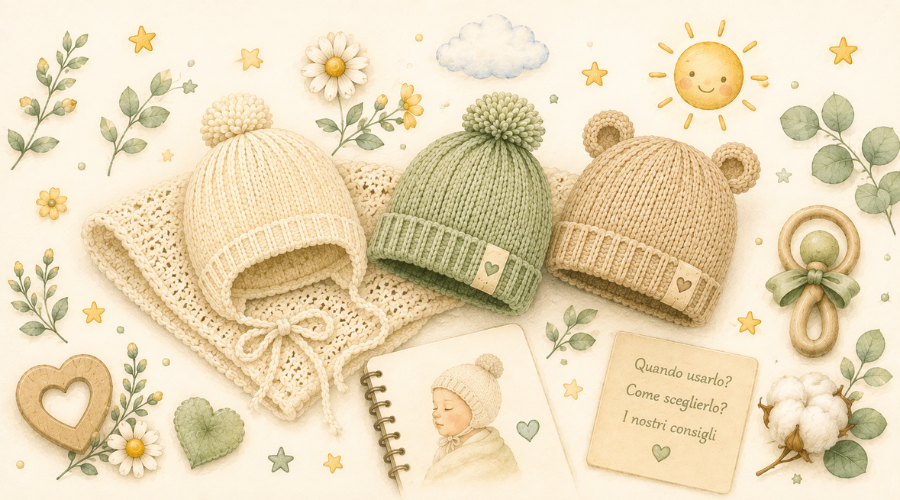
A wool hat for newborns can be useful during outings on cold, damp or windy days, particularly when you want to cover the baby’s head and ears with a soft layer that can be easily removed.
However, it should not automatically be used at every time of year or kept on the baby after entering the house.
To choose and use a hat correctly, consider:
To compare winter and summer styles, animal and plant-based fibres, and hats designed for older children too, you can read our general guide to https://www.maglificiodiverona.it/blog/150-cappelli-in-maglia.html
A hat can be considered particularly for outdoor outings when the temperature, wind or humidity make an additional layer over the head useful.
It may be used, for example:
However, whether it is genuinely necessary depends on the conditions at that moment.
A short outing on a mild day requires a different assessment from a long walk in low temperatures.
The hat should also be considered together with the other layers the baby is wearing:
Continually adding garments “just in case” can make it difficult to adapt the baby’s clothing when moving from outdoors into a warm environment.
For a complete guide to layering during outings, read how to dress a newborn outdoors.
It is not correct to say that every newborn should wear a hat throughout the entire year.
The choice depends on:
During warmer weather, a wool hat may be excessive.
For sun protection, a model specifically designed for sun exposure should be chosen, with a shape that provides adequate shade for the face. A standard knitted hat does not automatically provide certified UV protection.
Babies under six months should be kept out of direct sunlight; outdoors, NHS guidance recommends a wide-brimmed hat that shades the face.
A Merino Wool hat is therefore mainly useful on:
A hat used outdoors should be removed when it is no longer needed.
It is important to consider removing it when entering:
NHS guidance recommends removing hats and additional clothing as soon as you go indoors or enter a heated vehicle, even if this means waking the baby.
The transition between outdoors and indoors is therefore one of the reasons why a hat should be:
At home, during sleep, a newborn should not wear a hat unless specific advice has been given by a healthcare professional for particular circumstances.
Covering the head can limit heat loss and contribute to overheating.
Safe-sleep recommendations therefore advise keeping the baby’s head uncovered indoors.
The same care is needed when the baby falls asleep:
Whenever possible, layers should be adjusted to the new temperature and the baby should be moved to a suitable sleep space in accordance with the recommendations for their age.
Hands and feet may feel cool even when the baby is appropriately dressed.
To assess temperature more accurately, it is better to check:
Signs that may indicate overheating include:
If the chest or back of the neck feels very warm or sweaty, it is advisable to remove a layer. NHS guidance also notes that cool hands and feet can be normal and do not automatically mean that a newborn is cold.
In the case of fever, prematurity, medical conditions or uncertainty about the baby’s temperature, follow your paediatrician’s advice.
Head circumference is a more precise reference than age in months alone.
Two newborns of the same age may have different measurements.
To measure head circumference:
Do not automatically add several centimetres in the hope of buying a hat that will last longer.
The fit should also take into account:
A correctly sized hat should:
The larger size is therefore not automatically the safer choice.
The style should be chosen according to the temperature, length of the outing and fit.
It is practical for:
It may be made:
How securely it stays in place depends mainly on size and elasticity.
It may be preferred when greater coverage around the sides of the head is desired.
The earflaps should:
It can be particularly useful on cold and windy days, but should still be removed when entering a warm environment.
A short fastening may help keep the hat stable.
However, it is important to check that it:
Do not add improvised cords, pins or accessories.
A balaclava provides more extensive coverage of the head, ears and neck.
It may be considered on particularly cold days, but it is important to check:
It should not be used during sleep.
Merino Wool can be transformed into fine, elastic yarns suitable for different knitted constructions.
In a hat, the final result is influenced by:
The natural crimp of wool contributes to the elasticity of the knitted fabric and to the formation of small air spaces within its structure.
However, actual comfort does not depend solely on the word “Merino”.
A lightweight ribbed hat and a voluminous woollen-spun model can both be made from Merino Wool while offering very different weights and surfaces.
To understand the fibre without repeating the complete technical explanation here, read about the characteristics and properties of Merino Wool.
It is not correct to promise that every wool hat will never cause an itchy sensation.
Perception depends on:
Fine fibres tend to bend more easily when they come into contact with the skin, contributing to a softer and more flexible feel.
In cases of particularly sensitive skin, dermatitis or other skin conditions, follow the advice of your paediatrician or specialist.
Maglificio di Verona uses Extrafine Merino Wool and woollen-spun Ultrafine Merino Wool.
In this article, we compare only the results they produce when used for hats, without repeating the technical explanations available in the dedicated blog articles.
| Characteristic | Extrafine Merino | Woollen-Spun Ultrafine Merino |
|---|---|---|
| Typical surface | More regular and defined | Softer and fluffier |
| Volume | Balanced | Generally more pronounced |
| Appearance | Clean and versatile | Textured and enveloping |
| Knitted constructions | Ribbing, stockinette, links stitch, cables | Stockinette, cables, pom-poms and woollen-spun surfaces |
| Use | Everyday and versatile hats | Particularly soft and voluminous styles |
| Pilling | Possible | Possible, particularly in areas exposed to friction |
| Seasonality | Depends on weight and stitch | Depends on weight and stitch |
It may be preferred when looking for:
To learn more about the yarn, read our guide to Extrafine Merino Wool, its characteristics and uses.
The woollen-spun Ultrafine Merino Wool used by Maglificio di Verona has fibres measuring between 15 and 17 microns.
It may be chosen when you want:
The 15–17 micron measurement describes the fineness of the fibres, while the term woollen-spun refers to the preparation and spinning system.
For more information, read our guide to 15–17 micron woollen-spun Ultrafine Merino Wool.
Neither is universally better than the other.
Extrafine Merino may be preferred for a hat that is:
Woollen-spun Ultrafine may be preferred for a style that is:
The choice should also consider:
The hat should not be considered in isolation.
During a walk, a newborn may be wearing:
A very thick hat combined with a close-fitting hood and numerous other layers may be excessive.
When a hood is present, check that it:
For an overview of hats, booties, mittens and blankets, read our guide to winter accessories for newborns.
A Merino Wool hat can also develop small pills on its surface.
The phenomenon can be encouraged by friction with:
A woollen-spun and particularly soft surface may show loose surface fibres more easily, but pilling does not automatically mean that the product is poor quality.
To remove it:
The care label of the individual product should always be the main reference.
In general:
During drying, pay particular attention to:
For complete instructions, read our guide on how to wash, dry and store Merino Wool.
Before storing it, make sure it is:
Do not store it while it is still damp.
Before using it again or passing it on to another child, check:
It can be useful during outings on cold, damp or windy days. Whether it is needed depends on the temperature, length of the outing and the other layers the baby is wearing.
No. A wool hat is not necessary in every season or at every temperature.
Yes, when the indoor environment is heated and the hat is no longer needed. Layers should be adjusted when moving from outdoors to indoors.
At home, during sleep, the baby’s head should remain uncovered unless different advice has been given by a healthcare professional.
Check the chest or back of the neck. If the skin feels very warm, sweaty or damp, remove a layer. Cool hands and feet can be normal.
Measure the head circumference around its widest point and compare it with the size guide. The hat should remain secure without being tight or falling over the eyes.
A simple hat is versatile and practical. Earflaps provide greater side coverage on cold and windy days. The choice depends on how the hat will be used.
Extrafine generally provides a more regular and defined surface. Woollen-spun Ultrafine Merino with fibres measuring 15–17 microns creates a softer and fluffier surface.
Fine fibres tend to be more flexible, but perception depends on the yarn, knitted construction and individual sensitivity.
Potentially, but it should not be excessively large. A loose-fitting model can move around and fall towards the eyes or face.
It can be included when it is securely attached and proportionate to the style. Its condition should be checked periodically.
It can develop small pills, particularly in areas exposed to friction from hoods, the pram or car seat.
Only when permitted by the care label, using the recommended programme, temperature and detergent.
A wool hat for newborns can be a useful accessory during cold or windy outings, but it should always be chosen and used according to the actual conditions.
Before purchasing, consider:
A simple hat can be practical for everyday outings.
A model with earflaps can provide greater coverage on cold and windy days.
Extrafine Merino may be chosen for a regular and versatile surface, while 15–17 micron woollen-spun Ultrafine Merino can create a softer and fluffier appearance.
The most suitable model is not necessarily the heaviest one or the one purchased in the largest size.
It is the one that:
To compare styles, yarns and availability, explore our selection of knitted winter hats for babies and children.
Spedizione veloce e gratuita (>75€)
Filati naturali e pregiati
Design essenziale e senza tempo
Assistenza clienti online
Artigianalità made in Italy dal 1975
Resi facili e veloci